

How to Raise a Problem-Solver: Developing Critical Thinking in Young Learners
See also: Mindful ParentingChildren encounter small problems constantly. A block tower keeps falling. Two friends want the same toy. A puzzle piece seems to fit but does not. A maths answer looks wrong even though every calculation appears familiar. Each of these moments gives a child a chance to notice information, test an idea, revise a plan, and explain a choice. Adults can strengthen those habits by resisting the urge to supply every answer immediately.
Critical thinking is the ability to examine information, question assumptions, consider evidence and different possibilities, and reach a reasoned conclusion. For young learners, it does not need to be taught as an abstract concept. It can develop through ordinary opportunities to ask questions, test ideas, compare options and reconsider an answer when new information appears.
Critical thinking and problem-solving are closely connected, but they are not quite the same skill. Problem-solving involves working out how to respond to a challenge or achieve a goal, while critical thinking helps children examine the information, assumptions and possible approaches involved. Both skills grow through repeated practice rather than a single subject or activity.
Schoolwork contributes, but many valuable reasoning opportunities happen during ordinary conversations, games, errands, and household tasks. Families may also use more focused support, such as private maths tutoring, when a child needs additional help with a particular area of learning. Whatever the setting, parents can help young learners become more capable problem-solvers by changing how they respond to questions, mistakes, uncertainty, and competing ideas.
Give Children Time Before Giving Them Answers
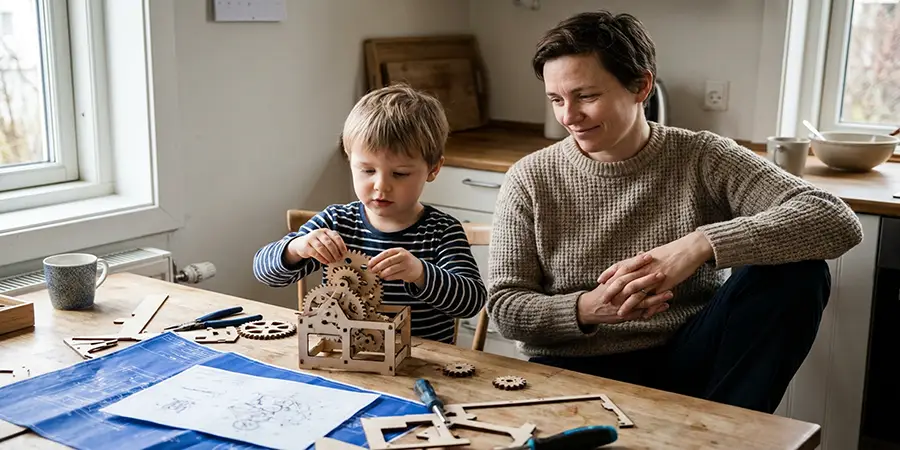
Adults solve small problems quickly because experience allows them to recognize familiar patterns. That speed can work against a child who needs time to build the same mental connections. When a child asks, “How do I do this?” an immediate explanation may finish the task, but it removes the part where the child has to examine the problem and decide what to try.
A better first response often takes the form of a useful question. Ask, “What do you already know?” “What have you tried?” or “What part seems confusing?” If a toy will not work, ask the child to inspect it before showing the solution. If a maths problem looks difficult, ask which information seems useful. These prompts direct attention without taking control of the thinking.
The pause itself has value. Some children need several seconds to organize an answer, especially when the question requires reasoning rather than recall. Filling that silence with hints can encourage them to rely on adult assistance. Give the child enough space to attempt an idea, even when you suspect it will fail. Productive problem-solving depends partly on learning that the first idea does not need to be the final one.
Teach Children to Explain How They Reached an Answer
A correct answer tells you what a child produced. An explanation reveals far more about how the child thought. Ask young learners to describe how they solved a puzzle, chose between two options, predicted what would happen, or reached an answer in schoolwork. Their explanation may expose a strong reasoning process, a lucky guess, or a misconception that the final answer happened to hide.
Keep these conversations natural. A child arranging toys by size might explain why one belongs before another. During a story, ask what a character might do next and what clues support that prediction. At the grocery store, invite the child to compare two package sizes and decide which one might last longer. The aim is to make reasons part of ordinary conversation rather than turning every activity into a lesson.
Parents can model this habit without giving long lectures. Think aloud occasionally when making a simple decision: “These two containers both look large, so I’m checking the labels before choosing one.” This shows that good decisions often require evidence. Children begin to see thinking as something people can examine and improve, rather than an invisible process that produces right or wrong answers.
Let Mistakes Become Information
Children who fear mistakes often choose the safest possible response. They may avoid difficult puzzles, erase work repeatedly, copy another person’s method, or ask for confirmation before taking even a small step. Those behaviors can limit critical thinking because problem-solving requires experimentation. A child needs enough confidence to test an idea without knowing in advance that it will succeed.
Adult reactions shape this attitude. When an answer is wrong, avoid rushing directly to the correction. Ask the child to check the result. “Does anything seem unusual here?” can encourage self-review. If a paper airplane falls immediately, examine what happened before rebuilding it. If a construction collapses, discuss which part moved first. The failed attempt becomes evidence for the next decision.
This approach does not require pretending every mistake is positive. Some errors come from rushing, skipped instructions, or insufficient practice. Children still need correction. The difference lies in using the error to identify what should change. “You added before multiplying. Which operation should come first?” gives the child a route back into the problem. Simply saying “wrong” ends the thinking at the point where useful analysis could begin.
Use Everyday Life as a Reasoning Lab
Critical thinking becomes easier to practice when the problem has a visible purpose. Cooking with children provides quantities, sequences, timing, estimation, and cause-and-effect relationships. Building with blocks introduces balance, shape, measurement, and spatial reasoning. Board games require planning and adaptation. Even organizing a bedroom can involve categories, available space, priorities, and decisions about where objects belong.
Give children real choices with manageable consequences. A young child can decide how to divide snacks equally among several people. An older elementary student can help plan what to pack for an afternoon outing based on the weather and activities. When assembling furniture or following a recipe, ask the child to predict why the steps appear in a certain order. Practical tasks show that reasoning has a purpose beyond completing worksheets.
Open-ended activities are especially useful because they allow several possible solutions. Give a child paper, tape, and straws and ask for a structure that can hold a small object. Ask for two different ways to organize a collection. Challenge siblings to invent several routes across a room while following specific rules. Afterward, discuss which approach worked best and why. Comparing solutions teaches children that a problem can support more than one defensible answer.
Help Children Evaluate Information Instead of Accepting It Automatically
Young learners receive claims from classmates, videos, advertisements, books, adults, and online content. Critical thinking includes learning to examine those claims instead of treating confidence as proof. Even younger children can start practicing this skill through simple questions about evidence and reliability.
Begin with situations they can grasp. If someone claims a particular paper airplane design always flies farther, ask how you could test the claim. If two people remember an event differently, discuss what information might help clarify what happened. When reading a story, distinguish between what the text states and what the reader is guessing. As children grow, introduce questions such as “How do we know?” “What evidence supports that?” and “Could there be another explanation?”
Parents should also allow children to question adults respectfully. If a child asks why a rule exists, an explanation can teach more than “because I said so” when time and safety allow discussion. Some rules have firm boundaries, yet giving a reason shows that conclusions can rest on evidence, experience, safety, fairness, or practical constraints. A child who learns to ask for reasons can become better prepared to examine information independently.
Look for Independence, Not Perfect Performance
Progress in critical thinking can appear in small behavioral changes. A child who once asked for help immediately may begin trying two approaches first. Another may notice that an answer seems unreasonable and check the work independently. A young learner may start asking more precise questions instead of saying, “I don’t get it.” These changes indicate greater control over the thinking process even when mistakes still occur.
You may also hear changes in the child’s language. Statements such as “I tried this because...,” “That didn’t work, so I changed...,” or “I need more information before I decide” show developing reasoning habits. Children may become better at comparing alternatives, identifying patterns, explaining predictions, and changing their position after receiving new information. Changing an answer for a good reason is a sign of thoughtful reasoning, not weakness.
Conclusion
Critical thinking develops through repeated opportunities to question, test, explain, reconsider and make decisions.
Parents can support this development by gradually moving from giving answers to providing prompts. A useful goal is to provide the smallest prompt that helps the child continue independently. Over time, questions that once came from an adult can become questions the child asks internally: What do I know? What am I trying to find? What could I try next? Does my answer make sense? Those habits prepare young learners for academic challenges, everyday decisions, and unfamiliar problems that no worksheet can predict.