

Building Life Skills Through Everyday Play
See also: Entertaining ChildrenPlay is easy to dismiss as something children do when the real work of learning is over. In practice, everyday play is one of the most reliable ways to develop transferable life skills: communication, cooperation, independence and self-control. These skills are used at home, in the classroom, with friends and later at work. They are not tied to a single subject, and they cannot be learned from a worksheet alone.
Everyday activities such as passing a cup, waiting for a turn or putting socks in a basket may seem ordinary. Underneath, the child is practising listening, sequencing, asking for help and recovering when something goes wrong. Adults who treat those moments as skill-building, rather than as filling time, give children repeated chances to learn in a setting they already trust.
This works especially well when play copies real life instead of an abstract task. A child is more likely to join a short, familiar situation — a shop, a playground, the morning routine — and to go through it more than once, at their own pace. This article sets out how to use those moments, and the principles behind play-based learning: a small scene, a repeat, and a pause.
What counts as a transferable life skill
A transferable skill can move from one situation to another. Turn-taking at the dinner table is the same skill as taking turns in a classroom discussion. Asking for help with a zip is the same skill as asking a teacher to repeat an instruction. Calming down after a tower falls is the same skill as recovering after a mistake at school.
Four skills sit underneath most of these moments:
Communication — making a sound, a gesture or a word, and leaving space for someone else to reply.
Cooperation — waiting, sharing attention, and accepting that another person has a turn.
Independence — starting a small step of a task without being fully directed.
Self-control — pausing, trying again, or stopping before frustration takes over.
None of these require special equipment. However, they do require an adult who is willing to slow down.
If the child looks away, pushes the object aside or becomes still, treat that as information, not as failure.
Stop, simplify, or try another day. Pressure turns play into performance, and performance is a poor teacher.
A simple framework: Pause, Name, Invite, Stop
A useful pattern for any short play moment is:
Pause. Offer one object, one phrase or one step of a routine. Then allow the child sufficient time to respond.
Name. Say what you notice, in a short sentence: "You looked at the cup." "You put the sock in."
Invite. Offer one next step the child can join or ignore: "Your turn." "In the box?"
Stop. End while the child is still willing. A short success teaches more than a long session that ends in tears.
The adult’s job is not to complete the task for the child, and not to withhold help until the child is distressed. Offer a small amount of support, then step back. That is how a child learns to do a little more than they can do alone.
The same logic sits behind good play-based methods. A complex real-life situation is broken into short, repeatable scenes. The child can go through the scene again, without rush and without a score. A social story, a turn in a game and a step of a household job all teach the same thing: what is happening, whose turn it is, and what comes next.
Communication: practise the exchange, not the sentence
Communication is an exchange. Many children can take part long before they use full sentences. A look, a reach, a sound or a pause can be a turn.
Exercise: echo and wait
Sit with the child during a calm, awake moment. If they make a sound, repeat it gently, add one familiar word, and wait. Do not ask them to copy you. The skill being practised is the back-and-forth of conversation: I speak, I leave a gap, you may join.
Exercise: one scene, one chance
Take one familiar situation — saying hello, asking for a toy, saying "more". Notice whether the child looks, reaches, vocalises or turns away. Follow that cue. Adding a second scene too quickly teaches the child that their first signal did not matter.
These exercises build listening and turn-taking in language, which later support asking for help, answering a question and staying in a conversation.
Cooperation: make turn-taking visible
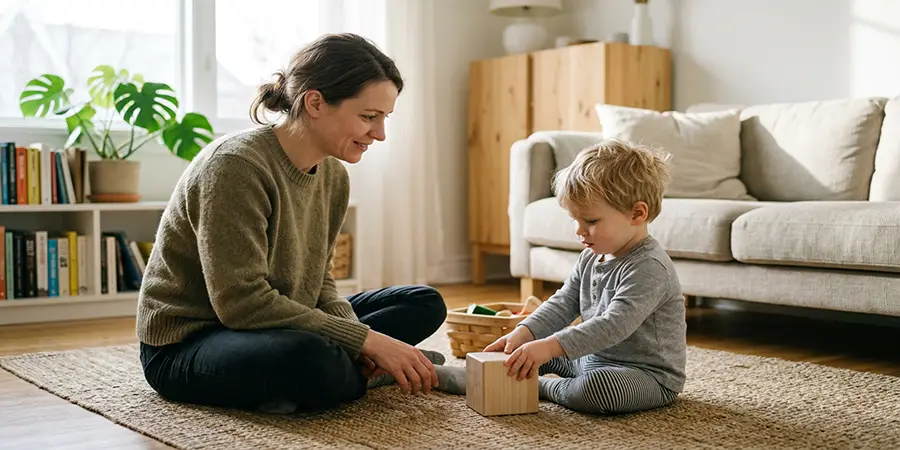
Cooperation is easier to learn when the child can see whose turn it is. A spoon passed from hand to hand, a block placed on a tower, or a page turned in a photo book all make the switch of attention obvious.
Exercise: pass and return
Use one object only. Say "my turn" as you hold it, then "your turn" as you offer it. Keep the words the same each time. If the child holds on, wait. If they offer it back, name that: "You gave it to me." The skill is not sharing in the moral sense. It is managing a social sequence.
Turn-taking is the same skill whether it happens with a toy, a song or a household job. Some children benefit from additional processing time and familiar, repeated activities.
Play-based methods make that turn visible through a social story: first one person, then the other, then you again. The child can see the order, instead of only hearing a rule. Families who want extra short ideas for this kind of practice can find practical play-based activities for children with Down syndrome written as everyday moments rather than as a programme. The same structure — one invitation, one pause, permission to stop — works for many children who learn at a different pace.
Some free learning games for kids with Down syndrome use the same principle: real-life situations are broken into small, repeatable moments that a child can go through at their own pace. That is not a substitute for live play. It is the same skill of turn-taking and communication, held in a short scene the child can return to.
Independence: use real tasks, not pretend ones
Independence grows when a child does a real step of a real job. Fetching a sock, putting a cup on the table, or dropping a wrapper in the bin all involve planning, movement and a visible result.
Exercise: one step of a home task
Choose a task the child already sees every day. Break it into steps and invite them into one step only. "Sock in the basket." Then wait. If they need a hand-over-hand start, give it once and step back. Praise the attempt, not a perfect result.
The transferable skill is learning to initiate an action without relying entirely on adult direction. This later becomes starting homework, packing a bag, or joining a group activity.
Keep the language identical for a week.
Changing the instruction every time ("Put it away", "Tidy up", "In here please") asks the child to decode new words instead of practising the skill.
Self-control: stop before the crash
Self-control is not the same as obedience. It is the ability to pause, to try again, or to leave a task before it becomes overwhelming. Adults often miss the early signs: a turn of the head, a still body, a push-away.
Exercise: end on purpose
Set a clear finish before you start. "Two turns, then finished." When you reach the end, stop even if the child still seems interested. This teaches that activities have a shape: begin, take part, finish. Children who struggle to move between activities often need this shape practised in a low-stakes game first.
If the child becomes distressed, the useful adult skill is to reduce the demand, not to push through. "We can try tomorrow" is a life skill for the adult as well as the child. Self-control is not simply about obeying instructions; it involves recognising feelings and gradually learning to manage responses.
Play scenes help here in the same way: a scene can be stopped and repeated. The child learns that the end is part of the activity, not a punishment.
Putting the four skills into one routine
A dressing routine can hold all four skills in five minutes:
Pause with one sock in view.
Name: "Here’s your sock."
Invite: "Foot in?"
Cooperate if they hold the other sock for you.
Stop when the first sock is on, even if the second is unfinished.
The child has practised communication (responding through a word, gesture or action), cooperation (a shared task), independence (one step) and self-control (a defined end). No extra materials are required.
The same pattern works at mealtimes, when washing hands, or when putting toys into a box. The routine is already happening. The skill-building is in the waiting and the wording.
What this is not
This approach does not replace speech therapy, occupational therapy or classroom support. It gives children extra chances to practise the same skills with a familiar adult. It also does not require a child to "catch up" before they are allowed to play. Play is the method, not the reward.
Adults sometimes turn every game into a test: "What colour is it? Say the word. Do it again." That crowds out the very skills being taught. One invitation and a genuine pause are enough. If a screen is used, it should repeat the same pattern, not speed it up.
Conclusion: A closing practice
Pick one routine you already do tomorrow. Apply Pause, Name, Invite, Stop once. Do not add a second exercise the same day. Transferable skills grow through repetition in ordinary life, not through a long list of new activities.
The most useful claim is a modest one. Communication, cooperation, independence and self-control are learned in relationships. A familiar adult who plays, waits and offers another opportunity tomorrow is already helping children develop these skills.
About the Author
Olga writes about everyday play and the transferable skills children practise at home with a familiar adult. She works with Down Syndrome Digital, a UK organisation that publishes free educational resources for families.