

The Essential Skills Modern SEO Professionals Need to Develop
See also: Critical Thinking and AISearch engine optimization has always required a particular combination of analytical thinking and creative judgment. You need to understand data and understand people at the same time. You need to know why a page ranks, and why a person clicks.
What’s changing is the environment that work happens in. AI tools are now embedded in every stage of the SEO workflow: keyword research, content planning, competitive analysis, technical audits. The professionals who will thrive are not simply those who learn to use these tools, but those who develop the human skills needed to use them well.
That distinction matters more than it might initially appear.
Why Technical Knowledge Is No Longer Enough
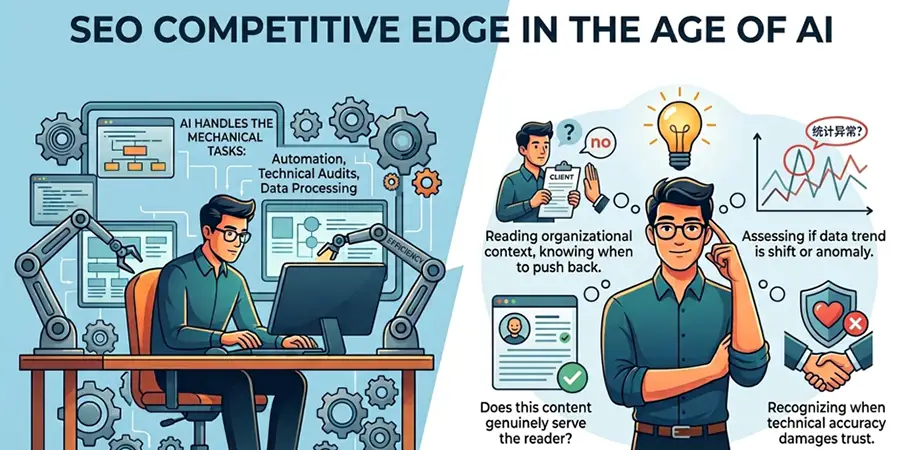
Historically, the competitive edge in SEO belonged to whoever had the deepest technical knowledge and the most efficient processes. Those things still matter. But they have become table stakes rather than differentiators, because AI SEO tools for professionals can now perform many of the mechanical tasks that once required significant skill and time.
What AI cannot do is exercise judgment. Some of the most important work in SEO falls squarely outside what any tool can reliably handle:
Deciding whether a piece of content genuinely serves the reader
Reading the organisational context of a client relationship and knowing when to push back on a brief
Assessing whether a data trend reflects a real shift in audience behaviour or a statistical anomaly
Recognising when a technically correct recommendation would damage a client’s credibility or trust with their audience
These are human skills. And they are becoming more valuable, not less, as the tools around them get more capable.
Critical Thinking: The Skill That Makes AI Useful
AI outputs are only as good as the thinking that goes into using them. This is a principle that applies across every discipline AI is touching, but it is particularly visible in SEO, where the consequences of acting on bad—pursuing the wrong keywords, misreading search intent, or building content around false assumptions—play out slowly and expensively.
Critical thinking skills in an AI-assisted SEO workflow means asking a different set of questions than the tool asks. When an AI tool suggests a list of target keywords, the critical thinking question is not “are these keywords?” but “do these keywords reflect how real people in our audience actually search?”
When AI generates a content outline, the question is not “is this a reasonable structure?” but “does this structure match what someone searching this query actually needs to find?”
Developing this skill requires practice in a specific direction: learning to treat AI output as a starting point that requires interrogation, not a conclusion that requires formatting. That is a different cognitive habit than most people bring to new tools, which is to optimize for speed and accept what comes back.
A useful exercise is to take an AI-generated piece of work—a keyword list, a content brief, and a set of title suggestions—and force yourself to find three things wrong with it before using any of it. Not because the output will necessarily be wrong, but because the habit of looking critically keeps the human judgment layer active.
Try This
Take any AI-generated piece of work and try to identify:
One factual assumption that needs verification;
One assumption about the audience or search intent;
One potential weakness, omission or unintended consequence.
Communication and Briefing Skills
One of the most underappreciated skills in AI-assisted work is the ability to communicate clearly and specifically. AI tools respond to the quality of the instructions they receive. Vague prompts produce generic outputs. Precise, contextualised prompts produce work that is genuinely useful.
This is, at its core, a communication skill. The ability to articulate exactly what you need, to whom, for what purpose, in what context these are the same skills that make someone effective in a client meeting or a cross-functional team. They just manifest differently when the audience is an AI tool rather than a person.
For SEO professionals developing this skill, it helps to think of AI briefing the same way you would think of briefing a junior team member. The junior team member needs to know the goal, the audience, the constraints, the existing context, and what success looks like.
Without that information, they will produce something technically correct but fundamentally off the mark. The same is true of AI.
Adaptability: Learning to Learn Continuously
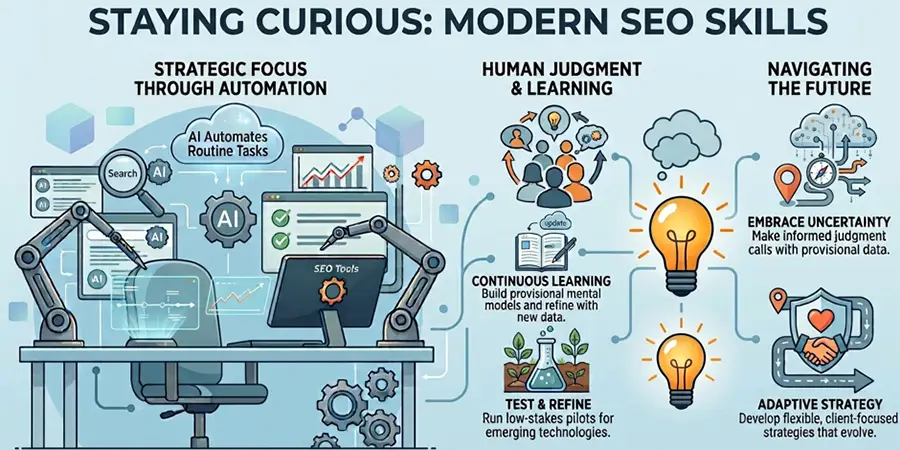
Search engine behaviour, AI-generated results, user expectations, and the tools available to practitioners are all shifting faster than any individual can track comprehensively.
The soft skill this demands is adaptability specifically, the willingness and ability to update your mental models when new information contradicts them.
This is harder than it sounds. People who have developed expertise in a field invest significant effort in building a view of how things work. When that view becomes outdated, there is a natural resistance to revising it.
In a slower-moving field, that resistance is manageable. In a field moving at the pace of change in SEO, it becomes a meaningful professional liability.
Adaptability in practice looks like a set of concrete habits rather than a general attitude:
Following practitioners whose views challenge your current assumptions, not just those who confirm them
Treating your existing knowledge as provisional - accurate for now, subject to revision
Testing new approaches in low-stakes situations before they become necessary in high-stakes ones
It also means getting comfortable with uncertainty. Many SEO decisions are made in conditions where the right answer isn’t knowable in advance - you are making a judgment call based on incomplete information.
Judgment and Ethics in AI-Assisted Work
As AI tools become more capable, they create new categories of professional judgment that didn’t previously exist. When AI generates content, who is responsible for its accuracy? When AI analysis surfaces a competitive opportunity, what are the limits of how that insight should be used?
Questions Worth Asking About Your AI-Assisted Work
Who is responsible for the accuracy of AI-generated content before it goes to a client?
What should you disclose about how a piece of work was produced?
Are you using AI to do work better, or to do more work with less care?
Would you be comfortable if a client could see exactly how this was produced?
These are not technical questions. They are ethical and professional ones, and they require the same kind of principled thinking that has always defined good professional practice across every field.
For SEO professionals, developing this judgment means thinking carefully about the difference between using AI to do work better and using AI to do more work with less care. The former is a professional asset. The latter tends to produce work that degrades in quality as the human oversight layer gets thinner.
Conclusion
The value of critical thinking, communication, adaptability and ethical judgment extends far beyond SEO. These skills help us evaluate information, communicate our needs clearly, respond constructively to change and make responsible decisions—whether we are working with AI, collaborating with colleagues, managing projects or solving problems in everyday life.
AI may change the tools we use and the way we work, but it does not remove the need for these human capabilities. In many situations, it makes them more important: we need critical thinking to question what a tool produces, communication to give it useful direction, adaptability to keep learning as circumstances change, and sound judgment to decide how its output should be used.
The good news is that none of these skills is fixed. They can be strengthened through deliberate practice, reflection and experience. Developing them for an AI-assisted SEO workflow can therefore provide benefits well beyond SEO, giving you a set of transferable skills that can support effective decision-making, collaboration and learning throughout your professional life.
About the Author
Nina Walker is a digital marketing consultant, freelance blogger, and psychology enthusiast passionate about creating engaging content and impactful online strategies. With a keen interest in human behavior and branding, she combines analytical insights with creative storytelling to connect with diverse audiences.