

How to Make Your Expertise Easier for AI Search to Understand and Cite
See also: Digital SkillsSearch is changing from a list of links into a conversation. AI search may be technological, but being understood by it increasingly depends on distinctly human skills. Someone researching a professional service, unfamiliar concept or business problem can now ask ChatGPT, Perplexity, Microsoft Copilot or Google a complete question and receive a synthesised answer rather than starting with ten blue links.
When web search is involved, these tools can also connect parts of their answers to supporting sources. ChatGPT Search can display inline citations, Perplexity provides citations and links to original sources, Microsoft Copilot can ground responses in Bing search results, and Google's AI search features can surface supporting web pages alongside generated responses.
For professionals, freelancers and small business owners, this creates a useful question: what makes your expertise easy enough to find, understand and trust that it can contribute to an AI-generated answer?
The answer is not simply more technology. Much of the work depends on familiar professional capabilities: choosing the right questions, communicating clearly, assessing evidence, solving information gaps and continuing to learn as the environment changes.
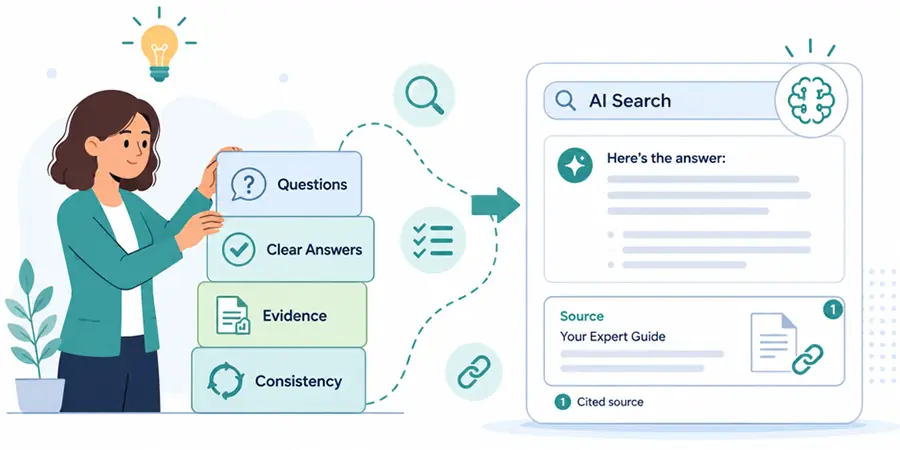
How Strategic Thinking Helps You Identify Useful Questions
AI search makes professional judgement more important because publishing more information is not the same as publishing more useful information. You need to decide which questions deserve your attention, what you genuinely know about them and what evidence supports the answer you provide.
Traditional search already rewards useful information, but answer-led interfaces change how that information may be encountered. Google says its generative AI search features remain rooted in its broader Search systems and continue to rely on useful, accessible web content. It also advises site owners to focus on unique, valuable and people-first information rather than special AI-search tricks.
That means the starting point should not be:
What can I publish so that AI mentions me?
A better question is:
What do I know that would genuinely help someone make a better decision?
Consider a management consultant who works with family businesses. They could publish general articles about "business growth", a subject already covered thousands of times. Strategic judgement would instead lead them towards the questions they encounter in real work:
How do you hand decision-making from a founder to a management team?
When should a family business hire its first external executive?
How do you separate ownership decisions from operating decisions?
Those questions are narrower, but the consultant is far more likely to contribute something useful because they reflect genuine experience.
A useful publishing habit is therefore to start with three questions:
What do people repeatedly ask me?
Where do I have first-hand knowledge or credible evidence?
What can I explain better than a generic summary can?
This is strategic thinking applied to digital communication. The aim is not maximum content. It is choosing where your knowledge has the greatest value.
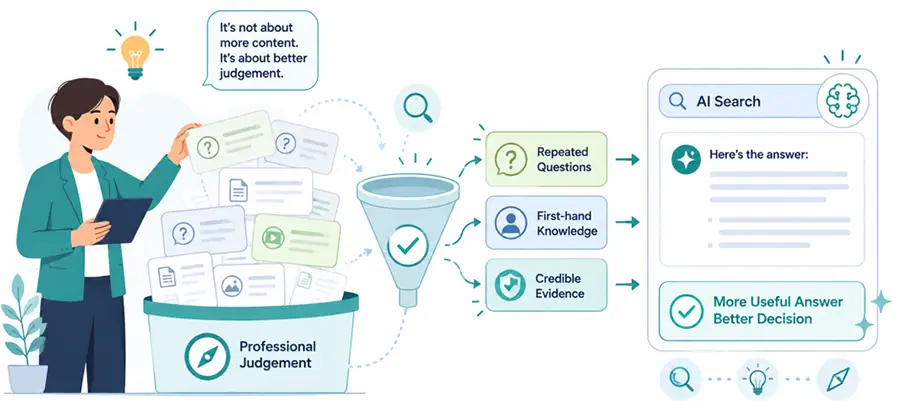
How Clear Communication Makes Expertise Easier to Understand
Clear communication makes expertise easier to use because readers identify the main point without working through several paragraphs of background first. State the answer, explain the reasoning and then add evidence, examples or qualifications. Context should follow the answer, not precede it.
Compare these two descriptions:
| Vague | Clear |
| We provide tailored solutions designed to help organisations unlock their full potential. | We help manufacturers replace manual monthly reporting with Power BI dashboards connected to finance and operations data. |
The first sentence sounds positive but communicates very little. The second tells the reader who the service is for, what problem it addresses and how the work is done.
The same principle applies when answering a question. Context can follow; the reader should not have to search for the answer inside the answer.
| Weak Opening | Clear Opening |
| There are many considerations involved, and the right choice will depend on a range of circumstances. | A small business should choose accounting software based on transaction volume, reporting needs, integrations and who will maintain the system. |
This is fundamentally a communication skill rather than an AI-specific technique. Communication skills include adapting language to the audience and writing clearly and concisely, both of which matter when professional knowledge is being communicated online.
A few habits make a significant difference:
Use specific nouns: Name the person, organisation, process or product rather than relying on "it", "they" or "this solution".
Explain specialist terms: Do not assume that a potential client understands your industry's shorthand.
Keep sections focused: One section should answer one main question.
Use descriptive headings: "How Do We Price Projects?" tells the reader more than "Our Approach".
Put the answer early: Background is easier to understand once the reader knows where the explanation is going.
A useful test is to copy one paragraph out of your website and read it on its own. Would a stranger know what question it answers? If not, the paragraph probably depends too heavily on surrounding context.
How Critical Thinking Helps You Check Evidence
A claim is reliable enough to publish when you can identify where it came from, what it actually proves and any important limits on how it should be interpreted. This requires more than finding a statistic that supports your point.
AI makes this especially important because generating a confident sentence has become extremely easy.
Suppose an AI tool tells you:
73% of customers prefer businesses with personalised websites.
Before publishing it, ask:
Who conducted the research?
Can you find the original source?
When was the study carried out?
Who was surveyed?
What did "prefer" mean?
Was the research about your country or industry?
Does the source actually say 73%?
If you cannot answer those questions, you do not yet have evidence. You have a claim that needs checking.
These habits sit at the heart of critical thinking, which involves activities such as observation, analysis, interpretation, evaluation, problem-solving and decision-making rather than simply accepting information at face value.
The same discipline applies to your own claims. Instead of writing "Our process dramatically increases efficiency," write something verifiable, if the evidence exists: "Our new reporting workflow reduced the team's weekly manual reporting time from 8 hours to 3 hours during the 12-week pilot."
The second statement has a starting point, an outcome and a timeframe. A reader can understand what changed. This does not mean every professional opinion needs a statistic. Expertise often involves judgement. The important distinction is knowing when you are expressing an informed opinion and when you are presenting something as an objective fact.
How Problem-Solving Helps You Find Information Gaps
Treat poor AI visibility as an information problem before treating it as a technology problem. Identify what is missing or inaccurate, trace where the problem originates and correct the most authoritative source first. The right fix is at the root of the information, not around it.
Imagine you are an independent consultant who now specialises in supply-chain risk, but an AI search tool repeatedly describes you as a general procurement consultant. The instinct might be to rewrite your entire website. A better problem-solving process starts with diagnosis. Check:
Does your homepage clearly describe your current specialism?
Does your LinkedIn profile use the same positioning?
Is an old author biography still appearing on another website?
Do business directories describe your former service offering?
Have you actually published enough material about supply-chain risk to demonstrate the specialism?
You discover the AI response reflects information that genuinely exists online. The problem is not necessarily that the technology misunderstood you. Your public information may simply be inconsistent.
This type of diagnosis is useful even when AI search is not involved. It helps clients, journalists, potential employers and collaborators understand what you actually do.
How Consistency Helps Others Understand Your Expertise
Consistency means the core facts about your professional identity agree across credible sources, even when the wording differs. Your website, professional profiles and business listings should tell the same story about your role, expertise and services. Conflicting information can make it harder for search systems to establish a clear identity for a person or organisation.
Start with the facts that matter most:
Your name
Business or organisation name
Professional role
Main services
Areas of expertise
Location or markets served
Relevant qualifications
Current biography
The wording does not need to be identical everywhere. A short conference biography might describe you differently from a LinkedIn profile. That is normal, but the issue arises when one profile says you advise technology companies while another says you specialise in hospitality, or when an old job title remains attached to your current work.
Google Search Central's guidance on Article structured data recommends connecting authors with identifying URLs to help Google better understand who the author is. Keeping important identity details accurate across the sources associated with you therefore gives search systems clearer information about who you are and what you do.
A quarterly check can prevent information from drifting: search your name, your organisation and your main service. Review the credible results and note anything that a potential client would find confusing. Then correct the inaccurate source rather than trying to compensate for outdated information by publishing more content elsewhere.
How Credibility Is Built Through Independent Evidence
Independent sources strengthen your credibility when they provide genuine evidence that supports your expertise, experience or professional identity. A reference from a credible third party can establish associations between you and a subject that do not depend entirely on claims made on your own website.
Examples include:
Membership of a recognised professional organisation
A genuine client review describing specific work
A conference page listing you as a speaker
An interview in an industry publication
Expert commentary attributed to you
Research to which you contributed
A relevant professional directory
Publishing dozens of artificial mentions or inserting promotional comments into unrelated discussions does not provide the same kind of evidence.
Ahrefs' study of 75,000 brands found that branded web mentions had a strong correlation with visibility across ChatGPT, Google AI Mode and AI Overviews. The relationship was substantially stronger than factors such as backlink volume or the number of pages published on a brand's own website.
The research does not prove that every external mention directly causes an AI citation. It does, however, show a clear relationship between being discussed across the wider web and being visible in AI-generated answers. Ahrefs consequently recommends earning genuine mentions across articles, guides and other relevant websites rather than pursuing link volume for its own sake. A better approach is therefore to contribute something worth referencing.
How Adaptability Helps You Respond to Change
Adaptability means learning what has changed, deciding whether it matters to you and adjusting your approach without chasing every new feature. AI search is developing quickly, but a durable strategy needs principles that remain useful even when individual platforms change their behaviour.
Search-enabled products add features, alter interfaces and modify how sources are displayed. Google’s dedicated Search Console offers reporting for generative AI visibility. Different AI search engines also operate with distinct editorial preferences. The wrong response is to rebuild your website every time somebody announces a new optimisation trick.
A more useful cycle is: Observe → evaluate → test → learn → adjust
Suppose somebody claims that adding a particular file to your website will dramatically improve AI citations. Before implementing it:
Check whether the relevant platform documents the recommendation.
Identify what evidence supports the claim.
Determine whether it applies to the AI tool you care about.
Test it on a limited basis if there is a reasonable case.
Measure whether anything meaningful changes.
Google's published guidance for its generative AI search features states clearly that site owners do not need special AI-specific files or markup. The same critical thinking applies to any new tactic: if a platform has not documented it, ask what evidence supports it before acting. Continuous learning is therefore less about memorising today's tactics and more about developing a reliable way to assess tomorrow's ones.
What Can You Improve Yourself in 30 Minutes?
You can improve the clarity and credibility of your online expertise without specialist software by reviewing a small number of high-value questions, claims and professional profiles. The exercise below takes 30 minutes. Each step builds directly on the professional capabilities in this article.
| Time | Focus | Action |
| 0 to 5 minutes | Strategic judgement | Write down 3 questions that clients, customers or colleagues regularly ask you |
| 5 to 10 minutes | Communication | Check whether your website answers those questions clearly and early |
| 10 to 15 minutes | Critical evaluation | Verify three important statistics or factual claims you currently publish |
| 15 to 20 minutes | Problem-solving | Search your name or company and identify inconsistent or outdated information |
| 20 to 25 minutes | Clear writing | Rewrite one vague paragraph as a specific, standalone answer |
| 25 to 30 minutes | Continuous learning | Ask two or three realistic questions in an AI search tool and inspect which sources it uses |
Do not treat the final exercise as a ranking report. One answer can vary according to the platform, wording and context. Instead, use it to learn: Which sources appear repeatedly? What information do they provide? Is your own expertise represented accurately? Is something important missing from your website?
When Is Specialist Support Worth Considering?
Specialist support becomes useful when the challenge extends beyond improving individual pages into site-wide content strategy, technical diagnosis, measurement and the coordination of expertise across a larger organisation. The skills in this article handle most situations. The question is when complexity or scale makes specialist support worth the investment.
A freelancer with a 10-page website can usually correct many issues personally. A B2B organisation with hundreds of pages, several markets, multiple subject-matter experts and a complex technical stack faces a different problem.
Outside support may become worthwhile when you need to:
Monitor a large set of commercially relevant questions
Diagnose technical crawling or rendering problems
Coordinate content across several teams
Establish reliable research and fact-checking processes
Track brand mentions and citations over time
Resolve inconsistent company information across many sources
Connect visibility with enquiries, pipeline or other business outcomes
At that scale, the work combines communication, technical implementation and measurement. Intelligent Resourcing's GEO service is one example of a B2B-focused approach to bringing those elements together.
The same critical judgement should apply when evaluating any specialist. Ask what they will measure before starting, how they verify claims, which platforms they actually monitor and what your organisation will own when the engagement ends. If the explanation depends entirely on jargon or promises guaranteed AI citations, keep asking questions.
The Most Durable AI Skill Is Better Judgement
AI search changes where professional expertise may appear, but it does not remove the need for human judgement.
Strategic thinking helps you decide which questions deserve your attention. Clear communication makes your knowledge easier to understand. Critical thinking keeps weak evidence out of your work. Problem-solving helps you identify why information is missing or inaccurate. Adaptability allows you to respond sensibly as the technology changes.
These capabilities matter whether your work is discovered through Google, an AI assistant, a professional network or a conversation between two people. The aim should not be to write for a machine; it should be to communicate what you know so clearly, accurately and credibly that both people and technology can understand why it is useful.
About the Author
Ronan Leonard is a Certified Innovation Officer and founder of Intelligent Resourcing. He works with B2B organisations on AI search visibility, GTM systems and revenue operations, helping teams turn complex digital processes into practical, measurable workflows. When not optimizing digital strategy, Ronan enjoys restoring vintage bicycles and exploring local hiking trails.