

Healthy Scepticism at Work: The Soft Skills That Help You Spot a Scam
See also: Critical ThinkingMost workplace scams are not technical at all. A message arrives that looks like it comes from your manager, a supplier or a colleague in finance. It is urgent, a little flattering or a little frightening, and it asks you to do something quickly: pay an invoice, share a code, open a file, change some bank details.
Nothing about it needs specialist knowledge to resist. What it needs is a set of everyday soft skills that let you notice the pressure, slow down and check before you act.
This article looks at those skills, why scammers target them, and how you can develop them so that healthy scepticism becomes a habit rather than an effort.

Why do scams target people rather than systems?
Because people are easier to persuade than software is to break. A well-crafted message does not need to defeat any security system; it only needs one person to believe it for a few minutes. Scammers therefore borrow the same levers that drive any persuasion: authority ("this is the CEO"), urgency ("by end of day"), scarcity ("last chance"), liking ("great work on the last project") and fear ("your account will be closed").
These levers work because they push us out of careful, reflective thinking and into fast, automatic responses. The skills below are all, in different ways, about getting back into reflective mode at the moment it matters.
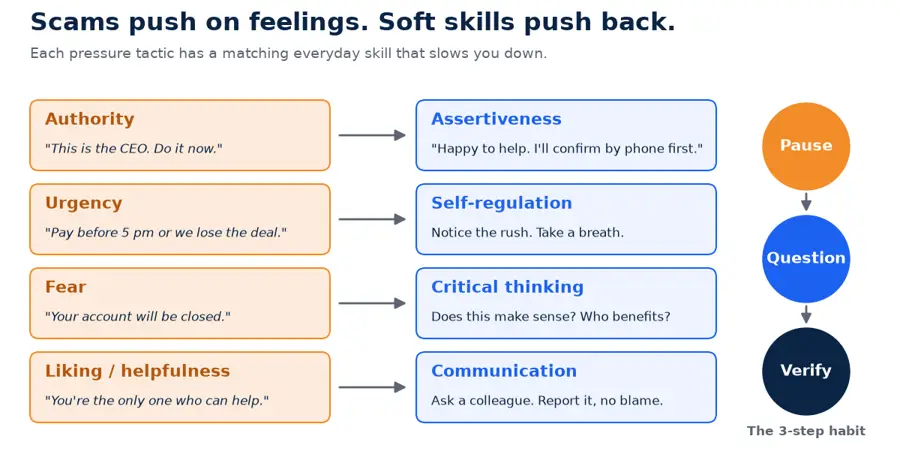
Essential Soft Skills for Scam Prevention
Critical thinking: asking "does this make sense?"
Critical thinking is the ability to evaluate information rather than simply accept it. In the context of scams, that means looking at a request and asking a few simple questions:
Is this the way this person normally contacts me?
Is this the kind of thing they normally ask for?
What would happen if I waited ten minutes to check?
Who benefits if I do what this message says?
None of these questions requires technical expertise. They require the habit of treating a message as a claim to be tested, not an instruction to be followed. A useful exercise is to practise on harmless material: when you read a news headline or an advert, ask what evidence supports it and what is missing. The same mental muscle works on a suspicious email.
Self-regulation: noticing the pressure and pausing
Self-regulation, a core part of emotional intelligence, is the ability to manage your emotional reactions rather than be driven by them. Scam messages are designed to provoke a feeling first: panic, guilt, excitement or the wish to be helpful. The feeling arrives before the thinking does.
The practical skill is to recognise that feeling as a signal. If a message makes your heart rate go up, that is the moment to stop, not to speed up. Some people find it helpful to name the emotion silently ("this is making me anxious") because labelling a feeling tends to reduce its grip. Others use a physical cue, such as taking their hand off the mouse or standing up, to create a short pause.
Building this skill takes practice in calmer situations too. Noticing how you react to a difficult email from a customer, or to criticism in a meeting, trains the same awareness you need when a message is deliberately trying to rush you.
Assertiveness: being comfortable saying "let me check"
Many scams rely on authority. The message claims to come from a senior manager, a regulator or an important client, and the implied message is: don't question me. Assertiveness is the skill of standing up for reasonable boundaries while remaining respectful.
In practice, assertiveness sounds like:
"I'm happy to help. I'll just confirm this with you by phone first."
"Our process is to verify bank detail changes before we update them."
"I can't share that code, but I can ask IT to help you."
Assertive responses are not rude, and they are not accusations. They simply put the process ahead of the pressure. People who find assertiveness difficult can practise with low-stakes requests at work, such as asking for a clearer deadline, so that saying "let me check" feels natural when it really counts.
Active listening and questioning on the phone
Not every scam arrives by email. Phone calls and voice messages are increasingly common, and some now use convincing synthetic voices. Active listening, the skill of paying full attention to what is being said and how, helps you spot inconsistencies: a caller who avoids simple questions, changes their story or pushes back hard when you suggest calling them back.
Good questioning is the partner skill. Open questions ("Can you tell me more about where this invoice came from?") give a genuine caller the chance to explain and often expose a fake one. The single most effective question is usually a procedural one: "What's the best number to call you back on?" followed by calling a number you already know, not the one they give you.
Communication: reporting quickly and without shame
The most underrated skill in scam prevention is the willingness to speak up. People who click a bad link or nearly pay a fake invoice often stay quiet because they feel embarrassed. That silence gives an attacker more time.
Clear, honest communication works in both directions:
If you are the person who made a mistake: report it straight away, stick to the facts (what arrived, what you did, when) and let the people responsible deal with it.
If you are a manager or colleague: thank people who report, even if it turns out to be a false alarm. Blame teaches people to hide problems; gratitude teaches them to raise them early.
Teams that talk openly about near misses build a shared sense of what scams look like, which is far more memorable than any slide in a training session.
Teamwork: making verification part of the culture
Individual skills are strongest when the team supports them. Teamwork in this context means agreeing, in advance, how certain requests will always be handled. For example, a team might agree that any change to a supplier's bank details is confirmed by phone with a known contact, or that no one ever shares a login code, whoever asks.
When a procedure is shared and expected, using it is no longer a personal judgement about whether a colleague can be trusted. It is just how the team works. That takes the social awkwardness out of checking and makes assertiveness much easier.
Putting it together: Pause, Question, Verify
The skills above can be summarised in a three-step habit that anyone can learn:
Pause. Notice any pressure or strong emotion, and give yourself a moment before acting.
Question. Ask whether the request makes sense, matches what you'd expect and could safely wait.
Verify. Confirm through a separate channel you already trust, such as a known phone number or a face-to-face conversation.
The value of a simple routine is that it holds up under stress. When a message is designed to make you hurry, you don't need to remember a long checklist, just three words.
How can you develop these skills?
Like any soft skill, healthy scepticism improves with deliberate practice and reflection:
Review real examples. Look at genuine scam messages your organisation has received, with personal details removed, and discuss which pressure tactics each one used.
Role-play difficult requests. Practise saying "let me check" to a colleague playing an impatient manager. It feels awkward the first time and much easier after that.
Reflect on near misses. After any close call, ask what made the message convincing and what helped you notice.
Practise calm under pressure in everyday work. Any situation that trains you to slow down before responding, from handling complaints to negotiating, strengthens the same skill.
Conclusion
Technology can filter out a lot of scam messages, but it cannot filter out all of them. The ones that get through are aimed squarely at human judgement, so human skills are the final line of defence. Critical thinking, self-regulation, assertiveness, active listening, open communication and teamwork are not specialist security skills; they are the same soft skills that make people effective at work generally. Developing them makes you better at your job and much harder to fool.
About the Author
Nathan Spitalny is the CEO of RDE Technologies, a managed IT and cybersecurity provider in Oceanside, New York. Since 2009, his team has helped organisations build practical, people-first habits for staying safe online.