

Creating a Blended Family
See also: Top Tips for Step-ParentsIt is a sad fact that a significant proportion of marriages now end in divorce. More importantly for the purposes of this page, up to a third of all marriages are estimated to be remarriages. This means that a significant proportion of marriages are likely to involve creating a ‘blended family’, one in which at least one of the adults brings children from a previous relationship.
Creating a blended family has potential to be very rewarding. However, it can also bring some serious challenges, especially if not handled carefully and with a close eye on the children concerned. It needs planning and active management. It may even require you to completely rethink your domestic arrangements—quite possibly more than once. This page provides some ideas to help you manage.
What is a Blended Family?
A blended family is defined as one where at least one partner brings children from one or more previous relationships.
There are also specific names for family relationships within blended families (see box).
Blended family relationships – some definitions
Step-child. Your spouse’s child from a previous relationship.
Note that this title only applies if you are married to the child’s parent; if not, this is simply your partner’s child, no matter how longstanding your relationship with your partner.
Step-parent. Your parent’s spouse, not your birth parent.
Note that your parent’s new partner (unmarried) is NOT your step-parent: a legal relationship is required for that title.
Step-sibling. Your parent’s spouse’s child from a previous relationship. Step-siblings do not share a birth parent, but they do both have a parent in the new marriage.
Half-sibling. The child of one of your birth parents and another partner, possibly but not necessarily your step-parent.
Why is Creating a Blended Family Challenging?
Creating a blended family is challenging because there are multiple people and relationships involved, and not everyone is excited about the change.
You and your partner will, of course, be excited to be getting married and/or living together for the first time. However, your children may not be so enthusiastic. They may:
Have got used to it being just you and them and be quite happy with that situation;
Not particularly like your partner;
Be anxious about moving house, or sharing their house with more people;
Be concerned about having to change school, or how they will manage a different journey to school if that is required;
Not like their future step-siblings—or simply be indifferent to them;
Be concerned about when they will see their other parent;
Be worried about how the dynamics of all the relationships will change, and what effect that will have.
If their other parent is dead, you ‘moving on’ can also trigger unfinished grieving. There is therefore a lot that can go wrong when creating a blended family.
What Should You Consider When Creating a Blended Family?
There are many aspects to consider—but perhaps the first and most important is time.
When you have found a new partner, especially after a painful divorce, the temptation is to look for your new ‘happy ever after’ as quickly as possible. However, this is unlikely to be a good way to create a blended family. Instead, the general advice is to wait at least two to three years, and quite possibly a lot longer. Indeed, some commentators suggest taking two or three years before dating seriously, then dating for at least two years before introducing your children into the equation.
It is important to remember that children don’t really like change anyway—and especially not when it all feels negative to them. It also takes time for new relationships to develop. You may have fallen in love with your partner (and them with you), but you also need time to get to know and like their children, and vice versa.
The second aspect to consider is how you will operate as a family.
Take time to talk about how you will live together, and thrash out the minutiae of everyday life. Spend time together as a family doing everyday things, not just having fun out and about. Talk to each other and the children about what might happen about schools, bedrooms, sleepovers—and anything else that they and you can think of to discuss.
It is also a good idea to agree any changes to your parenting styles and way of operating before you marry—and put them in place then, too. As much as anything, this will allow you to test them out before you have committed. It will also mean that the changes have happened before you marry, and the children won’t blame the new spouse for interfering.
It can also be helpful to agree a few ‘family rules’ altogether (see box).
An important rule
Nobody can guarantee that step-siblings will like each other, or their step-parents.
However, you can and should make—and enforce—a rule that everyone treats everyone else with respect, regardless of liking.
What Parenting Roles are Reasonable in a Blended Family?
Experts agree that there is one very fundamental rule that should apply in all blended families: the birth parent takes the lead.
The step-parent is not—and should not act as—the step-children’s parent.
Even if they are doing a lot of basic childcare, such as school or nursery drop-offs and pick-ups, they should still not be in the lead. Their role is to support their spouse in their parenting: supporting and enforcing their decisions, but not making their own. In fact, some people suggest that the step-parent should NOT be doing a lot of the basic childcare.
Similarly, parents’ primary relationship and responsibility should be to their children—not to their partner. A step-parent should never force their spouse to choose between them and their children, because they are never going to win that one.
Get on the band wagon and help the parent steer it. Don’t try and take the controls away from the parent and steer it your own way. You will all crash...and you probably won’t be forgiven.
The National Council for Integrative Psychotherapists on step-parenting
That said, parents should support their spouses. For example, it is reasonable to insist that your spouse is treated with respect by your children, even when you are not there. You should also make sure that you don’t allow your children to ‘divide and conquer’ by playing the ‘not my parent’ card.
For more about how to do so, you may find it helpful to read our page on Managing Disagreements About Parenting.
What Can You Do To Build Relationships With Step-Children?
First, and most importantly, make sure that your step-children’s needs are met.
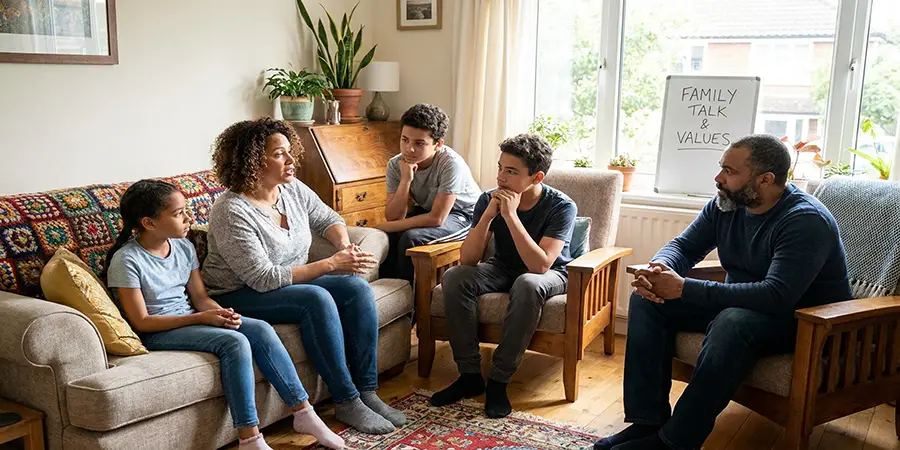
This includes making sure that they know that they are loved and wanted, and that they are safe and secure. Children may also find it helpful to be involved in decisions about how the house works—at least as far as is possible. For example, you may find it helpful to have a house meeting to agree on some rules of engagement, to give the children a bit more control over their situation.
Second, don’t try to enforce discipline except as any other ‘responsible adult’ would.
Leave discipline to your spouse, at least at first—or at most enforce the boundaries that they have set. Obviously you need to keep the children safe, but beyond that, you should act as if you are merely a ‘responsible adult’, not a parent.
Third, let your step-children set the pace.
Don’t try to rush the relationship. Let it evolve at a pace that is comfortable for your step-children. Respond to them, rather than pushing your expectations onto them.
Fourth, keep your expectations low.
You may never have a strong relationship with your step-children, and certainly not early on. Keeping your expectations low means that you won’t be disappointed. However, having low expectations does not mean tolerating a lack of respect—and your spouse should be actively supporting you in that.
How Can You Help to Build New Family Relationships?
Again, time is the most important aspect.
Everything about building new relationships, and especially new family relationships, takes time. Children will not automatically bond with step-parents or step-siblings, and nor would anyone expect that. However, there are some things that you can do that may help to build stronger relationships.
First, try creating new family rituals and traditions.
You probably won’t be able to keep doing every ‘old’ family ritual—and some of them would feel wrong to at least part of the family anyway. Instead, make new family rituals and traditions in your blended family. Involve your children and step-children in deciding what they would like to do together, and in creating those new rituals.
Second, treat all the children the same—or at least equally and fairly.
Every child in the new blended family needs to feel that they are being treated fairly, and that nobody is getting an unfair advantage. That means attention for everyone, time with their own parent, and equal treatment within the house: similar treats, similar rules (commensurate with age differences), similar sleeping arrangements and bedrooms, and so on.
However, each parent should also make dedicated time for their own children.
Your children don’t need to feel that they never see you alone. Sometimes it is nice for them to spend time as the ‘old firm’, without the new additions—and the same goes for your spouse and step-children. It is important to do things together, but you don’t always have to do everything together. You do, however, need to be careful that both sets of children get equal time with their birth parent.
What If Your Family Simply Won’t Blend?
Finally, what can you do if your family simply refuses to or is unable to blend?
We can define this situation as one where meeting the needs of all the children is simply incompatible with living together under one roof. Under those circumstances, it may be best to consider alternative living arrangements.
One spouse and their children might move into another house or flat nearby, for example. The spouses could continue to see each other regularly, and even sleep over at each other’s houses when the children are elsewhere. However, the living arrangement is of two separate households—and that may need to continue for some years, possibly until the children are ‘grown and flown’.
This should not be seen as a failure of step-parenting or blending.
Instead, you should see it as a better way of meeting the needs of all those involved—both parents and children. After all, it is in nobody’s interest to have stressed adults or upset children.
Conclusion
Creating a blended family is unlikely to be easy. It will take time and effort from both parents.
Ultimately it may even not be possible to do it under one roof.
However, with time and effort, and a little creativity at times, you should be able to find a solution that works for everyone—even if it’s not what you expected when you started.