

Nonverbal Communication: Gestures,
Eye Contact, Distance, and Common Mistakes
See also: Non-Verbal Communication
Nonverbal communication is the silent layer of every conversation. It includes posture, facial expressions, gestures, eye behavior, tone of voice, and how close we stand to others. Sometimes it reinforces what we say; sometimes it contradicts it. And because humans are wired to detect emotional and social cues quickly, nonverbal signals can shape trust, credibility, and rapport long before the content of a message is fully processed.
Research consistently shows that people form rapid impressions based on nonverbal cues such as facial expression and body language. While popular culture often exaggerates “body language decoding,” credible studies support the idea that nonverbal behaviors—especially facial expressions, vocal tone, and interpersonal distance—carry meaningful social information and influence how messages are received.
In this expert guide, you will learn:
What nonverbal communication actually is,
How gestures, eye contact, and distance shape interaction,
What your body might be communicating unintentionally,
And which mistakes undermine trust—often without you realizing it.

What Nonverbal Communication Really Includes (Beyond “Body Language”)
Many people equate nonverbal communication with “reading gestures.” But nonverbal signals are broader and more complex. In fact, nonverbal communication is best understood as a system of channels that work together.
The Main Nonverbal Channels
Kinesics: posture, gestures, head movements, body orientation
Facial expression: micro-expressions, smiles, eyebrow movement
Oculesics: eye contact, gaze direction, blinking
Proxemics: interpersonal distance and use of space
Haptics: touch (handshakes, taps, social touch)
Paralanguage: tone, pitch, pace, pauses, volume, vocal warmth
Appearance and artifacts: clothing, grooming, objects (including phones)
Chronemics: timing—how quickly you respond, interrupt, pause
Expert comment
The most important principle is congruence. If your verbal message says “I’m confident,” but your posture is closed and your voice is shaky, people trust the nonverbal layer.
Why Nonverbal Signals Matter: The Brain Processes Them Fast
Nonverbal cues are processed quickly because they help humans evaluate:
Safety vs threat,
Warmth vs coldness,
Competence vs uncertainty,
Dominance vs submission,
Honesty vs deception (though deception detection is far from perfect).
First Impressions Are Nonverbal-First
In many interactions—job interviews, negotiations, presentations—people decide whether you seem credible before they evaluate your argument. That doesn’t mean content is irrelevant; it means content must pass through a filter shaped by your nonverbal presentation.
Expert comment
Think of nonverbal communication as the “user interface” of your message. A great idea delivered with anxious signals often gets underestimated.
Gestures: What They Do, When They Help, and When They Hurt
Gestures are one of the most visible nonverbal channels. They can:
Clarify meaning,
Add emphasis,
Signal openness,
And help speakers think more clearly.
Types of Gestures and Their Meaning
Illustrators: hand movements that match the content (explaining size, direction, sequence)
Emblems: culturally specific symbols (thumbs-up, “OK” sign)
Regulators: signals that control turn-taking (hand raise, nodding)
Adaptors: self-touch or fidgeting driven by stress (rubbing hands, touching face)
How to Use Gestures Well
Do:
Keep gestures in a “neutral zone” between waist and chest
Use illustrators to structure ideas (three points = three beats)
Match gesture speed to speaking pace
Keep palms visible when appropriate (signals openness)
Avoid:
Repetitive fidgeting (keys, pen clicking, hair touching)
Pointing aggressively
Hiding hands behind your back (can signal tension)
Over-gesturing so it becomes distracting
Expert comment
Gestures should serve the listener. If your hands are working harder than your words, you are creating cognitive noise.
Eye Contact: The Most Misunderstood Signal
Eye contact is powerful because it signals attention, confidence, and social connection. But it is also context-dependent.
What Eye Contact Communicates
Engagement: “I’m with you.”
Confidence: “I can handle this.”
Respect: “You matter in this interaction.”
Dominance (when overused): “I’m controlling the exchange.”
The “Good Eye Contact” Rule (Practical and Natural)
Aim for a balance:
Maintain eye contact for a few seconds at a time,
Break naturally (look away briefly when thinking),
Return to the person when making key points.
Common Eye Contact Mistakes
Staring: feels aggressive or intense
Avoiding gaze: can look insecure or disinterested
Looking around too much: suggests anxiety or lack of focus
Only looking at one person in a group: signals exclusion
Expert comment
Eye contact should feel like connection, not interrogation. The goal is to create psychological safety.
Distance and Personal Space: Proxemics in Everyday Life and Work
How close you stand to someone affects comfort and trust. This is called proxemics, and it varies strongly across cultures.
Four Common Distance Zones (General Model)
Intimate: close relationships
Personal: friends, trusted colleagues
Social: most workplace interactions
Public: presentations and formal situations
Distance Rules in the Workplace
In professional settings:
Keep a respectful distance (especially with new people),
Adjust based on the other person’s body language,
Avoid cornering someone (reduces perceived control and safety),
Use side-by-side positioning for collaboration rather than face-to-face confrontation.
Virtual Proxemics: Distance in Video Calls
On video, distance becomes:
Camera framing,
How close your face appears,
And whether you lean in too much.
Expert comment
In video calls, being too close to the camera can feel intrusive. A neutral frame (head and upper torso) tends to feel more professional and comfortable.
Facial Expressions: The Fastest Way to Signal Emotion
Facial expressions are a core channel because they communicate emotion instantly and often involuntarily.
The Power of Micro-Expressions (But Don’t Overinterpret Them)
Micro-expressions can reveal fleeting emotional reactions, but interpreting them reliably is difficult without context. Many “body language hacks” overclaim what you can infer. The safest approach is:
Notice patterns,
Confirm verbally,
And avoid jumping to conclusions.
The Most Important Facial Skill: “Warm Neutral”
A warm neutral expression is relaxed, open, and attentive:
Slight smile,
Soft eyes,
Relaxed forehead and jaw.
It signals professionalism and approachability—especially in interviews and leadership contexts.
Expert comment
Leaders often underestimate how much their resting face impacts team climate. A tense face can create tension in others, even without words.
Paralanguage: Your Voice Is Nonverbal Too
People often focus on body language and forget the voice. But tone, pace, and pauses are powerful signals.
Key Vocal Signals
Pace: too fast can signal nervousness; too slow can feel condescending
Pauses: create authority and clarity
Pitch variation: makes speech engaging and confident
Volume: should match environment and not overpower
Vocal warmth: friendliness and empathy
Expert comment
Pauses are one of the highest-leverage skills in communication. They signal confidence because you’re not rushing to fill silence.
How Nonverbal and Verbal Communication Should Match
A common reason people miscommunicate is misalignment between their words and their nonverbal signals. For example, saying “I’m open to feedback” while crossing arms and avoiding eye contact creates doubt.
This is why many professionals use tools that help them refine the verbal layer—so it stays clear and consistent with the emotional tone they intend. For instance, you might draft an email or message and use OverChat AI Rephrase to explore alternative wording that sounds more diplomatic or confident—then pair that with appropriate nonverbal cues in the live conversation (steady posture, warm neutral expression, calm pace).
Expert comment
Clear language helps—but it will not fix contradictory nonverbal signals. The strongest communication is when your words and your body tell the same story.
The Most Common Nonverbal Mistakes (and How to Fix Them)
This section is a practical diagnostic. Many nonverbal mistakes are stress behaviors, not personality traits.
Mistake 1: Closed Posture (Arms Crossed, Body Turned Away)
Why it happens: self-protection, discomfort, cold room, habit.
Fix: Open your stance, keep shoulders relaxed, orient torso toward the person.
Mistake 2: Fidgeting and Self-Touching (Adaptors)
Why it happens: anxiety, adrenaline.
Fix: Ground your feet, use purposeful gestures, hold a pen still, breathe slower.
Mistake 3: Over-Nodding and “Approval Signals”
Why it happens: desire to please, fear of conflict.
Fix: Nod occasionally, but also pause and ask clarifying questions.
Mistake 4: Mismatch Between Face and Message
Smiling while delivering bad news, or looking tense while praising someone creates confusion.
Fix: Match expression to intent: calm seriousness for serious topics; warmth for appreciation.
Mistake 5: Poor Turn-Taking Signals
Interrupting, talking over others, or failing to give space.
Fix: Use regulators: short pauses, nod to invite, hand gesture to yield.
Mistake 6: Overly Intense Eye Contact
Feels aggressive in many contexts.
Fix: Use “connect and release”: eye contact → brief glance away → return.
Mistake 7: Invading Space or Blocking Movement
Standing too close or cornering someone can feel threatening.
Fix: Maintain social distance, stand at an angle, keep exits open.
Expert comment
Most nonverbal errors are “stress leaks.” The solution is not acting—it is nervous system regulation: slower breathing, stable posture, and controlled pace.
Culture and Context: Why “Body Language Rules” Can Be Wrong
A major mistake is treating nonverbal cues as universal. Many gestures, gaze norms, and personal space expectations vary across cultures.
Practical Cultural Caution Checklist
If someone avoids eye contact, it may signal respect—not dishonesty.
“OK” and other hand signs can be offensive in some regions.
Personal space expectations vary dramatically across countries and even cities.
Touch norms differ in professional contexts.
Expert comment
Instead of rigid rules, use adaptive intelligence: notice the other person’s comfort and mirror lightly, without mimicking.
Nonverbal Communication in High-Stakes Situations
Job Interviews
Steady posture, open shoulders
Warm neutral facial expression
Moderate eye contact
Controlled gestures
Slower pace with intentional pauses
Presentations
Use gestures to structure points
Move deliberately (avoid pacing)
Look at the audience, not at slides
Pause after key statements
Negotiations
Keep movements small and calm
Avoid sudden shifts
Use silence strategically
Maintain respectful distance
Expert comment
In high-stakes moments, calm is contagious. Your body sets the emotional tone of the room.
A Practical Training Plan (15 Minutes a Day)
Day 1–3: Posture + Breathing
Stand with feet grounded
Relax shoulders
Slow exhale longer than inhale
Day 4–7: Eye Contact and Pauses
Practice “connect and release”
Insert intentional pauses after key points
Day 8–12: Gesture Control
Rehearse 3 key gestures for 3 key points
Reduce adaptors (self-touch)
Day 13–15: Voice
Record yourself
Slow pace by 10–15%
Add pauses
Reduce filler words
Expert comment
Nonverbal improvement is like fitness: small daily practice beats rare intensive effort.
Further Reading from Skills You Need
The Skills You Need Guide to Interpersonal Skills eBooks.
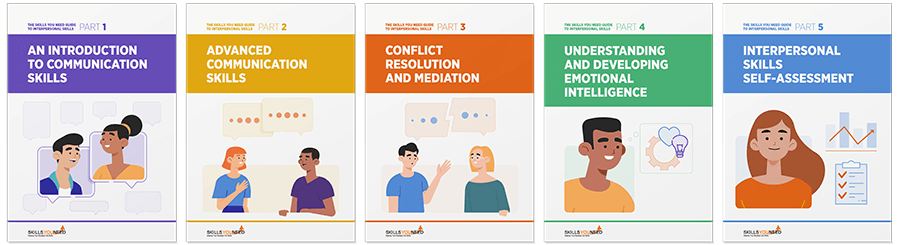
Develop your interpersonal skills with our series of eBooks. Learn about and improve your communication skills, tackle conflict resolution, mediate in difficult situations, and develop your emotional intelligence.
Conclusion: Nonverbal Communication Is Alignment
Nonverbal communication is not a set of tricks. It is alignment between:
What you intend,
What you say,
What your body signals,
And what the context requires.
When your gestures support your message, your eye contact creates connection, and your distance respects comfort, people feel safe, listened to, and ready to trust you. When your nonverbal cues leak stress—fidgeting, avoidance, closed posture—your words lose power even if your argument is strong.
The best goal is not perfect body language. The best goal is consistent communication: calm, clear, and respectful—so your message lands the way you intend.
About the Author
Ellie Yantsan is a digital marketer with more than 10 years of experience. She is a contributor to the Content Marketing Institute and is regularly quoted as an expert by large media outlets.