

7 Soft Skills You Can Develop Through Creative Hobbies
See also: Creative Thinking SkillsMost people think of hobbies as a reward at the end of the working day. Switch off, do something you enjoy, and come back sharper. That's not wrong, but it undersells what's actually happening when you sit down with a paintbrush, a needle and thread, or a sketchpad.
Creative hobbies are a form of deliberate practice. When done regularly, they build the same capabilities that employers now rank among their most valued assets: sustained focus, emotional regulation, problem-solving, and resilience. According to the World Economic Forum's recent Future of Jobs Report, creative thinking ranks fourth among the skills employers need most, alongside analytical thinking and resilience. These aren't abstract qualities. They're learnable, and hobbies are one of the most accessible ways to develop them.
The seven skills below each have a direct connection to a type of creative activity. Some you'll recognize in yourself already. Others might surprise you.

7 Key Soft Skills Enhanced by Creativity
Focus and Patience
Sustained attention is one of the most in-demand workplace skills and one of the hardest to practice deliberately. You can't sit down and decide to be better at focusing. But you can sit down and do something that requires it.
Structured creative activities are particularly good for this. Paint-by-numbers, for instance, requires you to work methodically through a canvas - section by section, color by color - without rushing or skipping ahead. There's no shortcut. You either finish the section or you don't. Number Artist creative kits offer exactly this kind of structured creative practice, where the process itself is the point: staying with each numbered area until it's complete builds the same patient, methodical attention that makes people effective at detailed professional tasks.
Psychologist Mihaly Csikszentmihalyi coined the term "flow" to describe a state of deep, focused immersion in an activity. Creative work is one of the most reliable ways to enter it. That state isn't just pleasant - it's training your brain to concentrate under the right conditions.
What is "flow"? Csikszentmihalyi described flow as complete absorption in a challenging but achievable task. People in flow lose track of time, ignore distractions, and produce their best work. Structured creative activities - where the task is clear but demands attention - are among the best triggers for this state.
Problem-Solving
Creative work is full of small problems. A color mix comes out wrong. A shape won't sit right on the page. The composition looks unbalanced, and you don't know why. These aren't failures - they're the actual work.
What makes creative hobbies effective for problem-solving is constraint. When you work within a structure - a fixed canvas size, a limited color palette, a pattern you're following - you can't just start over. You have to find a solution within the limits you've got. Constraint-based creative work trains exactly the kind of lateral thinking that applies when workplace problems don't have obvious answers. The World Economic Forum's Future of Jobs Report identifies analytical thinking and creative problem-solving as the skills employers expect to grow in importance fastest over the next five years.
Try activities where the goal is clear, but the path isn't: photography composition, DIY illustration, or working with mixed media. The habit of asking "How do I make this work?" translates directly to how you approach challenges outside a creative setting.
Resilience and Adaptability
Things go wrong in creative work. Constantly. A sketch that looked fine the night before looks flat in daylight. A project you've been building for two weeks isn't working, and you know you need to rethink it. You'll mess up. That's the point.
Resilience, in a professional context, means persisting through difficulty and adjusting your approach when the original plan isn't working. Creative hobbies build this because they give you repeated low-stakes experience of exactly that cycle: try, notice it's not working, adjust, try again. Pottery throws that collapse. Embroidery stitches you have to unpick. Illustrations you overwork. Each one is a small lesson in not catastrophizing, absorbing the setback, and carrying on.
The World Economic Forum's report lists resilience and flexibility among the most important skills for the next decade of work. Hobbies give you a reliable way to practice both, one small setback at a time. If you want to make this more deliberate, strengthening creative thinking through daily habits is a good starting point.
Stress Management and Emotional Regulation
Stress management isn't about eliminating stress. It's about managing your physiological and emotional response to it - staying functional when pressure is high, not letting frustration drive poor decisions.
A study by Kaimal et al., published in Art Therapy, found that 45 minutes of art-making lowered cortisol levels in participants regardless of their prior experience or skill level. You don't need to be good at drawing for it to work. You just need to do it. A study published in Nature Medicine, reported on by Harvard Health Publishing, tracked over 93,000 people across 16 countries and found that hobby engagement was consistently linked to better health, greater happiness, and fewer symptoms of depression.
Repetitive, present-moment creative activities - painting, knitting, coloring, pattern-making - work similarly to mindfulness practices in how they bring attention into the present and away from ruminative thinking. The type of hobby mattered less than regular engagement.
Attention to Detail
Attention to detail is the soft skill behind accuracy - the thing that separates work that's correct from work that just looks approximately correct. In a professional context, it shows up in proofreading, data review, quality checking, and following a process without cutting corners.
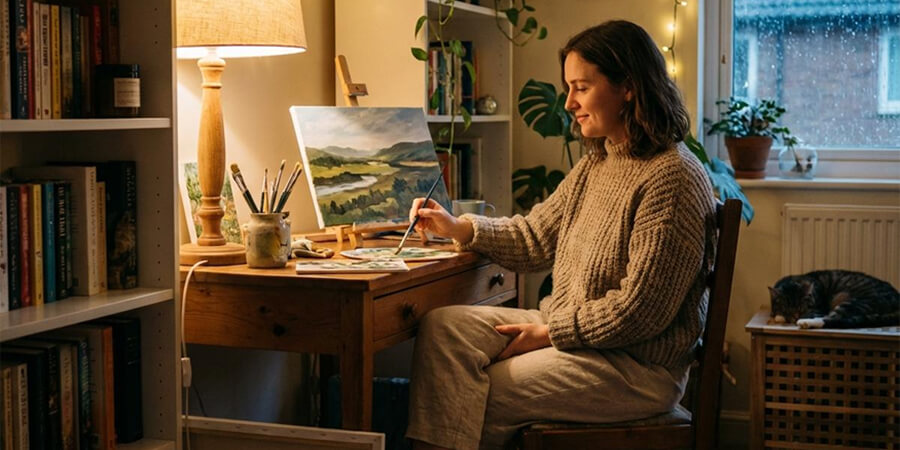
Creative hobbies develop it because the gap between "nearly right" and "actually right" is visible. In cross-stitch, one misplaced stitch throws off the pattern. In jewelry-making, a clasp that's slightly off-center is obvious when worn. In careful brushwork, the difference between a well-executed piece and a rushed one is immediately apparent. The stakes are low, but the feedback is honest.
A recent scoping review published in the International Journal of Mental Health Nursing found consistent links between regular creative engagement and improvements in cognitive function and focused attention - both prerequisites for high-quality, detailed work. The full review is available via Taylor & Francis.
Sustained practice at noticing small discrepancies - and caring enough to fix them - builds the precision habit that professionals need when the stakes are much higher.
Creative Thinking and Innovation
Creative thinking doesn't mean coming up with wild ideas from nowhere. In practice, it means seeing problems from multiple angles, experimenting rather than defaulting to what's familiar, and being willing to try an approach that might not work.
That's what creative hobbies require day to day. When you're working on an illustration or a craft project, there's no single correct answer. You make decisions about composition, color, technique, and approach - often without a template to follow. Even structured activities that give you a framework still require you to make judgments within it.
Creativity isn't a trait you have or don't. It's a skill you build through practice. Regular creative activity develops the mental habits - curiosity, tolerance for ambiguity, willingness to experiment - that make people better at thinking differently under pressure. The World Economic Forum's report puts creative thinking fourth in its ranking of skills employers need most. That's not an accident.
Self-Awareness and Emotional Intelligence
Emotional intelligence (EQ) covers a cluster of related abilities: recognizing what you're feeling, understanding why, managing your response, and reading the emotional states of people around you. It's among the most consistently valued soft skills in workplaces right now. SHRM's "Human Edge in the AI Age" report found that 71% of employers rank EQ above technical ability when hiring.
Creative hobbies build EQ because they put you in repeated contact with your own emotional responses in a situation with no serious consequences. When a project is going well, notice what that feels like. When it's not, notice how you handle the frustration - do you push through, give up, or step back and reassess? That habit of self-observation is exactly what emotional intelligence development looks like in practice.
Completing a creative project also builds a specific kind of self-confidence that transfers widely. You set out to make something. It was hard. You finished it anyway. That experience - repeated often enough - changes how you relate to your own capability.
Conclusion: How to Get Started
You don't need expensive materials or prior experience. The point isn't to produce gallery-worthy work - it's to show up regularly for something that requires your attention.
Pick one activity that connects to a skill you want to develop. A few starting points:
Focus and patience: structured kits, counted cross-stitch, step-by-step illustration courses.
Resilience: pottery, life drawing, or learning a new instrument - activities where failure and adjustment are built into the process.
Stress management: coloring, knitting, or pattern-based painting - mindfulness techniques and creative practice share common ground here.
Creative thinking: photography composition, collage, or mixed media - anything without a fixed "correct" answer.
Attention to detail: cross-stitch, jewelry-making, fine brushwork.
The Harvard Health report confirmed that the type of hobby matters less than consistent engagement. What you choose is less important than whether you actually do it regularly.
Soft skills training doesn't have to feel like training. These are capabilities you build through practice, and creative hobbies give you a reliable, enjoyable way to develop them - one session at a time.
About the Author
Henry Langdon writes about personal development, workplace skills, and the science of learning. An avid hobbyist himself, he explores how everyday habits and creative pastimes shape our professional capabilities and emotional intelligence.