

Developing Creative and Digital Life Skills
Through AI Image Generation
See also: Using AI for Visual Materials
Artificial intelligence (AI) tools are rapidly becoming an unavoidable part of our everyday lives. From sophisticated writing assistants to advanced image creation platforms, these technologies are fundamentally shifting how people communicate, learn, and express their most complex ideas.
While AI image generators are often dismissed as mere entertainment, fleeting internet trends, or tools strictly for graphic designers, they can actually serve as highly practical environments for developing a wide range of transferable life skills. When approached with intention, engaging with AI platforms can drastically improve your personal and professional capabilities.
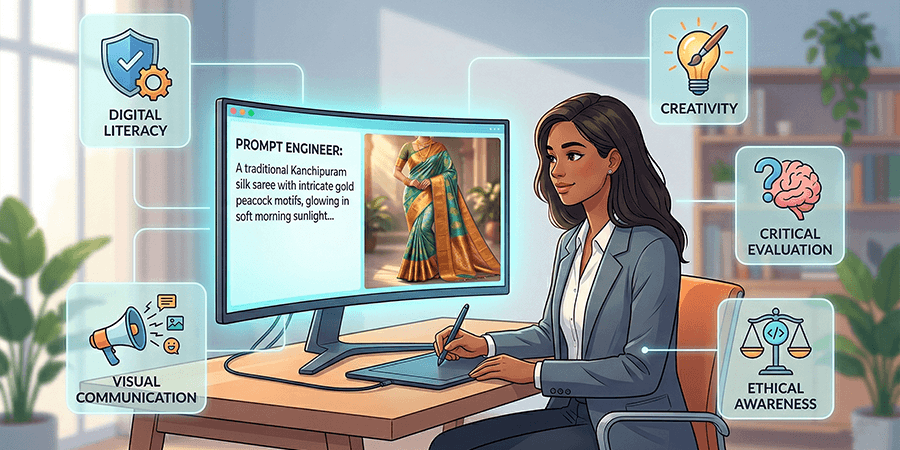
This article explores how active engagement with AI image generation can support the continuous development of digital literacy, creative thinking, critical evaluation, ethical awareness, and visual communication skills. These are core competencies that remain relevant across all cultures, industries, and stages of life, proving that AI is much more than just a novelty.
Understanding AI Image Generation in Everyday Life
At its core, AI image generation refers to digital systems that create, modify, or enhance visual images based on text descriptions (known as prompts) or uploaded reference photos. These tools are now widely accessible to the general public, used for tasks ranging from casual creative exploration to high-level marketing material creation and basic image editing.
In everyday contexts, you are likely to encounter AI image tools integrated into general-purpose photo editors, social media creative platforms, or highly specialised generators focused on particular visual styles. Understanding how these tools work, the algorithms that power them, and, crucially, their current limitations, is an indispensable part of modern digital competence. It is no longer enough to simply consume digital media; you must understand how it is constructed.
Improving Digital Literacy
To truly understand the value of AI image generation, we must first look at its impact on digital literacy. But what exactly does that term mean in today's landscape?
What Is Digital Literacy?
Digital literacy is the ability to use digital technologies confidently, critically, and responsibly. It involves much more than knowing which buttons to press or how to turn on a device; it encompasses a deep understanding of how digital systems process information, how algorithms make decisions, and how the resulting outputs should be correctly interpreted and utilized.
Learning Digital Skills Through AI Image Tools
Working hands-on with AI-based image tools helps users develop this essential digital literacy by actively encouraging them to:
- Explore unfamiliar interfaces: Navigating new software builds technological adaptability.
- Understand cause and effect: Learning how specific instructions directly influence digital outcomes.
- Distinguish between automation and human judgment: Recognizing when a machine's output needs human refinement.
For example, using an AI-based photo editor forces users to learn how varied image inputs, subtle stylistic adjustments, and strict constraints affect the final visual results. The overarching goal is not necessarily to achieve total mastery of one specific, fleeting software tool, but rather to build improved confidence in navigating complex digital environments as a whole.
The life skills developed here include digital confidence, informed technology use, and a robust awareness of system limitations.
Enhancing Creative Thinking and Problem Solving
There is a common misconception that engaging with AI removes the need for human creativity. In reality, effectively directing an AI requires a highly refined creative process.
Creativity as a Life Skill
Creativity is frequently misunderstood as purely artistic talent—the ability to paint, draw, or play music. In reality, creative thinking is a fundamental problem-solving skill that involves experimentation, cognitive flexibility, and iterative idea development. These abilities are universally useful in academic education, the corporate workplace, and personal decision-making.
Using AI to Explore Ideas
AI image generation allows users to exercise their creative muscles by enabling them to:
- Translate abstract ideas into visual form: Forcing you to articulate thoughts clearly.
- Experiment with different interpretations: Seeing how slight variations change a concept.
- Reflect on language: Understanding how wording, context, and detail shape outcomes.
For instance, experimenting with prompts related to traditional clothing styles can help users understand how descriptive language influences visual results. Tools designed for this purpose, including AI generators that focus on cultural or stylistic themes like ai saree imagery, can serve as useful learning contexts rather than ends in themselves. By tweaking the adjectives, lighting descriptions, and cultural signifiers, users learn to creatively solve the problem of visual representation.
The life skills developed in this area include creative exploration, visual thinking, and iterative idea development.
Building Critical Evaluation Skills
Just because a computer generates an image does not mean the image is flawless, factual, or appropriate for use. This is where critical thinking comes into play.
Evaluating AI-Generated Content
AI outputs are not inherently accurate. Developing the ability to evaluate results critically is absolutely essential in the modern age. When reviewing an AI-generated image, critical thinking skills prompt you to ask key questions, such as:
- Does the output accurately reflect the original intention?
- Is the image culturally, historically, or contextually appropriate?
- What elements appear physically unrealistic, distorted, or "hallucinated" by the AI?
Through active comparison and reflection, users quickly learn that AI-generated content still requires stringent human judgment and oversight.
Cultural Awareness and Context
When AI tools generate images related to culture, clothing, or specific human identities, they frequently rely on stereotypes and may oversimplify or misrepresent important details. Recognising these limitations helps users become more critical and culturally aware consumers of all digital content, not just AI imagery. It forces the user to question the underlying data the machine was trained on.
The life skills developed through this evaluation process include critical thinking, cultural sensitivity, and contextual judgment.
Ethical and Social Awareness in AI Use
The rise of generative AI has brought a wave of new ethical dilemmas. Engaging with these tools provides a practical sandbox for exploring these complex moral issues.
Understanding Data and Privacy
Many AI tools require users to upload their own images, provide personal data, or grant extensive permissions. Learning to read privacy policies and truly understand how your data may be stored, used, or sold is a crucial aspect of responsible digital behaviour. In an era of data mining, protecting your privacy is a non-negotiable skill.
Bias and Representation
AI systems are not objective; they reflect the data they are trained on, which inherently includes human biases, prejudices, or historical gaps. Awareness of this structural bias encourages users to question the results they are given and avoid treating AI outputs as objective truth. Ethical AI use demands that we recognise when an algorithm is excluding certain demographics or reinforcing harmful stereotypes.
The life skills developed here include ethical reasoning, responsible technology use, and a heightened respect for diversity and inclusion.
Developing Communication and Visual Literacy Skills
We process visual information incredibly quickly, making image generation a powerful tool for communication.
Visual Communication as a Global Skill
Images often cross language barriers much more easily than written text. Understanding how visuals convey complex meaning, tone, and emotion is an increasingly important communication skill in a highly globalised world. Whether you are drafting a presentation or creating a website, the right image speaks volumes.
Applying Visual Skills in Practice
By working directly with AI-generated visuals, users can actively learn how images influence an audience's interpretation of a subject. They learn to combine visual and written communication more effectively, ensuring the two mediums complement rather than contradict one another. This allows users to adapt their content to suit drastically different audiences with ease.
These skills are incredibly useful in corporate presentations, collaborative team work, and everyday digital communication. The life skills developed include visual literacy, audience awareness, and the clear expression of ideas.
Problem-Solving Through Iterative Learning
Perhaps the most valuable skill taught by AI generation is patience and iteration.
Learning Through Trial and Adjustment
AI image generation rarely produces a perfect result on the very first try. Instead, it encourages a cyclical, iterative learning process. You must try an idea, review the result, adjust your inputs (prompt engineering), and try again. This mirrors highly effective problem-solving strategies used in formal education, science, and personal development.
Applying Iterative Thinking Beyond Technology
The same trial-and-error approach can be applied to learning any new skill, improving your interpersonal communication, or responding constructively to negative feedback in the workplace. It teaches us that failure is simply a stepping stone to a better outcome.
The life skills developed here are adaptability, psychological resilience, and reflective learning.
Conclusion
AI image generation tools can be incredibly valuable learning environments when they are approached thoughtfully and with purpose. Rather than focusing solely on the final visual outcomes or viewing them as mere novelties, engaging with these tools provides a unique opportunity to actively develop digital literacy, creativity, critical evaluation, ethical awareness, and advanced communication skills.
By constantly reflecting on how AI tools actually work—and critically analyzing how we respond to their outputs—individuals can strengthen a wide array of life skills that remain highly relevant far beyond any specific software or technological trend.
About the Author
Sammie Goodwin is a digital literacy advocate and technology writer dedicated to demystifying artificial intelligence for everyday users. Specialising in the intersection of emerging tech and personal development, they write for SkillsYouNeed to help readers build the critical thinking, communication, and creative skills required to thrive in the modern digital landscape.