

Understanding and Avoiding Mansplaining
See also: Attitudinal Barriers to CommunicationWe all like to show off our expertise from time to time. That is perfectly reasonable, but only if our audience actually needs and wants the information that we are sharing. When you start to explain a topic or show off your expertise to an unwilling audience, you step over a line.
If your audience is not expert, but also not interested, then you are boring them. Communication is a two-way process, and you should stop talking, and start having a conversation that interests both of you, not just you. However, if your audience is, like you, expert in the subject that you are explaining, then you may be at risk of mansplaining. This page explains more about this phenomenon, how to know when you may be doing it, and how to avoid it.
What is Mansplaining?
Our page on Attitudinal Barriers to Communication provides some definitions of mansplaining (see box).
Definitions of mansplaining
mansplain, n. the explanation of something by a man, typically to a woman, in a manner regarded as condescending or patronising.
Oxford Languages, via Google.
mansplain, n. to explain something to a woman in a condescending way that assumes she has no knowledge about the topic.
Merriam-Webster’s Dictionary
Both these definitions make clear that the behaviour is generally used by men, and towards women. Is this fair? The answer is both yes and no.
It is fair to say that mansplaining is not totally a behaviour of men.
The general consensus when this topic is discussed on social media—the water cooler of our times—is that men are more likely to adopt this behaviour, and women are more likely to be on the receiving end. However, some groups of women are also quite likely to adopt this behaviour, and particularly towards men. The term mum-splaining has been coined for one example of this.
It is also clear that mansplaining is very definitely not a behaviour of all men, and that some men like to mansplain things to other men as well as to women.
Why is Mansplaining a Problem?
The issue with mansplaining is that it starts from the perspective that your audience is less capable or knowledgeable than you.
When you make this assumption, it affects how you communicate with others. It also affects how they hear what you have to say.
If you are condescending or patronising, people are less likely to be willing to listen to what you have to say. This may be true even if you are making a very good point that they would be prepared to concede under normal circumstances.
Instead of engaging with you, they are more likely to turn away mentally or physically.
However, even if they do engage, you are also less likely to listen to what they have to say.
You do not give them a chance to respond, because you do not fully believe that they are capable of meeting you on your level of knowledge or intellect. This undermines them, but can also prevent you from learning from them. Oddly enough, it can also undermine you, because it can make you seem as though you have an inflated opinion of your own knowledge and expertise. This will be particularly true if they are an expert, and those around you know that.
Overall, mansplaining interferes with the clear passage of communication, and should therefore be avoided.
“Am I Mansplaining?”
The question ‘Am I mansplaining?’ seems to worry quite a number of men.
The answer is most likely to be that if you are worrying about it, you probably aren’t mansplaining. Women who have experienced the phenomenon generally agree that the men doing it are not usually concerned about whether it is happening—or even aware of the potential.
However, this may not be enough to reassure some people. It is certainly not enough to prevent mansplaining altogether.
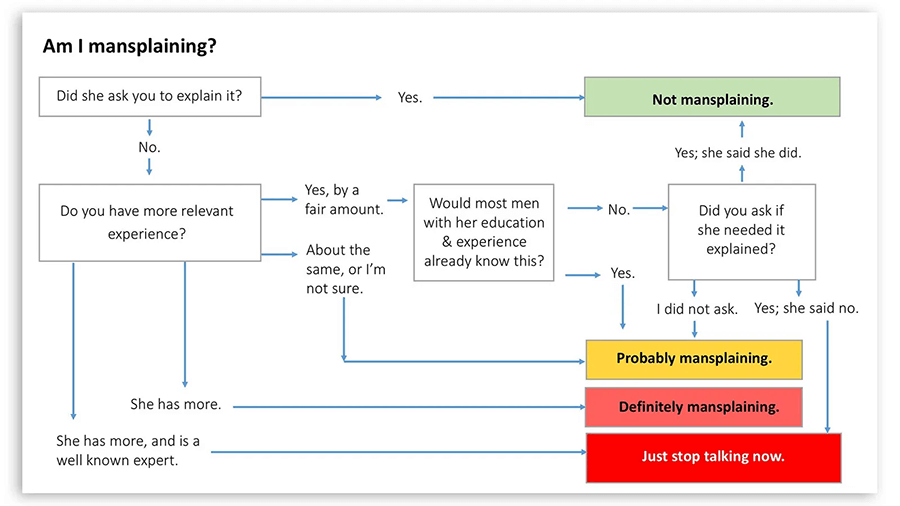
Author, designer and consultant Kim Goodwin says that she was asked by several colleagues how they would know if they were mansplaining. She explains that they were experts in their field, but concerned not to appear patronising. She created a “helpful chart”, which she published on Twitter (see figure).
Credit: Kim Goodwin
Goodwin later explained in an article on the BBC website that she believed that mansplaining could be identified using three factors:
-
Does your audience want your explanation?
If someone has asked you a question, it is entirely reasonable to answer it. It is also reasonable to explain things to someone you manage or teach. However, if they tell you that they don’t want your explanation, and you continue to provide it, that is, in Goodwin’s words, “almost always disrespectful”. It is always wise to check and seek consent before embarking on an explanation.
-
Are you making unjustified assumptions about their (and your) competence?
Do you actually know anything about their level of expertise, or are you just assuming that they know less than you? It is always worth checking that, because you actually make yourself look incompetent when you try to patronise someone who is more expert than you. It is also worth considering whether you are really as expert as you think.
-
Is bias affecting your answer to either of those questions?
We are all exposed to various gender-based biases from the time that we are very young. Certain communication behaviours are more likely to be expected of men than women (and vice versa). It is worth surfacing and considering your own norms and biases around gender roles and expectations.
There is more about how to do this in our page on Understanding and Addressing Unconscious Bias.
Managing and Avoiding Mansplaining
How can we manage and avoid mansplaining in ourselves and others?
In the first place, Goodwin’s chart—or a mental approach going through similar steps around audience consent and knowledge—should help people to identify unhelpful behaviours in themselves.
What, though, if you are confronted by mansplaining in action?
There are two main options for dealing with it in a mature and adult way:
You can roll your eyes, ignore it, and move away; or
You can explain your expertise in the subject, and then try to engage on more equal terms.
The first may be the easiest in the moment. It avoids having to confront these behaviours, or engage any further with the person using them.
However, the second is probably a more helpful way to ensuring that this behaviour is challenged and made less acceptable. It may also be helpful to challenge mansplaining when you see it aimed at other people, by explaining their expertise in the topic.
A Final Thought
As this page makes clear, mansplaining is always unhelpful behaviour.
It prevents the clear flow of communication in both directions, and also hampers our ability to learn from each other. It would be ideal if nobody used this behaviour. Kim Goodwin probably puts it best.
I think it is fair to ask: if men also find mansplaining counterproductive, why, exactly, should any of us accept it as the norm?
Kim Goodwin, author and designer