

Deception and Lying
See also: The Ladder of InferenceAs our page on Truthfulness makes clear, truth matters—both to individuals and to society as a whole. We value truthfulness, because we recognise that if it were not a foundational principle of interpersonal interactions, society would break down.
However, we also recognise that not everyone always wishes to tell the truth. For example, if everyone always told the truth, there would be no need for witnesses to swear in court that they will tell “the truth, the whole truth and nothing but the truth”. We would also not have consumer protection laws that set out rules about how items must be described when being sold.
It is, therefore, important for us as individuals to understand what we mean by deception and lying—two closely related but not quite identical concepts—and to have some idea of when someone may be trying to deceive us. This page explains more about why people lie and seek to deceive others, and sets out some of the signs that this is happening.
What is Deception?
What do we mean by deception? Is it the same as lying or are there distinctions between them?
Lying is relatively easy to define. You can find definitions in all major dictionaries, and various academics have also made attempts to define the concept clearly (see box).
Definitions of lying
lie, v. tr. to make an untrue statement with intent to deceive
Merriam-Webster’s Dictionary
“A lie is a statement made by one who does not believe it with the intention that someone else shall be led to believe it.”
Isenberg, A., 1973. ‘Deontology and the Ethics of Lying,’ in Aesthetics and Theory of Criticism: Selected Essays of Arnold Isenberg, Chicago: University of Chicago Press, 1973. 245–264.
“An act in which someone makes a deliberate choice to mislead another person(s) without giving prior notification of that intention.”
Dr Paul Ekman, expert on deception, at paulekman.com
There are, therefore, several elements to lying.
You have to make a false statement.
You must do this deliberately.
You must also intend that the listener will believe your statement to be true.
All three of these elements must be in place for you to be lying.
If you believe in your own false statement, it is not lying. If you tell someone that you are going to tell them a story that you have made up, that is also not lying—even though you are telling them something untrue.
What about deception?
The definition of that seems to be wider than ‘mere’ lying. It includes the making of false statements, but also encompasses the withholding of information (see box).
Deception in psychology
deception, n. any distortion of or withholding of fact with the purpose of misleading others. For example, a researcher who has not disclosed the true purpose of an experiment to a participant has engaged in deception.
Source: American Psychological Association Dictionary of Psychology
In other words, all lies are a form of deception. However, deception can take other forms.
Forms of Deception/Lies
Paul Ekman explicitly defines two main types of deception: falsifying and concealing.
Using the definitions above, concealing would seem to be deception, and only falsifying is lying. Indeed, Ekman notes that many people do not consider concealing information to be lying. Concealing information is also generally viewed as less ‘serious’ than actually providing false information.
Ekman also identifies several other forms of lying:
-
Misdirection is when you acknowledge an emotion, but provide false information about the reason for that emotion.
For example, you might be accused of lying about something if you got angry when asked about it. You might then admit to being angry. However, you might then say that you were angry because you were outraged that your integrity had been called into question, rather than because you were caught out in a lie.
-
Telling the truth falsely is when you tell the truth, but in such a way that it sounds like a lie.
For example, you might use a sarcastic tone of voice, or make your response sound like a joke. This is designed to mislead the other person into thinking that your answer is not true even though it is.
-
Half-concealment is when you provide part of the truth, but not the whole story.
For example, you might only provide the good part of the story, and not the negative aspects. For example, if asked whether your house is clean, you might say “You should see the kitchen! It’s absolutely sparkling.” Notice that you have not said anything about the rest of the house...
-
Incorrect inference is when you tell the truth, but in a way that implies the opposite of what you say.
Examples include saying that you have “never tasted anything like that before” when asked if you liked your meal. This implies a positive reaction—but actually you might mean the complete opposite.
There are three types of lies: lies, damned lies, and statistics.
Phrase used by Mark Twain, which he incorrectly attributed to Benjamin Disraeli. The actual source is unknown.
There are therefore many different ways to lie. However, there are also many ways to provide false information but not lie.
Providing False Information
What would count as providing false information, but not lying? Paul Ekman suggests that there are several types of non-lie of this nature. They include:
-
A memory failure
This is when you have forgotten something, so your information is incorrect, but you believe it to be true. This form of non-lie is complicated by the fact that liars will often claim to have ‘forgotten’ when challenged about their lies.
-
Making a false statement
If someone makes a false statement—that is, says something that is not true—but with no intent to deceive, it is not a lie. Someone may make a false statement because they believe it to be true. They may also say something expecting it to be treated as a joke.
-
Misinterpreting events
People may misinterpret events, and particularly the motivations that underlie them (and our page on the Ladder of Inference explains more about this). This may lead to them providing incorrect information, but in the belief that it is true. It is certainly true that people’s views of the same event may be widely different.
…some recollections may vary…
Statement issued on behalf of Her Majesty Queen Elizabeth II in 2021, in response to public claims by the Duke and Duchess of Sussex that they had been mistreated.
-
Believing the lie
If a lie is repeated often enough, someone may come to believe it is actually true. They may even retain no recollection of having made up the information.
Why Do We Lie?
We know that truth is very important, both to us as individuals, and to society as a whole. Why, then, do any of us lie?
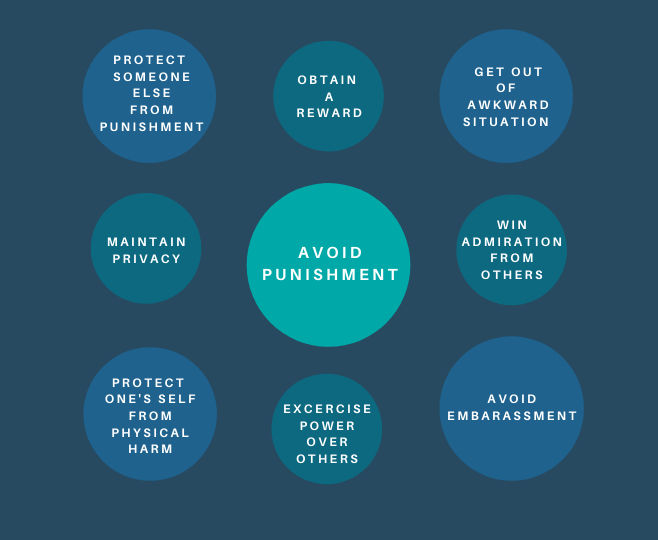
The answer is that there are many possible reasons. The majority of them are about protecting ourselves or someone else from some perceived harm, such as embarrassment or punishment. We may also lie as a form of power, or to make ourselves look better in the eyes of others. Finally, we may lie to obtain a reward.
Source: paulekman.com
There are, therefore, both good and bad reasons for lying. Protecting someone else might seem like a ‘good’ reason for lying—but any lie may have unforeseen consequences. The question of whether lying is ever ‘good’ is therefore a difficult one in moral terms. However, we tend to judge it more lightly when the intention is good.
Detecting Lies and Deception
The next question is whether it is possible to reliably detect lies and deception.
Lie detector tests have been around in one form or another for thousands of years. The ancient Chinese people had a system involving mouthfuls of rice—a bit like the witch-ducking systems in medieval England. In the nineteenth century, people tried to predict someone’s propensity to lie by looking at the shape of their skull or their handwriting. More recently, governments and others have used combinations of technology to detect physiological or neurological changes, coupled with behavioural analysis.
However, the answer is still that it is not always possible to know when someone is lying.
Some people are really good at lying. They practise hard, and they do it often. Over time, they get better at it—just as you will with any activity. They also know how to behave to avoid giving away their deception.
Oh, what a tangled web we weave, when first we practise to deceive!
But when we’ve practised just a bit, we find we’re very good at it.
Play on Walter Scott’s lines in Marmion (1808), suggesting that deception gets easier with practice.
There are also times when you don’t necessarily want to know the truth. For example, some people simply do not wish to know if their partner is cheating on them. They would rather close their eyes to the clues, and remain in the relationship.
However, it is also important to understand that there are often clues that someone is lying.
These are usually related to people trying to hide an emotion. Our page on Non-Verbal Communication explains that body language, facial expression, tone of voice and other non-verbal communication often serves to provide important information about our emotions.
It is very hard to alter these to either reflect emotions that you are not feeling, or not to reflect strong emotions.
The stronger the emotion, the harder it is to hide it.
However, there is also no single ‘tell’ that will give people away. It is not, for example, a matter of whether someone can meet your eyes or not. Generally speaking, you can often tell when someone is uncomfortable—and sometimes that might mean that they are lying. Sometimes, though, it might just mean that they are uncomfortable for some other reason.
It is more likely that someone is lying (or trying to deceive you) if:
Their non-verbal communication does not match their words. You may not even notice this consciously, but might just be uncomfortable with the interaction. If this happens, it is a good idea to trust the non-verbal communication rather than the words.
They are behaving in uncharacteristic ways. For example, if someone who is normally very chatty suddenly goes quiet, or avoids discussing something, that might indicate a wish to conceal information.
They show a brief flash of unexpected facial expression. This is a form of mismatch between verbal and non-verbal communication called a ‘micro-expression’, and is often a giveaway. The micro-expression shows how they really feel, but is usually quickly concealed in someone who is lying. Blink and you might easily miss it.
Their facial expression doesn’t quite match their expressed emotions. It is relatively easy to falsify facial expressions—but only to some extent. Research has shown that faked emotional facial expressions are often asymmetrical, unlike genuine expressions of emotion, which are usually bilateral. Some faked expressions also have particular characteristics. For example, we all know about smiles that don’t seem to reach the eyes—but most of us can also put on a good fake smile, especially in front of people we don’t know very well.
It’s a combination thing!
It is unlikely that you will catch someone out in a lie using just one of these factors. Indeed, if only one of these factors is in place, they may not even be lying. The key to detecting lying is that there is often what psychologists call ‘emotional leakage’ across several elements. Put them together, and the picture may start to become clear—but there are still no guarantees.
A Final Thought
There are probably very few people who can claim never to have lied or tried to deceive anyone in any way.
It is possible that deception is as human as the drive towards truthfulness—and perhaps that is why we place such a high value on truth.