

The Art of Learning What You Don't Know: Cognitive Awareness and Lifelong Growth
See also: Personal DevelopmentThe biggest obstacle to learning is not always a lack of knowledge. Sometimes, it is the belief that we already understand enough.
People develop mental shortcuts through education, work, and everyday experience. These shortcuts make familiar tasks easier, but they can also prevent us from recognizing when an old approach no longer works. A professional may struggle to learn new technology because previous methods have served them well. A student may repeatedly use the same revision technique without questioning whether it helps them understand the material.
Lifelong learning therefore requires more than collecting information. It requires the ability to observe how we think, recognize the limits of our understanding, and remain willing to change our minds.
This ability can be described as cognitive self-awareness: understanding not only what we know, but also how we approach problems, respond to mistakes, and absorb unfamiliar ideas.
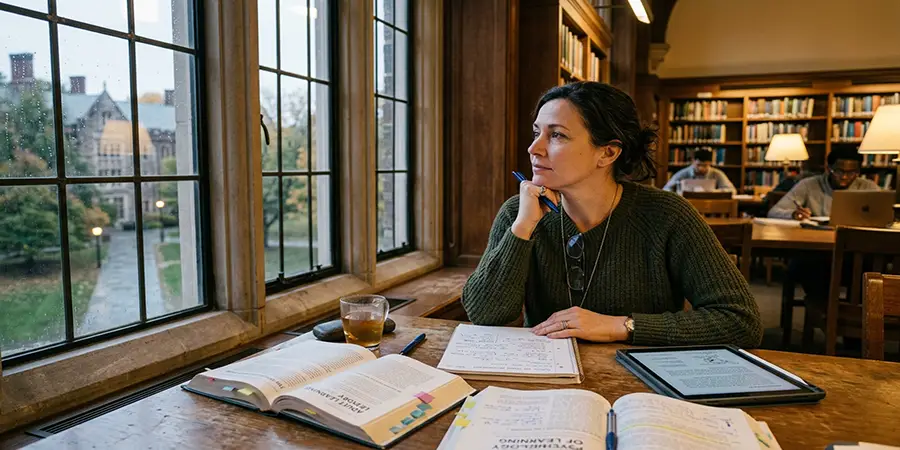
Learning Begins When Familiar Methods Stop Working
Many learning difficulties arise from a mismatch between a familiar strategy and a new challenge.
Memorization may work for vocabulary but prove insufficient for understanding a complicated argument. Repeated practice may improve a familiar procedure while doing little to develop the flexibility needed for an unfamiliar problem.
Effective learners recognize that different challenges require different approaches.
The Difference Between Effort and Useful Effort
Spending more time on a task does not automatically produce deeper understanding. A person can reread the same chapter several times while remaining unable to explain its central argument.
A more productive approach is to examine the relationship between effort and results.
For example, after studying a difficult subject, ask:
- Can I explain the idea without looking at my notes?
- Can I apply it to a situation I have not encountered before?
- Can I identify where my understanding becomes uncertain?
- Can I explain why an incorrect answer seemed convincing?
These questions shift attention from the appearance of studying to evidence of actual learning. They also help identify whether the next step should be more practice, a different explanation, or a return to the underlying concepts.
Cognitive Flexibility: The Skill of Changing Your Mind
Learning often requires abandoning an explanation that once seemed correct. This can be uncomfortable because people naturally become attached to familiar beliefs and successful routines.
Cognitive flexibility is the ability to consider alternatives and adjust one's approach when new information warrants it.
It does not mean accepting every new idea or constantly changing opinions. Rather, it means being willing to examine evidence without treating previous conclusions as permanent.
A Practical Exercise in Intellectual Flexibility
When you encounter an unfamiliar concept, try the following process:
- Write down your initial explanation.
- Identify the assumptions behind it.
- Find a credible alternative explanation.
- Compare the evidence supporting each interpretation.
- Revise your original view where necessary.
This exercise is useful because it makes learning visible. Instead of measuring progress only by how much information you can recall, you begin to notice how your understanding changes.
Over time, the ability to revise an idea can become as important as the ability to develop one in the first place.
What Cognitive Self-Assessment Can Contribute
People differ in how they approach reasoning, problem-solving, and unfamiliar tasks. Reflecting on these differences can help learners become more deliberate about their development.
Online IQ testing is one way to explore certain aspects of cognitive ability. Its potential place in a learning routine is best understood as a starting point for curiosity rather than a definitive judgment of someone's intellectual potential.
An IQ score does not measure every quality associated with effective learning. It cannot fully capture creativity, motivation, persistence, practical expertise, emotional awareness, or the ability to collaborate. Nor does a single result determine how much a person can learn in the future.
The more useful question is what someone does with the information they receive.
From a Result to a Reflection
A cognitive assessment can prompt questions about personal strengths, expectations, and approaches to problem-solving. Those questions become more meaningful when combined with observations from everyday learning.
For instance, someone might enjoy structured reasoning tasks but find open-ended projects difficult. Another learner may generate ideas easily yet struggle to organize them into a coherent explanation.
These observations should not be treated as fixed labels. Instead, they can guide experimentation with different learning methods.
Readers interested in personal experiences involving online IQ testing can explore this MyIQ Reddit discussion. An individual post offers a personal perspective, not scientific proof of what an IQ score means or how effectively someone can learn.
Why Mistakes Are More Useful When They Are Analyzed
Mistakes become valuable learning experiences only when people investigate what caused them.
Simply repeating an incorrect answer may reinforce the same misunderstanding. By contrast, examining the reasoning behind an error can reveal a missing concept, a faulty assumption, or a strategy that needs adjustment.
The Three-Part Mistake Review
After a difficult task, write down three things:
| Reflection | Question to ask |
| What happened? | Which answer, action, or assumption was incorrect? |
| Why did it happen? | What information or reasoning did I overlook? |
| What changes next time? | Which specific strategy will I test? |
The final question is essential. Reflection should lead to an experiment, not simply an explanation of past failure.
This approach also encourages intellectual humility. Admitting that a method did not work is not evidence of an inability to learn; it is information that can guide the next attempt.
Build a Personal Learning Laboratory
Lifelong learners benefit from treating new methods as experiments rather than universal solutions.
For one week, try retrieving information from memory instead of repeatedly rereading it. For another, explain a difficult concept in simple language. When learning a practical skill, alternate between studying examples and attempting the task independently.
Track what changes. Did you remember more after several days? Could you apply the concept in a new context? Did a different explanation make a confusing idea clearer?
The goal is to discover which strategies work for particular tasks and circumstances.
A simple learning journal can help. Record the skill you practiced, the method you used, the difficulty you encountered, and the result. Over time, this creates a record of how your learning process evolves.
Final Thoughts: Staying Open to Learning Throughout Life
The most effective learners are not necessarily those who find every subject easy. They are the people who can recognize uncertainty, respond constructively to feedback, and adjust their methods when circumstances change.
Cognitive self-assessment tools may encourage curiosity about reasoning abilities, but meaningful development depends on what follows: deliberate practice, thoughtful reflection, and a willingness to challenge familiar assumptions.
The deeper lesson is that learning is not simply the accumulation of correct answers. It is the gradual improvement of the process used to find them.
When people become curious about how they think, mistakes become more informative, unfamiliar experiences become less threatening, and changing one's mind becomes a sign of progress rather than weakness.
That is the foundation of lifelong learning: not knowing everything, but remaining willing to discover what you have yet to understand.