


The Skills You Need for a
C-Level Position in any Industry
See also: Self-Motivation Skills
No matter the specific industry, ambitious professionals often share a singular, defining objective: ascending to the highest echelons of corporate leadership. Securing a position within the C-suite—as a Chief Executive Officer, Chief Operations Officer, or Chief Financial Officer—represents the absolute pinnacle of corporate achievement.
However, transitioning from a highly effective senior manager to a visionary, capable executive requires a profound, deliberate shift in both mindset and operational capability.
Maintaining a dedicated focus on cultivating the specific competencies required to thrive in an executive boardroom is essential to making your hard work pay off. Understanding what these executive capabilities are, and how they directly correlate to sustained organizational success, is the critical first step on your journey to the top. Fortunately, the fundamental skills required for high-level governance are well documented. For those seeking to join the ranks of elite industry leaders, the following competencies are absolutely non-negotiable.

Strategic Leadership and Visionary Guidance
In any commercial enterprise, strong Leadership Skills are unequivocally one of the most prized assets an individual can possess. At the C-level, however, foundational management is no longer sufficient; executive leadership requires visionary strategic guidance. C-suite executives are explicitly charged with defining the overarching, long-term strategic goals of the entire business.
This means shifting your daily focus from immediate operational tactics to long-term enterprise sustainability. True executive leadership is about creating a shared organizational vision and successfully inspiring managers, stakeholders, and frontline employees to execute that vision with precision. You must empower your workforce to achieve more than they previously thought possible, actively fostering a resilient, positive corporate culture. At the executive level, knowing where the company needs to go is only a small part of the equation; knowing exactly how to get thousands of other people to eagerly follow you there is the true test of a leader.
Advanced Interpersonal and Communication Skills
Anyone taking on a C-level position operates at the absolute apex of their organization. Because executives must constantly negotiate, mediate, and collaborate with highly diverse stakeholders—from demanding board members to skeptical labor unions—they must possess a deeply refined set of Interpersonal Skills. Cultivating these critical relationships ensures that cross-departmental alignment is maintained and organizational friction is kept to an absolute minimum.
Furthermore, having exceptionally well-developed Communication Skills is a mandatory prerequisite for C-level success. Executives spend a vast majority of their time distilling complex information, pitching bold ideas to institutional investors, and listening to department heads. Many top-tier leaders now actively study advanced concepts like Neuro-Linguistic Programming to better understand non-verbal cues, micro-expressions, and internal emotional states, allowing for deeper, much more persuasive dialogue.
Proactive Risk Assessment and Mitigation
Becoming a member of a company's C-suite means taking on the ultimate responsibility for guiding the business toward profitability, but it equally involves steering the massive enterprise clear of catastrophic failure. To protect the organization, executives must deeply hone their Risk Management capabilities, allowing them to spot potential trouble long before it manifests on the balance sheet.
Proactive risk assessment requires looking far beyond immediate quarterly gains to evaluate geopolitical shifts, impending economic downturns, emerging cyber threats, and rapidly changing consumer behaviors. Rather than reacting blindly to crises as they occur, successful C-level executives use rigorous data-driven modeling and scenario planning to build robust corporate contingencies. A leader who can confidently navigate uncertainty, forecast disruption, and safeguard company assets will quickly distinguish themselves as an indispensable boardroom asset.
Expert Change Management
Today's most successful, disruptive businesses are highly agile, forward-thinking, and entirely willing to challenge traditional industry paradigms to create explosive new value. However, pushing for rapid, transformative innovation often directly conflicts with the traditional corporate desire for stability and predictable operational outcomes. To successfully bridge this divide, executives must provide exceptionally competent Change Management.
Leading a large-scale corporate transformation requires a highly structured, multi-faceted approach. You must be able to define the exact scope of the desired change, present a clear, data-backed business case to skeptical stakeholders, and draft a meticulous execution plan. Furthermore, you must continually gather performance data mid-stream and courageously adapt your processes in response to real-world resistance. Gaining this specific experience by volunteering to lead high-stakes, cross-functional projects in your current role is a vital stepping stone to the C-suite.
Decisive Problem Solving and Critical Thinking
In the executive suite, the problems presented to you will rarely have obvious, painless, or straightforward solutions. If a corporate challenge could have been solved easily, it would have been handled by middle management before ever reaching your desk. Therefore, possessing elite Problem Solving Skills is an absolute necessity for anyone holding a prestigious C-level title.
Executive problem solving goes far beyond applying standard, textbook operational procedures. It demands deep critical thinking, the rare ability to synthesize vast amounts of disparate commercial information, and the raw courage to make highly consequential business decisions with imperfect or incomplete data. C-suite leaders must be able to separate the signal from the noise, identifying the deep root cause of an organizational crisis rather than merely treating its surface symptoms. A highly decisive executive instills profound confidence in shareholders and employees alike, visibly demonstrating that the company is guided by a steady, analytical hand.
Continuous Learning and Cognitive Agility
If there is any single competency universally common to every highly successful C-level executive, it is an insatiable appetite for knowledge and the ability to rapidly acquire new capabilities. The modern business landscape evolves at a blistering, unforgiving pace, and relying strictly on the technical expertise that earned you your early promotions will inevitably lead to severe professional stagnation.
Maintaining an open, highly adaptable mindset is crucial. You must actively seek out dissenting opinions, rigorously analyze competing methodologies, and familiarize yourself with emerging, disruptive technologies. Lifelong learning is not a corporate buzzword; it is a vital, mandatory survival mechanism for the modern executive. Even the most accomplished, globally recognized CEOs understand that their business education never truly ends. Staying intellectually curious ensures that your strategic vision remains incredibly sharp and highly relevant.
Further Reading from Skills You Need
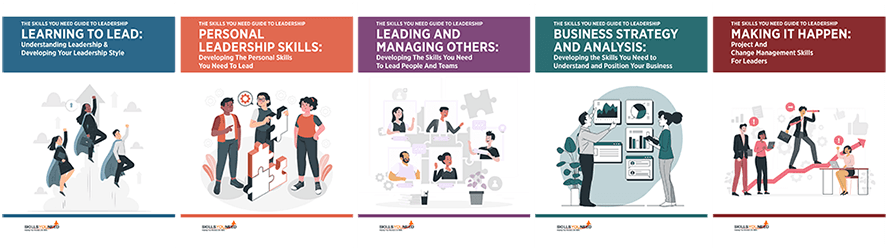
The Skills You Need Guide to Leadership eBooks
Learn more about the skills you need to be an effective leader.
Our eBooks are ideal for new and experienced leaders and are full of easy-to-follow practical information to help you to develop your leadership skills.
Conclusion
The competencies required to break into the C-suite cover a diverse, highly complex range of disciplines. From leading large-scale human transformations and communicating persuasive corporate visions, to mitigating severe enterprise risks and committing to lifelong cognitive growth, the modern executive must be a deeply well-rounded professional.
While profound technical mastery within your specific industry remains the essential baseline, it is these overarching leadership, communication, and strategic capabilities that truly separate middle management from the executive suite. By proactively dedicating yourself to cultivating these specific, high-level skills, you can effectively map your trajectory toward the absolute pinnacle of your organization.
About the Author
Philip Piletic is an executive leadership coach and corporate strategy consultant specializing in C-suite transitions and elite organizational development.
With a rich background in advising senior leaders across the technology and finance sectors, Philip helps ambitious professionals refine their strategic acumen, master complex change management, and cultivate the high-level interpersonal skills strictly required for executive success.