


Marketing Skills
See also: Content MarketingThere are a wide range of skills that are needed to become a good marketer. Like any other role, it is possible to argue that almost any skill is essential, but there are some that are clearly more important than others.
This page explains more about marketing, including what it is, and the core skills that are required in a modern marketing role.
It is important to think about your skills because marketing has changed significantly over the last few years.
Marketing used to be an almost entirely creative role, partly because there was very little hard information about customers or the direct effect of marketing campaigns. Now, however, with much marketing, research, and buying activity happening online, there is an increasingly large amount of data available about customers. Marketing activity can be tied much more readily to revenue, and marketing has become a much more scientific and analytical endeavour.
What is Marketing?
Marketing is the management process for identifying, anticipating and satisfying customer requirements profitably.
The Chartered Institute of Marketing (CIM)
In other words, marketing, at its simplest, is the set of business activities that involve being able to sell products or services to customers at a profit.
Marketing is, however, far more than just advertising or selling. The mention of ‘customer requirements’ is crucial: marketing is about understanding exactly what customers want, and supplying it.
Skills Marketers Need
To be highly effective at their jobs, therefore, modern marketers need to be able to:
-
Understand their customers
Customers are at the core of marketing. You cannot sell anything to anyone unless they want or need it. If marketing is about satisfying customer needs, then first you must understand those needs. This means being able to identify customers’ problems, sometimes before they do, and find a way of addressing those needs and problems through the products and services that you provide.
This requires use of two skill areas: communication skills and analytical skills.
Communication skills are essential for listening to customers, sales staff, and others who know your customers personally. It is important to hear what people do not say, as well as what they do: sometimes business problems may be hard to acknowledge.
Analytical skills may be required for both quantitative and qualitative information (that is, information that involves numbers, and more text-based or image-based information). These skills will enable you to dig deeper into the information available, and generate insights from it that will help you to market more effectively.
You may, for example, have numerical data about how much your customers spend, and where, and will need to do some simple statistical analysis to work out which customers are most profitable, so that you can focus your resources on those individuals.
It can be helpful to separate or segment your customers into different groups, with different needs. This enables you to target your marketing much more specifically. Techniques used for this include customer segmentation and the creation of buyer personas.
-
Know their market
Marketers also need to know exactly what is happening in the wider market. This means knowing what other companies are offering, what suppliers are doing, and what complementary products exist. They must become subject matter experts on their market.
One way to understand the market is to use a strategic analysis technique like Porter’s Five Forces or the 7 Ps of Marketing. This provides a structural way of examining the market, ensuring that you have considered every aspect of the situation.
You may find our page on Market Research and Competitive Intelligence helpful in developing your skills in this area.
Good general commercial awareness is also essential for marketers. They need to understand the context in which the business is operating and the wider economic world. They also need to know about future and forthcoming regulatory changes, and how these might affect the business. Finally, they need to understand and be able to demonstrate how what they do contributes to the bottom line.
There is more about this in our page on Commercial Awareness.
-
Think creatively to identify new approaches
Marketing may be increasingly data-driven, but that does not mean that there is no place for creativity. Marketers must be good creative thinkers, able to use their skills in generating ideas to find new ways to reach out to customers and create customer experiences that are more memorable (for the right reasons).
You may also find our page on Innovation Skills helpful, since innovation is the process of putting creative ideas into practice.
-
Communicate effectively in writing and orally
Good marketers are very effective communicators, in writing, in face-to-face meetings, and in presentations. They are able to get their point across simply and succinctly, often in a new way that will grab their audience's attention.
The power of stories
Marketers are often skilled at using stories to make a point.
We are hard-wired to like stories. Our ancestors used them to remember important messages, and the consequence is that a story is often easier to remember than a simple statement of fact.
Developing the ability to use stories effectively is a strong tool in any marketer’s armoury, not least because it creates a more memorable experience for customers.
Content marketing is an online marketing activity that uses text as a way to provide general and useful information to customers. The idea is that customers doing their research for products or services, or simply in the hope of resolving a problem, will come across the article. They will recognise the author as a subject matter expert, and look for more information from them, eventually (hopefully) making contact with the company when they wish to buy.
This type of marketing is increasingly used in both business-to-business and consumer contexts, meaning that the ability to write compelling copy is highly prized among modern marketers.
Being able to communicate is only half the battle, however.
Marketers also need to understand why they are communicating, and use their communication skills to influence and persuade clients and customers.
Persuading someone is partly a matter of good communicating, but it is also about communicating effectively. Nagging, for example, may persuade someone to do something, but probably not very willingly. If you turn your back, you may find that they have wandered off, leaving the task half done. It is more effective to persuade them to want what you want, and this is essential in marketing.
There is more about this in our pages on Persuasion and Influencing and Developing Your Persuasion Skills.
-
Understand and use digital tools and AI
Today’s marketers must be confident using digital technology and Artificial Intelligence (AI). It is no longer enough to simply come up with a brilliant creative concept; you must also know how to put it into practice digitally and measure its success, including calculating its exact Return on Investment (ROI).
This involves understanding how search engines work, navigating customer relationship management (CRM) software, and making sense of data from digital dashboards. Furthermore, basic 'AI literacy' is now a core skill. A strong digital marketer can use AI tools to help generate ideas quickly, test different approaches, streamline their daily tasks, and analyse data to forecast customer behaviour.
-
Be adaptable and agile
The marketing landscape changes rapidly. Consumer trends shift, new social media platforms emerge, and global economic changes can make a carefully planned strategy obsolete almost overnight.
Marketers therefore need the flexibility to embrace an 'agile' approach to their work. This means being able to test new ideas quickly, measure their immediate impact, and change direction seamlessly if a strategy is not working. Highly adaptable marketers view sudden changes in the market not as crises, but as unique opportunities to reach new customers.
The Human Edge in the Age of AI
As Artificial Intelligence increasingly automates the technical execution of marketing—such as generating generic ad copy, scheduling posts, and organising data—the baseline for content has been commoditised.
Because AI cannot truly feel a customer's pain points or innovate entirely new cultural approaches, human-centric soft skills have become a marketer's ultimate competitive advantage. Empathy, authentic storytelling, and strategic creativity are now the most highly prized assets you can possess.
Further Reading from Skills You Need
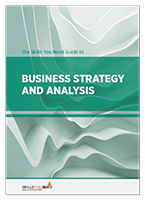
The Skills You Need Guide to Business Strategy and Analysis
Based on our popular management and analysis content the Skills You Need Guide to Business Strategy and Analysis is a straightforward and practical guide to business analysis.
This eBook is designed to give you the skills to help you understand your business, your market and your competitors.
It will help you understand why business analysis is important for strategy—and then enable you to use analytical tools effectively to position your business.
Conclusion
Good marketers possess a highly diverse blend of hard and soft skills, seamlessly combining creative storytelling with rigorous data analysis.
Perhaps most importantly, though, the best marketers understand that they must commit to lifelong learning. The digital landscape and consumer behaviors will constantly evolve, meaning there will always be new ways to connect with audiences, new platforms to master, and new skills to develop.