

Personal Organisation: How to Build Systems You'll Actually Keep
See also: Organising SkillsMost of us only notice how organised we are when something goes wrong. A deadline creeps up unnoticed, a form needs a document you can't find, or a manager asks for a record you were sure you'd saved. Then the search begins, through inboxes, drawers and half-remembered folders.
Being organised isn't really about tidiness. It's about being ready. And readiness comes from a handful of skills you can learn and practise: planning, prioritising, paying attention to detail and building habits that keep a system running long after the initial burst of motivation fades.
This article looks at how to develop those skills, using a familiar example, keeping track of your qualifications, to show the principles in action. The same approach works for almost any area of life or work.
Key Takeaways
Decide what genuinely needs keeping or tracking before you start organising it.
Build one simple, repeatable system rather than a different method for every task.
Turn the system into routines tied to things you already do.
Review your systems regularly, and adjust them when your needs change.
Practise with small exercises so the skills transfer to bigger responsibilities.
What Personal Organisation Really Involves
Good organising skills draw on several abilities at once. Planning helps you decide what a system needs to do. Prioritising tells you where to start and what to ignore. Attention to detail means the information you store is accurate and complete. Habit formation keeps everything working over time.
These skills are transferable. The person who keeps tidy project records at work usually relies on the same habits as someone who always knows where their passport is. The context changes, but the underlying process stays the same.
Step 1: Decide What Actually Needs Keeping
Organising starts with judgement, not storage. Before you build any system, ask what you really need to keep, track or act on.
A useful approach is to sort items into three groups:
- Keep: things you may need to prove, refer to or reuse, such as contracts, qualifications or key project decisions.
- Act: things with a deadline or next step, such as a renewal, an invoice or a follow-up email.
- Let go: duplicates, outdated drafts and anything you'll never need again.
This simple sort prevents a common trap: carefully organising things that should have been thrown away. It also highlights the items that carry real consequences if they go missing.
Step 2: Design One Simple, Repeatable System
The best systems are simple enough to use without thinking. If filing something takes effort, you'll put it off, and the system will quietly fall apart.
Group Things the Same Way Everywhere
Choose one way of grouping information and apply it consistently, whether you're dealing with paper, computer folders or email. Grouping by type, then by date, works for many people. Using the same structure everywhere means you can find anything in seconds, because you always know where to look.
Keep a Short Index
An index is a single list of what you hold and where it lives. It can be one page or a small spreadsheet. For each item, note what it is, where the original sits, what the digital copy is called and any date that matters, such as a renewal. An index turns a vague sense of "it's somewhere" into a quick, confident answer.
A Worked Example: Your Qualifications
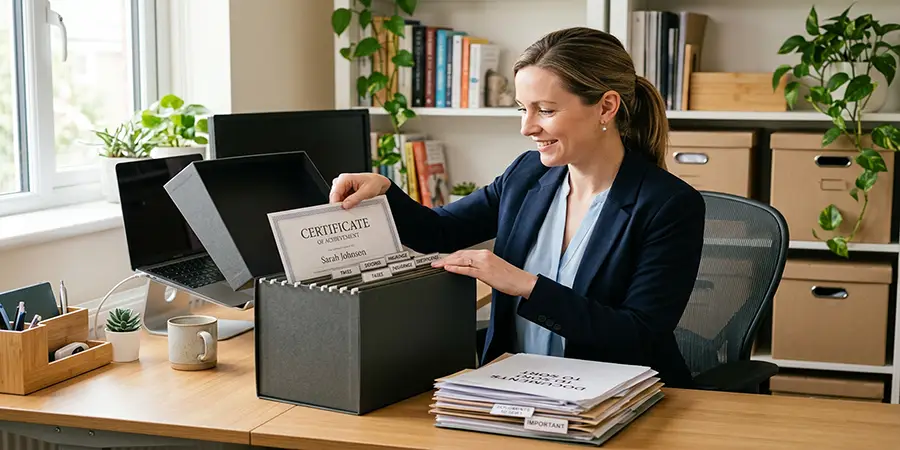
Certificates show how these principles fit together. Gather every diploma, degree and training certificate in one place, check that names and dates are correct, and note anything missing. If an original is lost, the issuing school, university or exam board can tell you what replacement evidence it provides.
Group the certificates by type, such as school, higher education and professional training, and add each one to your index. Store paper originals flat and dry, scan them, and keep the scans in two separate places.
Some certificates are also worth presenting, at a graduation, an interview or on an office wall. That's a separate need from long-term storage. A diploma case from Honor U, for example, is an empty tent-style cover that holds a certificate you already have, so measure the paper itself rather than an old cover. Recognising that display and storage are different jobs is itself an organising skill: each item gets the right home for its purpose.
Step 3: Build Routines That Run Themselves
A system only works if you keep using it. That's where habits come in.
Link New Habits to Existing Ones
Habits stick more easily when they're attached to something you already do. File new documents on the same day you check your post. Update your task list each time you close your laptop for the evening. The existing routine acts as a reminder, so you don't have to rely on willpower.
Deal With Things on Arrival
The longer an item sits in a pile, the more effort it takes to sort. A simple rule, such as filing anything new within the same week, stops backlogs from forming. For a certificate, that means scanning it, storing the original and updating your index straight away.
Make the System Visible
Keep your index, calendar or task list somewhere you'll see it often. Visibility turns maintenance into a natural part of your day rather than a chore you have to remember.
Step 4: Review and Adjust Regularly
Even good systems drift. Folders fill up, categories stop making sense and priorities change.
Pick a fixed point for a review, such as the start of the year or your birthday. Check that your files still open, your categories still fit and any renewal dates are current. Ask yourself what you struggled to find in the past year, then adjust the system so it doesn't happen again.
Reviewing is also a chance to reflect on your own habits. Notice which routines you kept and which slipped, and simplify the ones you keep avoiding.
Applying the Same Principles Elsewhere
Once you've built one reliable system, you can reuse the method almost anywhere:
- Household admin: keep bills, warranties and insurance documents in one consistent structure, with renewal dates in a single calendar.
- Project records: store decisions, versions and key emails in one agreed place, so anyone can find the latest information.
- Deadlines: list every deadline in one location and review it weekly, rather than relying on memory or scattered reminders.
- Professional development: record each course or training session as you complete it, with a note of what you learned and where the evidence is saved.
The details differ, but the pattern stays the same: decide what matters, organise it simply, maintain it with routines and review it regularly.
Exercises to Practise Your Organising Skills
Skills improve with practice. Try one of these each week:
The ten-minute audit. Choose one drawer, folder or inbox. Sort everything into keep, act or let go, and see how much you can clear.
Write your index. List the ten documents you'd least like to lose, and note where each one is right now. Any gaps show you where to start.
Design a habit trigger. Pick one task you often forget and link it to something you do every day. Track how many days in a row you keep it up.
Run a mini review. At the end of the week, note one thing you couldn't find quickly and one small change that would have helped.
Conclusion
Personal organisation isn't a personality trait you either have or don't. It's a set of skills you can build: deciding what matters, creating simple systems, turning them into routines and reviewing them over time.
Start with something small and familiar, like your certificates, then apply the same method to your work, your household and your learning. Each system you build makes the next one easier.
Frequently Asked Questions
What are the most important personal organisation skills?
Planning, prioritising, attention to detail and habit formation. Together, they help you decide what to manage, set up a system and keep it running.
How can I stay organised when I'm busy?
Keep your systems simple, deal with new items as they arrive and link maintenance tasks to routines you already follow.
How often should I review my systems?
A thorough review once a year works for most personal records, with a quick weekly check for deadlines and active projects.
Can organising skills be learned?
Yes. Like any skill, organisation improves with practice. Small, regular exercises build habits that transfer to bigger responsibilities.
About the Author
Vlad Orlov is a passionate writer and link builder. Having started writing articles at the age of 13, their once past-time hobby developed into a central piece of their professional life.