


Cybersecurity Dangers in Academia:
Ways Students Can Suffer
See also: Protecting Yourself in the Digital World
When it comes to cybersecurity and hacker attacks, the focus often lands squarely on corporate data breaches or financial institutions. However, an increasingly targeted demographic is the modern student population. Today's students live and study in a fully digital environment, relying heavily on connected devices, cloud storage, institutional databases, and student portals.
This heavy reliance on digital infrastructure makes academia a prime hunting ground for cybercriminals. Students handle their finances, store years of academic work, and manage their personal identities entirely online. If a malicious actor compromises these systems, the fallout can devastate a student's academic standing, financial stability, and future career prospects.
To help you understand the risks and how to protect yourself, we have outlined the most common ways students suffer from cyberattacks and the actionable steps you can take to secure your digital life. Security is no longer an optional extra; it is a fundamental requirement for anyone pursuing higher education.

-
Online Classes Disrupted by Cyberattacks
The shift to remote and hybrid learning introduced unique vulnerabilities into the virtual classroom. An instance of unauthorized access, often referred to as "Zoom bombing," during a critical lecture can cause significant disruptions. If an attacker hijacks a session, you might miss out on vital information necessary for passing an upcoming exam or completing a major assignment. These attacks often involve the broadcasting of offensive material, forcing educators to terminate the session prematurely.
When these disruptions happen repeatedly, they effectively rob you of your educational experience. You lose the opportunity to participate in discussions, ask questions, and engage directly with your peers. Missing essential course material can cascade into poor academic performance, turning a paid tuition into a compromised learning experience that fails to deliver the promised value.
While universities must implement robust server antivirus protection and secure their platforms, students also share the responsibility for endpoint security. You must ensure you are using up-to-date software and secure platforms. For instance, maintaining strong antivirus software on your personal laptop is essential for protecting your connection to the university network and preventing malware from spreading to institutional servers.
-
Assignments Encrypted by Ransomware
Ransomware is a malicious software that locks your files or entire system, demanding a financial payment to restore access. While businesses are frequent targets, students are equally vulnerable to these extortion attempts. Imagine working on a dissertation or a final project for months, only to find the files locked days before the submission deadline with a threatening message demanding cryptocurrency.
If ransomware encrypts your academic work, you are faced with a catastrophic scenario. You might have to start the project from scratch, missing crucial deadlines and potentially failing the module. Not every professor will grant an extension due to a cyberattack on a personal device, as data management and digital hygiene are generally considered the student's responsibility.
To mitigate this risk, you must adopt a rigorous data backup strategy and make backups constantly. Always keep several versions of your files across multiple, disconnected devices. External hard drives and secure cloud-based storage solutions are excellent ways to ensure that even if your primary laptop is compromised, your hard work remains safe and accessible.
-
Personal Data Stolen Through Phishing
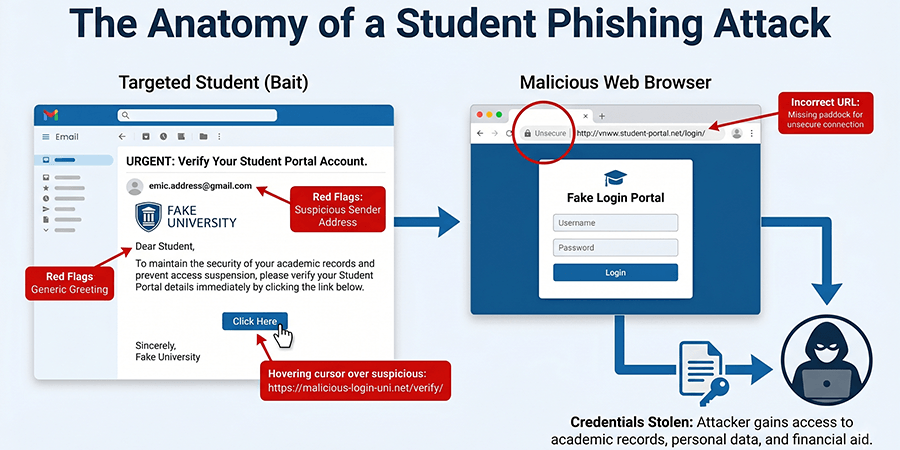
Phishing remains one of the most effective tools in a cybercriminal's arsenal. In an academic setting, this often takes the form of a deceptive email that appears to come from a credible source, such as the university administration, the library, or the IT department. These messages are meticulously designed to trick you into revealing login credentials or financial details by creating a false sense of urgency.
Falling for a phishing scam can result in severe identity theft or financial fraud. Once attackers gain access to your student portal, they can view your grades, intercept financial aid disbursements, or steal highly sensitive personal information. This data can be used to open fraudulent credit card accounts in your name or engage in synthetic identity theft, which merges real and fake information to create a new, untraceable identity.
Protecting yourself requires constant vigilance. Always verify the sender's email address and avoid clicking on suspicious links embedded in emails. If you receive an urgent request to update your password or verify your account, navigate to the university portal manually using your browser rather than clicking the link provided. Additionally, using multi-factor authentication adds an essential layer of security that can stop an attacker even if they have your password.
-
Academic Work Plagiarized Due to Hacked Accounts
Unauthorized access to your personal cloud storage or university accounts exposes your drafts and unpublished research to theft. No author wants their unpolished work leaked, as it often contains rough ideas, incomplete data, or personal notes. However, the greater threat lies in the outright theft of your intellectual property by someone seeking a shortcut to a passing grade.
A compromised account allows another individual to steal your hard work, rework it slightly, and submit it as their own. When the university's plagiarism software inevitably flags the similarities between your genuine submission and the stolen copy, you may find yourself facing severe academic dishonesty charges. Proving that you are the original author can be a long, stressful, and bureaucratic process that puts your academic career on hold.
Securing your accounts with complex, unique passwords is non-negotiable. Enable two-factor authentication on every platform that supports it. By adding this secondary verification step, you drastically reduce the chances of a hacker gaining entry, ensuring that your essays, research papers, and code remain strictly yours.
-
Loss of Critical Research Data
For postgraduate students and researchers, data is the most valuable asset they possess. Hacked cloud backup storage containing years of research, primary source materials, and statistical models represents an irreplaceable loss. Reconstructing this data requires an incredible amount of time and resources, assuming it can be replicated at all without compromising the integrity of the study.
If you rely on primary sources that you have collected yourself through interviews, surveys, or field experiments, the loss is often permanent. This kind of setback will inevitably delay your graduation, postpone the publication of your work, and severely impact your future career trajectory in either academia or the private sector.
The most effective defense against permanent data loss is the 3-2-1 backup rule. Keep three total copies of your data, stored on two different types of media, with at least one copy stored securely off-site. Regularly test your backups to ensure the files are uncorrupted and can be fully restored when an emergency strikes.
-
Social Media Profiles Compromised
University life extends far beyond the lecture hall; it is deeply intertwined with social networking and digital communication. If a malicious actor hijacks your social media profiles, they can post inappropriate, offensive, or embarrassing content under your name. This can alienate your peers, offend your professors, and make you an outcast in your study groups.
A compromised digital footprint can be highly damaging to your personal and even professional reputation. Recruiters and hiring managers routinely screen candidates' social media presence before offering internships or graduate roles. If they find highly problematic content, they will move on to the next candidate, regardless of your academic achievements. Proving that your account was hacked after the damage is done is incredibly difficult and rarely reverses the negative impression.
To protect your online reputation, use the strictest privacy settings available on your social media platforms. Be mindful of the personal information you share publicly, avoid engaging with suspicious third-party apps that request profile access, and regularly audit your digital presence. Treat your online profiles as a public extension of your professional resume.
Conclusion
Your time at university is the perfect opportunity to learn and solidify essential cybersecurity habits. Because students handle sensitive data, rely heavily on digital infrastructure, and have so much on the line regarding their academic and professional futures, they are prime targets for modern cybercrime.
Fortunately, by remaining vigilant, adopting strong password practices, and consistently backing up your work, you can secure your digital life. Understanding these threats is the first step toward building a resilient personal defense system, ensuring your academic journey is defined by your hard work and achievements rather than a devastating and entirely preventable cyberattack.
About the Author
Sadie Smith is an Educational Technologist and IT Security Consultant who has spent over a decade advising universities on network security and student data protection. With a background in digital forensics, she specializes in creating actionable, easy-to-understand security frameworks for the academic community. When she is not securing networks, Sadie enjoys restoring vintage mechanical keyboards and hiking in the Peak District.