

Academic Referencing
See also: Writing a Dissertation or ThesisFor information on how to reference this website for non-academic purposes, see the SkillsYouNeed referencing guide.
Citing and referencing information can be daunting for students who do not understand the principles.
There are numerous ways to reference. Different institutions, departments or lecturers may require different styles so check with your teacher, lecturer or instructor if you are unsure.
Bad referencing is a common way for students to lose marks in assignments, so it is worth taking the time and effort to learn how to reference correctly.
Why Do We Cite and Reference?
When writing any academic essay, paper, report or assignment, you need to highlight your use of other authors ideas and words so that you:
- Give the original author credit for their own ideas and work
- Validate your arguments
- Enable the reader to follow up on the original work if they wish to
- Enable the reader to see how dated the information might be
- Prove to your tutors/lecturers that you have read around the subject
- Avoid plagiarism
Referencing Styles
There are many different styles of referencing, including Harvard, APA (from the American Psychological Association), Chicago and Vancouver. Harvard, APA and Chicago are what are known as author/date systems, because the in-text citations contain the authors' names and the date of publication. The reference list is then ordered alphabetically by the surname of the first author. Vancouver is a numerical system, with references numbered in order of citation, and each citation only given as a number.
The Harvard referencing system is one of the most popular styles and the remainder of this article deals with this system. However, your university may prefer the use of a different system, so check with your lecturer or in your course information as to which referencing style to use. Journals also specify the style required in their guidelines to authors, usually with examples.
What is Plagiarism?
- Presenting another's ideas as if they are your own - either directly or indirectly
- Copying or pasting text and images without saying where they came from
- Not showing when a quote is a quote
- Summarising information without showing the original source
- Changing a few words in a section of text without acknowledging the original author
WARNING:
Plagiarism is a serious academic offence. You are likely to be awarded 0% for an assignment which has evidence of plagiarism. If you continue to plagiarise then you may be excluded from your course.
Most universities will want a signed declaration with submitted work to say that you have not plagiarised.
Universities use anti-plagiarism software to quickly find plagiarised work. This software usually draws on huge databases of web sources, books, journals and all previously submitted student work to compare your work to so you will be found out.
Therefore, if you plagiarise, you are likely to be caught so don't take the risk and reference properly.
Be Organised
When writing an essay, report, dissertation or other piece of academic work, the key to referencing is organisation. As you go along, keep notes of the books and journal articles you have read and the websites you have visited as part of your research process. Never leave your referencing until the end; it is significantly harder to track down a specific source once you have closed your browser tabs or returned books to the library.
There are various digital tools to help you manage your bibliography efficiently. Your university may provide access to industry-standard software such as EndNote (www.endnote.com), which is excellent for complex research projects. For a powerful open-source alternative, Zotero (www.zotero.org) is a standalone application that uses browser connectors to save sources with a single click. Other popular options include Mendeley, which is particularly useful for managing PDF libraries, or the built-in 'References' and 'Citations' tools found within Microsoft Word and Google Docs.
What Needs to be Recorded?
Record as much information as possible in references to make finding the original work simple.
Author/s
Include the author/s name/s where possible. You should write the surname (last name) first followed by any initials. If there are more than three authors then you can cite the first author and use the abbreviation 'et al', meaning 'and all'.
Examples:
For one, two or three authors:
Jones A, Davies B, Jenkins C
For more than three authors
Jones A et al.
For some sources, especially websites, the name of the author may not be known. In such cases either use the organisation name or the title of the document or webpage.
Example: SkillsYouNeed or What Are Interpersonal Skills.
Date of Publication
You should include the year of publication or a more specific date if appropriate, for journal or newspaper articles/stories. For webpages look for the when the page was last updated. Include dates in brackets (2020) after author information. If no date can be established, then put (no date).
Title of Piece
Include the title of the piece; this could be the name of the book, the title of a journal article or webpage. Titles are usually written in italics. For books you should also include the edition (if not the first) to make finding information easier. Often when books are republished information remains broadly the same but may be reordered, therefore page numbers may change between editions.
Publisher Information
Usually only relevant for books, but for these you should include the publisher name and place of publication.
Page Numbers
If you are referencing a particular part of a book, then you should include the page number/s you have used in your work. Use p. 123 to indicate page 123 or pp. 123-125 to indicate multiple pages.
URL and Date Accessed
For webpages you need to include the full URL of the page (http://www... etc.) and the date you last accessed the page. The web is not static and webpages can be changed/updated/removed at any time, so it is therefore important to record when you found the information you are referencing.
Once you have recorded the information, you have everything you need in order to reference correctly. Your work should be both referenced in the text and include a reference list or bibliography at the end. The in text reference is an abbreviated version of the full reference in your reference list.
Direct Quotes
If you are directly quoting in your text you should enclose the quote in quotation marks, and include author information:
"Communication is simply the act of transferring information from one place to another." SkillsYouNeed (2026)
For longer direct quotations it may be neater to indent the quotation in its own paragraph.
Your reference list should then include the full version of the reference:
SkillsYouNeed (2025) What is Communication? [online] available at www.skillsyouneed.com/ips/what-is-communication.html (Accessed October 14 2025)
For a book you would use, in your text:
"Long before the twelfth century rhetoricians had collected quotations, particularly from classical authors, into anthologies called florilegia..." (Clanchy, M.T, 1993)
The reference list would then include the full reference:
Clanchy, M.T. (1993) From Memory to Written Record England 1066 - 1307 Oxford, Blackwell, p. 115
The same rules also apply when you are referencing indirectly and you have not included a direct quote. If you have used the ideas of another source, reference both in your text at the relevant point and in your reference list or bibliography at the end of your document.
Further Reading from Skills You Need
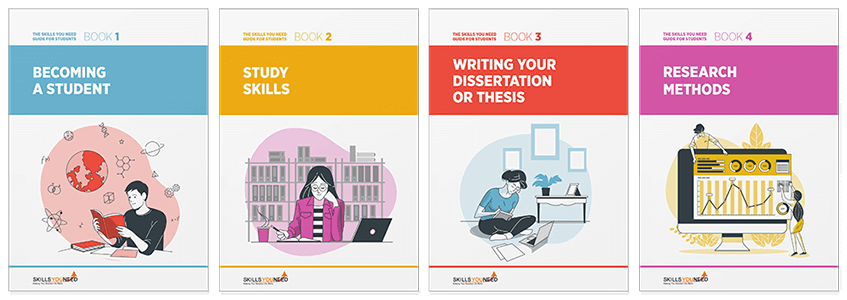
The Skills You Need Guide for Students

Develop the skills you need to make the most of your time as a student.
Our eBooks are ideal for students at all stages of education, school, college and university. They are full of easy-to-follow practical information that will help you to learn more effectively and get better grades.
Additional Information
When quoting you may sometimes want to leave out some words, in which case use ... (three dots).
"Communication is ... transferring information from one place to another"
If you need to add words to a quote for clarity, then square brackets are used:
"Communication is simply the act [in communication skills] of transferring information from one place to another."
You can use [sic] to note an original error and/or foreign spelling, SkillsYouNeed is a UK site and therefore uses UK spellings:
"The color [sic] of the water..."
Academic Referencing and Artificial Intelligence (AI)
As generative artificial intelligence (AI) becomes more ubiquitous, it is also becoming clear that it can create more problems than it solves in some areas.
Academic referencing is one of those areas.
Generative AI is a brilliant tool for helping with writing or thinking, as our page on Using Large Language Models (LLMs) explains. However, these algorithms have their drawbacks. One of the most important is that they do not distinguish between accurate information that they have 'seen' during their training, and something that looks very similar, but that they have made up.
If you ask an LLM to write something in the academic style, it will therefore contain references and citations.
Unfortunately, some or all of those references may not exist.
Our page on Critical Thinking and AI contains a cautionary tale about a book published by Springer Nature called-ironically- Social, Ethical and Legal Aspects of Generative AI. More than two-thirds of the citations in one chapter of this book could not be verified, suggesting that they were created by AI.
It is therefore not wise to rely on AI to format or suggest your references.
Always check any citations and references provided by an AI algorithm using a database such as Google Scholar to ensure that they exist. Similarly, do not be tempted to ask a large language model like ChatGPT to formulate your references into a particular style, because you may find that they are changed in the process. Instead, use dedicated software such as Endnote-or just do it yourself.
In Conclusion
Referencing is an essential part of academic writing.
It is crucial that your references are accurate and complete, to enable readers to track ideas back to their source, and to credit the original authors. Do not be tempted to cut corners, because errors can come back to haunt you. They can even damage your reputation through accusations of plagiarism.
Continue to:
Academic Writing
Clarity in Writing