

The Skills Required to Become a Carer – and Why the Role Matters More Than Ever
See also: Careers in HealthcareAs the UK's population continues to age, the demand for high-quality care has never been greater. Professional carers are needed for the vital role of supporting elderly people to live safely, comfortably and with dignity. Increasingly that is in their own homes with a dedicated carer rather than in a residential care home. This is because of a growing recognition that both health outcomes and emotional well-being are better when an elderly person remains in their own home with the right professional support.
What that means for the caring profession is there are now more roles where you can provide personalised care on a one-to-one basis. It gives you time to build meaningful relationships with the people you care for instead of rushing from one person to another under strict time pressures in a care home.
Being a carer may no longer be what you imagined.
But what does it actually take to become a carer? And why are so many companies actively seeking more people to enter the profession?
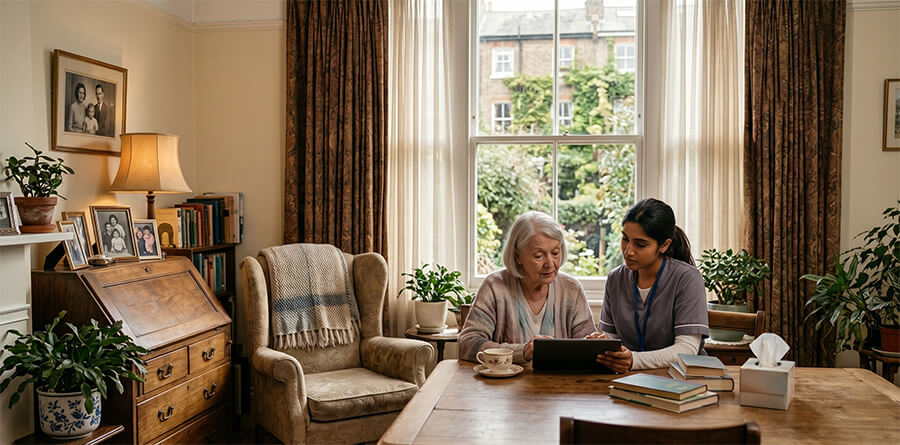
The core skills of a professional carer
Caring for older people is far more than performing a set of tasks. It is a skilled profession that combines practical ability with a high level of emotional intelligence.
At its foundation, of course, carers must be able to provide safe, reliable physical support. This includes helping with daily activities such as mobility, personal care, medication management and meal preparation. That means you need these skills:
Attention to detail is essential. Particularly when monitoring changes in health or behaviour that may indicate a more serious or complex health issue.
Communication is equally important. Carers must be able to listen carefully, explain clearly, and adapt their approach depending on the needs of the individual - whether that involves supporting someone with dementia, reassuring an anxious client, or coordinating with family members and healthcare professionals.
Patience and adaptability are other important skills. No two days are the same in care work. Circumstances can change quickly, and carers must respond calmly and effectively, often in emotionally sensitive situations.
Reliability and professionalism underpin everything. Families are placing trust in carers to look after their loved ones, often at vulnerable stages of their life. That means consistency, punctuality and a strong sense of responsibility are essential to help families build trust with their carer.
Sensitivity and discretion. These are vital when supporting someone with personal care or daily living tasks. The best carers ensure that the people they help feel valued and in control, rather than dependent.
Emotional intelligence: the defining quality
While skills such as communication, adaptability, reliability and discretion can be taught, the best carers also have a high level of emotional awareness and empathy.
Emotional awareness and empathy are often described as innate traits, but evidence from psychology and professional practice suggests they are skills that can be learnt. While we all have a different natural baseline, most people can develop greater emotional intelligence through training and experience. In care settings especially, organisations increasingly treat empathy not as a personality trait, but as a core professional competency that can be strengthened over time.
One of the most effective approaches is learning through experience. Rather than relying solely on theory, training programmes use role play, scenario-based exercises and supervised practice to help people recognise emotional cues and respond appropriately. For example, carers may be guided through situations involving confusion or distress, learning to identify tone and body language. Over time, people learn to develop more instinctive and appropriate responses in real-world situations.
It is also important to recognise that empathy is not about feeling what another person feels; it is about understanding and responding appropriately. This means that even those who do not naturally experience strong emotional resonance can still learn to demonstrate empathetic behaviours.
In practice, the most successful carers are not necessarily those who begin with the highest levels of innate empathy, but those who are open to learning and committed to improving how they relate to others.
That said, there are limits to what training can achieve when it comes to emotional awareness and empathetic behaviour. For this reason, it's important to be honest with yourself about whether a role as a carer could be right for you.
The personal and emotional rewards of caring
Despite the challenges, caring is widely regarded as one of the most rewarding professions.
One of the most significant benefits is the sense of purpose it provides. Carers see, often on a daily basis, the difference their work makes. Especially if they work providing home care, they can help someone remain in their own home, improve their quality of life, health and emotional well-being.
There is also a strong element of human connection. Many live-in carers develop meaningful relationships with the people they support. These relationships are genuinely fulfilling - something that is not easy to replicate in more transactional roles.
Skills developed as a carer, such as resilience and communication are not only valuable professionally, but also enrich an individual's wider life.
A growing demand - and a shortage of carers
The importance of the role is reflected in the scale of the UK's care sector. According to recent industry data, there are approximately 1.7 million jobs in adult social care, supporting hundreds of thousands of people receiving care in their own homes and in residential care homes. With an ageing population this demand will continue to grow.
The result is a clear and ongoing challenge: the UK needs more trained, committed carers to meet rising demand.
Final thoughts: Why this matters now more than ever
The shortage of carers is not just a workforce issue - it has real consequences for families across the country. Access to care, continuity of support and quality of life all depend on having enough skilled professionals in place.
For those considering a career in care, this presents an opportunity to join a profession where demand is strong, job security is high, and the impact of the work you do is highly meaningful.
It's not always easy work, but it is valuable to both to the people receiving care and to society as a whole. For those with the unique combination of practical skills, emotional intelligence and personal commitment, it's not just a job, but a vocation that makes a genuine difference every day.
About the Author
Trudi Scrivener has more than 30 years' experience in the care sector and is the founder of Ashridge Home Care, an award-winning specialist live-in care provider. She is also a board member of The Princes Centre charity and an ambassador at the Heart of Bucks charity. When she is not advocating for better standards in social care, she enjoys long walks in the countryside to recharge.