

How to Ask Better Questions Before a Workplace Decision
See also: Decision-Making and Problem-SolvingA colleague finishes explaining a recommendation. Everyone seems ready to move on, but you're still wondering about one detail. Perhaps the evidence covers a different situation, or the conclusion goes further than the explanation supports. You could stay quiet, although the decision might depend on the answer. You could also say, “Are we sure about that?” and leave your colleague trying to guess what you doubt.
There is a more useful conversation available. Explain what you need to understand, give the other person room to answer, and be clear about any concern that remains. You cannot control how someone responds, but you can make your question specific and give them a fair chance to address it.
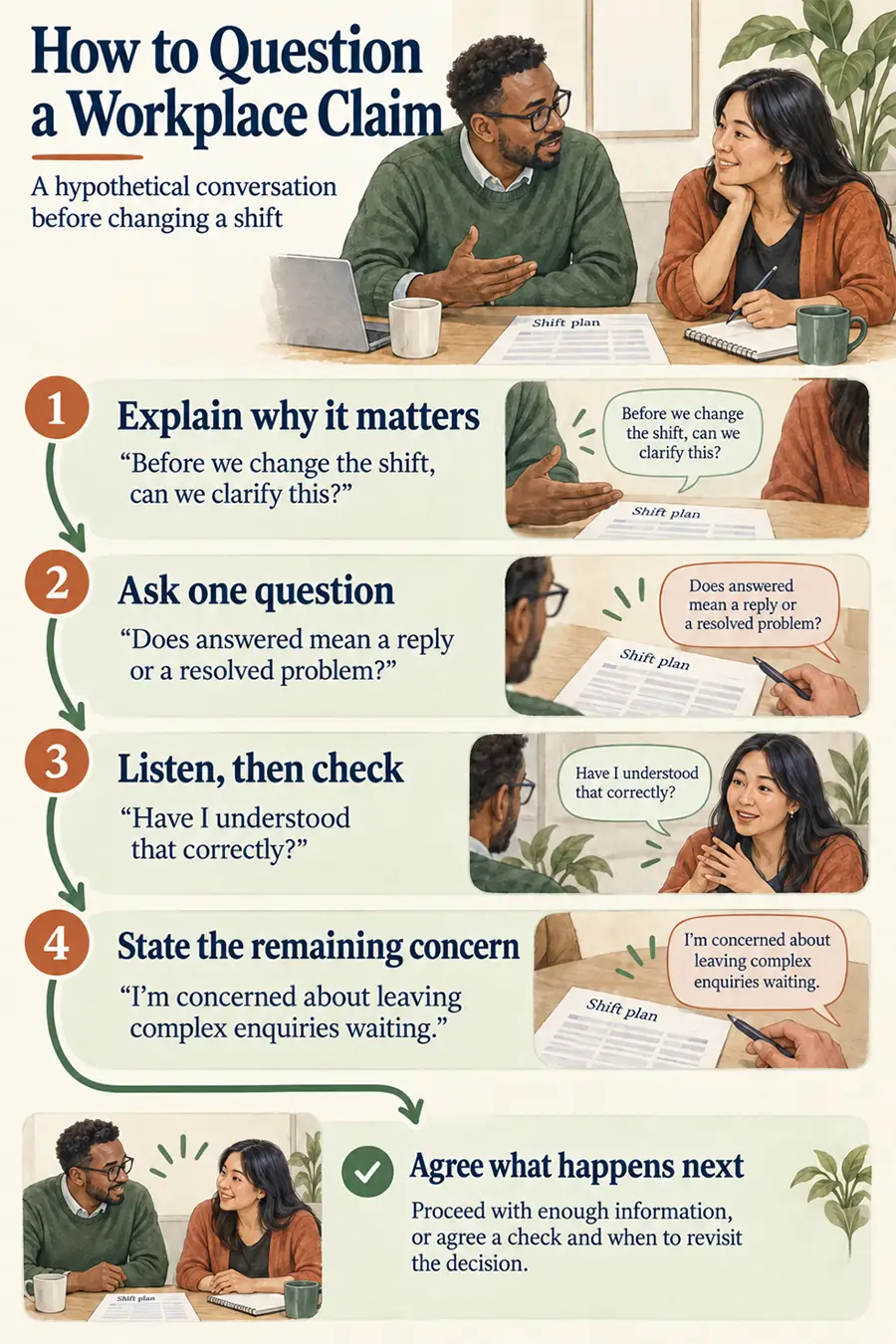
Start with the decision the team needs to make
Before speaking, ask yourself what the missing information could change. Would it affect whether to proceed, how widely to apply a proposal, or what to check first? If you cannot name the connection, you may need to think further before interrupting.
Consider a hypothetical team meeting. A manager says customer enquiries are being answered faster and suggests removing an extra shift. You wonder whether “answered” means the customer received an initial reply or the problem was resolved.
“What do you mean by answered?” is a reasonable question, but a little context makes its purpose clearer:
“Before we change the shift, can we clarify whether that figure measures the first reply or the customer's problem being resolved? I think it could affect how much cover we need.”
You have identified the decision and the distinction that matters. You have given your colleague a specific point to address and explained why it matters to the decision.
This approach also helps you keep the discussion proportionate. A detail that will not affect today's decision can often wait for a separate conversation.
Ask one question and leave room for the answer
It is tempting to demonstrate that you have thought carefully by asking several questions at once. Who checked the figures? Which enquiries were included? What happened last month? Did anyone speak to the customers?
The person answering now has to choose where to begin. You may hear a response to the easiest question while the one that matters goes unanswered.
Start with the uncertainty closest to the decision. In the hypothetical meeting, that is what “answered” means. Then let the response determine whether another question is needed.
Suppose your colleague says, “It measures the first reply, but most issues are straightforward.” You could ask:
“What helps us judge how many are resolved in that first exchange?”
That invites an explanation of the evidence behind the conclusion. “So you haven't checked whether anything was actually resolved?” would instead put an accusation inside a question. It assumes the omission before your colleague has explained what they know.
After asking, let them finish. Resist filling every pause with another example or a suggested answer. If you need a moment to understand the response, say so rather than rushing into the next challenge.
Check that you understood before you challenge
Listening needs to change what happens next. If you ask for an explanation and then repeat your original objection regardless of the answer, the conversation has nowhere to go.
Suppose your colleague adds, “We also checked a sample of completed enquiries from last week.” You now have a new detail to understand, rather than a reason to assume the staffing question is settled.
Try summarizing the distinction you think you heard:
“So the first-reply figure improved, and the team also checked a sample of completed enquiries. Have I understood that correctly?”
Your colleague may confirm it or correct something important. Perhaps the sample covered the evening shift you were concerned about, or perhaps it excluded that shift entirely. Either answer helps you decide whether your concern still stands.
When the explanation addresses the gap, acknowledge it plainly: “That answers my question about which shifts were checked. Thank you.” You do not need to invent another objection to justify having spoken.
When the explanation leaves a gap, recognize what it does establish before saying what is missing: “That helps me understand the overall improvement. I'm still unsure whether the same pattern applies during the shift we're considering removing.”
You are keeping the useful information in the discussion while being precise about its limits. There is no need to pretend agreement or dismiss everything because one question remains open.
State a remaining concern plainly
Sometimes the evidence is clear but you disagree about what it is enough to support. More questions can start to conceal that disagreement rather than resolve it.
Say what concerns you and connect it to the proposed action:
“I'm concerned that removing the shift now could leave the more complicated enquiries waiting. I'd like us to check completed and still-open enquiries from that period before changing the rota.”
This gives the team something concrete to consider. “I just don't trust the numbers” offers no clear way to address your concern.
Be equally willing to explain what would change your view. Would a check of the relevant enquiries be enough? Could the team try a limited change and review what happens? Your request should fit the consequence of getting the decision wrong, rather than demand certainty nobody can provide.
Hierarchy and relationships matter too. If a public discussion is becoming personal, you might suggest a separate conversation about the detail. If the decision cannot wait, state the unresolved concern briefly and use the appropriate route for raising it in your workplace. Careful wording cannot make every environment safe or every disagreement comfortable.
Agree what happens after the conversation
A constructive exchange still needs a conclusion. Otherwise, one person may think the concern has been resolved while another thinks a check was promised.
The team might have enough information to proceed. Summarize what addressed the concern: “We've checked the unresolved enquiries as well as the completed cases, and agreed how the new rota will cover that work.” The decision still depends on what the check shows. A shift being included in a sample does not, by itself, justify reducing cover.
It might need a specific check first. Agree who will do it and when the decision will be revisited: “Can Sam check those enquiries before Thursday's rota meeting, so we can decide then?”
Or the person responsible may decide to proceed despite the uncertainty. Make sure the remaining question and any agreed review are understood. Asking a good question does not give you ownership of every decision, but it can make the basis for that decision clearer.
These skills apply beyond reports. If a colleague recommends a supplier because “everyone found them reliable”, you can ask which experiences they mean, listen to the examples, and explain whether the proposed work has a requirement those examples do not cover. The purpose is to understand how the recommendation supports the choice being made.
Final thoughts: Practice the conversation before the meeting
Think of one recommendation you expect to discuss. Write down the decision, the detail you need to understand, and why the answer could matter. Then try saying your question aloud.
Would the other person know what you are asking? Does the wording leave room for an answer that changes your mind? If you already disagree, are you saying so honestly rather than inviting them into a trap?
You do not need a perfect script. A useful starting point is: “Before we decide, could you help me understand this part?” Follow it with the specific uncertainty, listen to the answer, and decide together what needs to happen next.
About the Author
Bernie Grohsman is the founder of Morpheus Consulting Inc., a marketing consultancy working on SEO, paid search, content, websites, and measurement. His work involves making business information clearer so people can decide what to do next.