


Essential Life Skills for
Children and Teens
See also: Parenting Skills
While formal education provides children and teens with the academic knowledge they need to pass exams, it is their life skills that will truly determine their success, happiness, and wellbeing in the real world.
As parents, educators, and guardians, one of our most important responsibilities is equipping the next generation with the tools they need to navigate an increasingly complex world. From managing emotions on the playground to managing a budget at university, life skills form the foundation of a healthy, independent adulthood.
Teaching these skills is not a one-time event, but a gradual process that aligns with a child’s cognitive and emotional development. This guide breaks down the essential life skills for children and teens by age group, providing practical ways to foster independence, resilience, and emotional intelligence at every stage.
The Foundation: Social-Emotional Learning (SEL)
Before diving into practical, age-specific skills, it is crucial to understand the framework that underpins childhood development: Social-Emotional Learning (SEL).
SEL is the process through which children and young adults acquire and apply the knowledge, attitudes, and skills necessary to understand and manage emotions, set and achieve positive goals, feel and show empathy for others, establish and maintain positive relationships, and make responsible decisions.
The Five Core Competencies of SEL
Self-Awareness: Recognizing one's own emotions and thoughts.
Self-Management: Regulating emotions and behaviors.
Social Awareness: Empathizing with others from diverse backgrounds.
Relationship Skills: Communicating clearly and resolving conflicts.
Responsible Decision-Making: Making ethical, constructive choices.
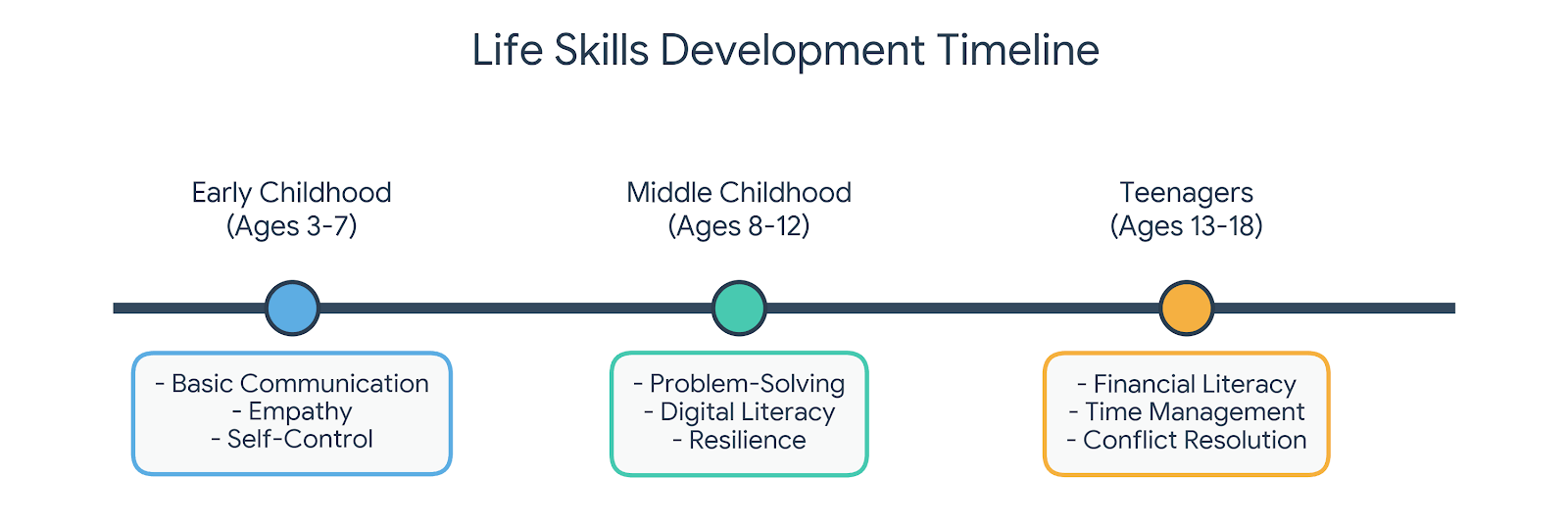
Early Childhood (Ages 3–7): Building the Basics
In the early years, children are like sponges, absorbing social cues and behavioral norms from the adults around them. The focus at this stage should be on foundational interpersonal and emotional skills.
-
Basic Communication and Empathy
Before children can resolve complex conflicts, they need to know how to express their feelings using words rather than actions. Teaching children to name their emotions (e.g., "I feel angry because...") is the first step in developing emotional intelligence.
How to teach it: Encourage active listening by asking them to repeat what someone else has said. Model empathy by validating their feelings and discussing how characters in books or television shows might be feeling.
-
Self-Control and Patience
The ability to delay gratification is an important predictor of future success. Children need to learn that they cannot always have what they want immediately, and that sharing and taking turns are essential parts of living in a community.
How to teach it: Play games that require waiting for a turn, such as board games. Praise their patience when they wait successfully, reinforcing the positive behavior.
-
Everyday Independence
Life skills also encompass practical, physical tasks. Learning to dress themselves, tie their shoes, and tidy up their toys gives young children a profound sense of competence and autonomy.
Middle Childhood (Ages 8–12): Growing Autonomy
As children enter their tweens, their social circles expand, and they begin to spend more time away from direct parental supervision. The life skills required here become more complex, focusing on self-reliance and navigating social dynamics.
-
Decision-Making and Problem-Solving
At this age, children need to start solving their own problems rather than immediately looking to an adult for the answer. Decision-making is a muscle that must be exercised.
How to teach it: When your child comes to you with a problem, resist the urge to fix it for them. Instead, ask, "What do you think you should do?" Guide them through weighing the pros and cons of their proposed solutions.
-
Digital Citizenship and Media Literacy
In the 21st century, digital literacy is a non-negotiable life skill. Children in this age bracket are often getting their first smartphones or accessing the internet independently for homework and socializing.
How to teach it: Establish clear boundaries regarding screen time. Discuss the permanence of the internet, the importance of privacy, and how to identify cyberbullying. Teach them to question the media they consume—not everything they read or see online is true.
-
Resilience and Coping with Failure
Many children fear failure, which can lead to anxiety and a reluctance to try new things. Resilience—the ability to bounce back from setbacks—is vital for mental wellbeing.
How to teach it: Normalize failure as a part of the learning process. When they perform poorly on a test or lose a sports match, focus the conversation on what they learned and how they can improve, rather than the negative outcome.
Teenagers (Ages 13–18): Preparing for Adulthood
The teenage years are the final training ground before adulthood. This is the time to transition from parental management to parental consulting, allowing teens to take the driver's seat in their own lives while you provide a safety net.
-
Financial Literacy and Budgeting
Many young adults leave home without a basic understanding of money management, leading to unnecessary debt and stress. Teaching financial skills is one of the greatest gifts you can give a teenager.
How to teach it: Give them a set allowance that they must use to cover their discretionary spending (movies, eating out). Help them open a bank account and teach them how to track their expenses, understand interest, and save for larger goals.
-
Time Management and Organization
With increasing academic pressures, extracurricular activities, and social lives, teenagers must learn how to juggle multiple responsibilities without burning out.
How to teach it: Provide them with the tools (planners, digital calendars) but let them manage their own schedules. Let them experience the natural consequences of poor time management, such as having to stay up late to finish a procrastinated assignment.
-
Advanced Interpersonal Skills and Conflict Resolution
Teenage social dynamics are notoriously difficult. Teens need to know how to set healthy boundaries, resist negative peer pressure, and resolve conflicts without resorting to aggression or passive-aggressiveness.
How to teach it: Role-play difficult conversations. Teach them assertiveness—the ability to stand up for their own rights while respecting the rights of others. Encourage open dialogue about relationships and consent.
-
Practical Domestic Skills
A teenager should not leave for university or move into their first apartment without knowing how to sustain themselves. This includes cooking basic, nutritious meals, doing their own laundry, performing basic household maintenance, and understanding how to navigate healthcare systems (like booking their own doctor's appointments).
How Parents and Educators Can Foster Life Skills
Knowing what to teach is only half the battle; knowing how to teach it requires patience and strategy. Keep these core principles in mind:
Model the Behavior: Children learn more from what you do than what you say. If you want them to have good emotional regulation, you must model healthy stress management.
Allow for Natural Consequences: It is incredibly tempting to swoop in and rescue your child from every mistake. However, rescuing them robs them of a learning opportunity. Unless their safety is at risk, let them experience the natural consequences of their actions.
Praise the Process, Not Just the Result: Praise their effort, persistence, and problem-solving strategies rather than just their intelligence or the final outcome. This fosters a "growth mindset."
Further Reading from Skills You Need

The Skills You Need Guide to Life
This two-part guide is an easy-to-read summary of the essential skills you need for a healthy mind and body.
The first eBook, Looking After Yourself, covers some of our most popular content and will help you to live a happier, healthier and more productive life.
The second eBook, Living Well, Living Ethically, considers how you can live your best life all the time. It helps you to answer the question: how can I avoid having too many regrets about my life?
Conclusion
Equipping children and teenagers with essential life skills is a lifelong journey that extends far beyond the classroom walls. By progressively introducing concepts like emotional intelligence, financial literacy, and problem-solving, we empower them to step into adulthood with confidence. Remember that teaching these skills requires patience, role-modeling, and the willingness to let young people make (and learn from) their own mistakes. The ultimate goal of parenting and educating is not to create a sheltered child, but to build a capable, resilient adult.
Continue to:
Toddlers and Young Children
Parenting Teenagers