

10 Types of Learning
for Children in Primary School
See also: 8 Types of Learning Styles
Every young learner possesses a distinct set of capabilities, strengths, and preferences that shape how they interact with the world.
Understanding that children absorb and retain information differently is the foundation of effective education. As a teacher, parent, or guardian, identifying a child's preferred learning style enables you to tailor your approach, making education more engaging and impactful.
A learning style essentially defines how a young learner receives information, organises it, interprets it, and ultimately retains it in their long-term memory. It is important to note that very few children fall strictly into a single category. Most students exhibit multimodal learning, where various styles overlap seamlessly depending on the subject matter or their environment.
The traditional educational framework heavily relied on the VARK model (Visual, Auditory, Reading/Writing, and Kinesthetic). However, modern pedagogy has expanded this to recognise a much broader spectrum of intelligences. Recognising these nuances early in a child's primary school journey allows educators to leverage their natural strengths. For those needing focused, individualised attention, exploring options like private tutoring can provide the bespoke educational support required to nurture a specific learning style.
Below, we explore ten distinct types of learning styles commonly observed in primary school children, along with actionable strategies to support them.
10 Types of Learning Styles
-
Visual (Spatial) Learning
Visual or spatial learners thrive when information is presented to them in a graphical or pictorial format. They rely heavily on visual cues to construct understanding and retain complex data.
These learners respond exceptionally well to mind maps, colour-coded notes, and diagrams. They are typically highly observant, possess a strong visual memory, and prefer explicit visual directions over spoken instructions. In a classroom setting, they are often the students drawn to doodling or meticulously organising their planners.
To support visual learners effectively, educators and parents can:
Incorporate charts, graphs, and rich imagery into daily lessons.
Use technology, such as interactive whiteboards or projectors, to display concepts visually.
Encourage the use of highlighters and colour-coding for different subjects or themes.
Guide them in creating flowcharts and mind maps to link complex ideas together.
-
Auditory Learning
Auditory learners process information most efficiently when it is spoken or heard. They have a natural aptitude for distinguishing changes in pitch, tone, and rhythm within a voice.
These students often read aloud to themselves and prefer verbal instructions over written manuals. They excel in environments where they can discuss concepts, participate in debates, and converse about academic topics. However, because they are so attuned to sound, they can be easily distracted by background noise in a busy primary classroom.
Strategies to engage auditory learners include:
Varying your vocal tone and pitch while narrating stories or explaining new topics.
Encouraging active participation in group discussions, class presentations, and structured debates.
Using listening skills exercises, such as repeating key facts or summarising information verbally.
-
Verbal (Read/Write) Learning
Verbal learners—often closely associated with reading and writing preferences—excel in traditional educational settings. They learn best when interacting with written text, whether reading extensively or taking detailed notes.
These learners typically develop a comprehensive vocabulary early on. They enjoy word games, acronyms, tongue twisters, and writing activities. Because they connect deeply with written narratives, customised reading materials can be highly effective. For example, personalised stories, such as those created by WonderWraps, capture their imagination by placing them directly into the text, fostering a deeper engagement with reading.
To captivate verbal learners, try the following:
Integrate mnemonics, rhymes, and acronyms to help memorise complex lists.
Provide plenty of opportunities for creative writing, journaling, and reading comprehension tasks.
Introduce word-based puzzles, scripts, and vocabulary building games.
-
Physical (Kinesthetic) Learning
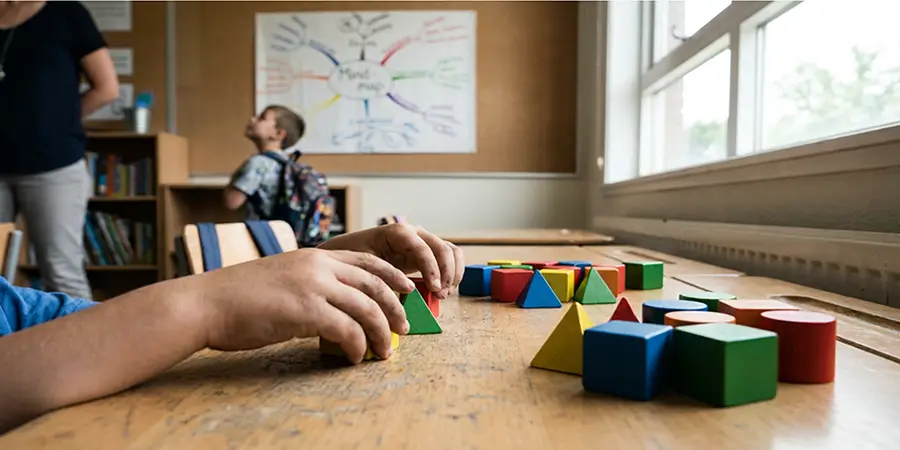
Kinesthetic learners require movement and hands-on experience to fully grasp new concepts. Sitting still for extended lectures is often counterproductive for these active, energetic children.
They learn by doing, touching, and physically interacting with their environment. They are often described as outgoing or restless, but this simply reflects their need to engage their bodies in the learning process. They benefit immensely from building models, conducting physical experiments, and participating in active educational games.
Ways to support physical learners include:
Using tactile resources like counting blocks, physical flashcards, or interactive models.
Incorporating frequent, short learning breaks to allow them to expend excess energy.
Encouraging them to act out historical events or use physical gestures to remember facts.
-
Logical (Mathematical) Learning
Logical learners are driven by reasoning, systems, and structured patterns. They have a natural inclination towards categorising information and understanding the underlying rules of a concept.
These students excel at recognising sequences and solving complex problems. They are typically drawn to subjects where understanding numbers and equations takes precedence. They thrive when they can uncover the "why" behind a process, relying on logic rather than rote memorisation.
To engage logical learners effectively:
Introduce statistics and data-driven tasks into non-mathematical subjects.
Help them classify concepts into distinct categories and establish clear cause-and-effect relationships.
Provide brain teasers, strategy games, and open-ended problem-solving activities.
-
Musical (Rhythmic) Learning
While many students find background noise distracting, musical learners often use rhythm, melodies, and beats as powerful memory aids.
These children are highly sensitive to the sounds of their environment and can effortlessly identify patterns in music. They process information well when it is set to a tune or a rhythmic beat. This learning style is heavily linked to logical reasoning, as it involves recognising mathematical structures within sound.
To stimulate musical learners:
Encourage the use of educational podcasts and audiobooks to supplement reading.
Allow the use of soft, instrumental background music during independent study time.
Turn essential facts, such as multiplication tables or historical dates, into simple songs or rhythmic chants.
-
Naturalist Learning
Naturalist learners possess a profound affinity for the outdoors and the natural world. They are highly observant of their environment and learn best when interacting directly with nature, animals, and plant life.
This style shares traits with both visual and kinesthetic learning but is specifically focused on the biological and geographical world. These students excel in subjects like science and geography, particularly when the curriculum is moved beyond the four walls of the classroom.
Strategies to engross naturalist learners include:
Conducting lessons outdoors or organising nature-focused field trips.
Assigning projects that involve collecting natural specimens, gardening, or environmental observation.
Using natural phenomena to explain abstract mathematical or scientific concepts.
-
Linguistic Learning
Linguistic learners share characteristics with both verbal and auditory learners. They have an intrinsic mastery of language and engage most effectively when reading, writing, speaking, or listening to complex narratives.
These students are articulate and enjoy expressing themselves through words. They can easily absorb information from traditional lectures but also thrive when tasked with writing essays, giving speeches, or participating in literature circles.
To involve linguistic learners:
Read complex texts aloud and encourage them to summarise or recount the story in their own words.
Assign extensive written projects, creative storytelling, and detailed research reports.
Avoid overly simplistic diagrams, relying instead on rich, descriptive text and dynamic vocal delivery.
-
Social (Interpersonal) Learning
Interpersonal learners are highly sociable and draw energy from working collaboratively. They learn best when interacting with peers, sharing ideas, and bouncing concepts off others.
These children usually exhibit strong emotional intelligence and empathy. They naturally gravitate towards group activities and often demonstrate an early aptitude for understanding leadership. They are the students who thrive in study groups and peer-to-peer mentoring scenarios.
To cater to social learners in the classroom:
Structure lessons around collaborative group projects and team-based problem-solving.
Encourage role-playing exercises to explore historical events or social concepts dynamically.
Provide opportunities for peer teaching, allowing them to explain concepts to their classmates.
-
Solitary (Intrapersonal) Learning
In stark contrast to social learners, solitary learners prefer quiet, independent study. They are deeply introspective, self-motivated, and highly focused when allowed to work without external interruptions.
These students are comfortable with their own thoughts and often require a peaceful environment to process complex information effectively. While they may appear quiet or reserved during bustling classroom activities, they frequently produce highly insightful, detailed work when given the space to reflect.
To support solitary learners:
Designate quiet zones within the classroom for focused, independent work.
Assign individual contributor projects that allow them to dive deeply into a topic at their own pace.
Check in with them privately to gauge their understanding, rather than forcing public participation.
Conclusion
It is crucial to remember that no child fits perfectly into a single, rigid learning category. Attempting to force a student into one specific educational mould can severely hinder their development. If a young learner is struggling to grasp a concept, it is highly likely that the current teaching method simply does not align with their preferred processing style.
The most effective educators and supportive parents employ a dynamic, multimodal approach. By weaving together visual aids, physical activities, logical reasoning, and social interaction, you create a rich, inclusive learning environment where every child has the opportunity to thrive and excel.
About the Author
Dr. Sarah Jenkins is an Educational Psychologist and Curriculum Strategist with over 15 years of experience in primary education. She specialises in child cognitive development and inclusive teaching practices. When she isn't consulting with schools, Sarah enjoys gardening and hiking with her two spaniels.