

In Demand Skills:
Top Trades for Wannabe Welders
See also: Careers in Construction
Welding as a skilled trade suffered a bit of an image problem over the last few decades, as many potential recruits mistakenly assumed the industry was contracting alongside traditional manufacturing output.
Those fears were drastically overplayed. Today, a massive push toward advanced infrastructure, renewable energy, and automated manufacturing has created a severe skills shortage. The reality is that there are hundreds of thousands of unfilled skilled positions in the industrial sector compared to previous generations.
This deficit means that those who decide to train as qualified welders and fabricators will enjoy an incredibly high level of demand. In return for acquiring these highly technical skills, modern tradespeople can expect to command an attractive and rapidly growing salary.
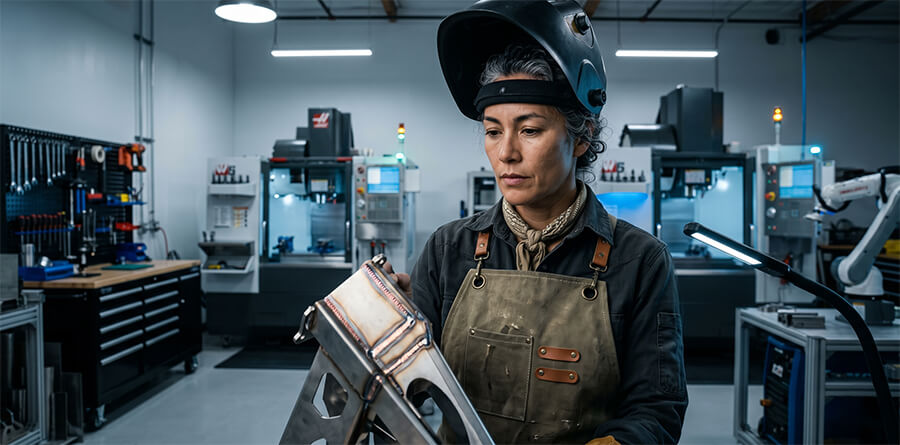
The Modern Welding Trades
As you will discover if you visit the resource section of a site like Lincoln Electric, considered to be welding experts, there are numerous specialized avenues of expertise you can pursue within the welding trades.
Welding is a foundational skill that is very much in demand. You will find lucrative employment opportunities that range from industrial and commercial infrastructure to maritime trades, aerospace, and cutting-edge robotics.
Fabrication is also a highly skilled and evolving trade. The way you learn the craft has transformed with the times; you no longer find many candidates learning their skills solely through trial and error on the floor of a steel shop. Today's candidates are more likely to be highly qualified graduates with a deep knowledge of metallurgical theory and safety standards.
This robust academic foundation complements their technical abilities, allowing them to tackle some of the most demanding and complex jobs even at a relatively early stage in their careers. Many of these modern training pathways include combination welding, where students develop hands-on experience across multiple processes such as SMAW, GTAW, GMAW, and FCAW, typically through a technical school for welders that integrates rigorous safety standards and certification preparation.
Filling the Generational Gap
The American Welding Society consistently predicts ongoing shortages of several hundred thousand professionals in the welding trades over the coming years, driven largely by a massive wave of retirements from the baby boomer generation.
This persistent shortage covers a wide range of different positions. It obviously includes hands-on welders, but it also extends to engineers, inspectors, and vocational teachers who are just as vital to the industry but are noticeably missing from the current pipeline of recruits.
Infrastructure Booms Highlight Immediate Opportunities
There is currently a massive demand for welders to work on ongoing national infrastructure projects, renewable energy grids, and localized advanced manufacturing hubs. Employers across the country are voicing concerns that critical progress could be halted unless the skills shortage is rapidly addressed.
Industry analysts estimate that tens of thousands of newly qualified workers are required annually just to meet baseline construction targets. Welding is routinely identified as one of the key skills where shortages could threaten to derail major economic development and jeopardize national energy independence.
Because of this intense demand, skilled combo-pipe welders and specialized fabricators are seeing robust double-digit annual wage growth, with many earning well above the national average right out of school.
Furthermore, many newly qualified welders take the entrepreneurial route. By purchasing their own trucks and mobile welding rigs, self-employed contractors can earn highly lucrative contracts servicing energy fields, industrial pipelines, and commercial construction sites.
Key Skills Required for Success
With a significant portion of current welders approaching retirement age, unprecedented openings are emerging in custom welding, commercial construction, and specialist areas like marine and aerospace fabrication.
One of the most critical soft skills you will be required to demonstrate as a welder is a high level of problem-solving ability. Skilled welders must be meticulous and pay exceptional attention to detail so they can spot potential flaws in structural designs or base materials, alongside troubleshooting active equipment issues.
Mathematics and science are equally important. Welders are required to use their fundamental knowledge of geometry, physics, and metallurgy on a daily basis. Estimating materials, calculating angles, and understanding the complex chemical reactions of shielding gases are all part of the necessary technical skillset.
Physical and mental endurance are also paramount. You will face a variety of challenging scenarios, unconventional working angles, and extreme conditions. Because structural mistakes can be dangerous and incredibly costly, you must be mentally focused and physically capable of executing precise movements for extended periods.
Finally, successful welders need strong interpersonal skills. While fabricators can spend hours working independently under a hood, they must also be able to communicate clearly and collaborate effectively with engineers, project managers, and fellow tradespeople to see a complex job through to a safe, efficient completion.
Life After Graduation
Graduates from top national vocational programs consistently boast high employment placement rates, often securing lucrative contracts before they even finish their final certifications.
While the average starting salary for a graduate welder provides a solid middle-class living, there are abundant opportunities to scale your income well beyond six figures as your career progresses—especially if you specialize in high-risk sectors or are willing to travel worldwide for specialized contracts.
While formal technical training requires an upfront financial investment, it is universally considered one of the highest-ROI educational paths available. By acquiring certified, in-demand welding skills, you ensure a lifetime of career stability and financial independence.

Further Reading from Skills You Need
The Skills You Need Guide to Jobs and Careers: Getting a Job
Develop the skills you need to get that job.
This eBook is essential reading for potential job-seekers. It covers the entire process from identifying your skills through the mechanics of applying for a job and writing a CV or resume, to attending interviews.
Conclusion
If you are drawn to the idea of working with your hands, mastering complex technology, and building the infrastructure of tomorrow, welding is a skilled trade that welcomes dedicated professionals. Given the severe, ongoing skills shortages in the industrial sector, choosing to become a qualified welder offers virtually guaranteed job security, excellent compensation, and the profound satisfaction of a highly respected career.
About the Author
Jim Granger is a Master Welder and Vocational Educator with over 30 years of experience in custom fabrication and industrial metallurgy. He is passionate about closing the skilled trades gap and frequently writes to mentor and inspire the next generation of industrial professionals.