

Why and How to Use a Grammar Checker
See also: Improving GrammarIn an increasingly digital world, the written word is often your very first impression. Whether you are a student submitting a master's thesis, a professional drafting a high-stakes proposal, or a manager communicating with a remote team, your writing dictates how others perceive your competence. While no one is immune to typographical errors, consistently submitting riddled drafts can severely undermine your professional credibility.
Fortunately, modern software has evolved far beyond the basic spell-check features of early word processors. Advanced grammar checkers have become indispensable tools that automate the proofreading process, offering sophisticated insights into syntax, tone, and readability. If you have never fully integrated a grammar checker into your daily workflow, now is the perfect time to explore how these applications can elevate your writing.
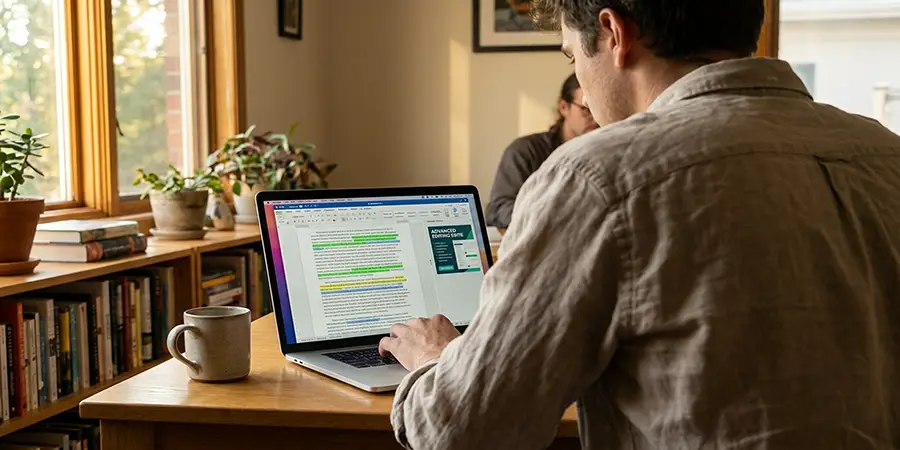
What is a Grammar Checker?
At its core, a grammar checker is a software tool designed to identify, highlight, and correct grammatical errors within a body of text. However, today's leading tools use complex Natural Language Processing (NLP) and machine learning algorithms to do much more than just fix simple misspellings.
Modern grammar checkers analyze your text for contextual spelling errors (such as confusing "their" with "there"), improper punctuation, structural anomalies, and stylistic weaknesses. They highlight overly complex sentences, flag passive voice, and suggest more powerful vocabulary. Instead of simply pointing out a mistake, the best platforms explain the underlying grammatical rule, effectively acting as an interactive writing coach that helps you systematically improve your grammar over time.
Leading Examples of Grammar Checkers
There are dozens of grammar checking applications available, ranging from simple browser plugins to comprehensive editing suites. Not all are equally competent. Given the nuance required for effective writing, choosing a reliable tool is essential. Here are three of the most highly regarded checkers used by professionals today.
Grammarly
Grammarly is arguably the most widely recognized writing assistant on the market, offering both robust free versions and premium tiers. It utilizes advanced algorithms to run hundreds of unique checks against your text in real time. Beyond basic grammar and punctuation, Grammarly analyzes your content for clarity, engagement, and delivery. It even features tone-detection technology to ensure your email sounds confident rather than aggressive, making it an exceptional tool for business communications.
Hemingway App
Unlike traditional proofreaders, the Hemingway App prioritizes readability and bold, punchy prose. Accessible via a web interface or a dedicated desktop app, it grades your writing based on reading level. It specifically targets common structural weaknesses by highlighting excessively long sentences, flagging unnecessary adverbs, and pointing out instances of passive voice. This makes it an incredibly effective tool to help you spot and fix common mistakes in writing, ensuring your message remains impactful.
ProWritingAid
ProWritingAid caters heavily to long-form writers, authors, and academics. It provides incredibly deep, comprehensive reports on your writing habits. It evaluates pacing, identifies repetitive sentence starts, highlights overused words, and maps out your readability scores across entire chapters. If you want a deep dive into your specific stylistic quirks rather than just a quick surface edit, ProWritingAid is an invaluable analytical tool.
5 Core Benefits of Using a Grammar Checker
Many writers mistakenly believe that using software to check their work is a crutch. In reality, it is a strategic productivity mechanism. By automating the mechanical aspects of proofreading, you free up your mental bandwidth to focus on narrative flow and argumentation. Here are five primary benefits of incorporating a grammar checker into your routine.
Save Substantial Time on Proofreading
Manually proofreading your own work is notoriously difficult because your brain naturally fills in missing words and corrects transposed letters. With an automated grammar checker, you can write much faster, knowing that the software acts as a reliable safety net. It catches missing commas, dangling modifiers, and incorrect verb tenses in milliseconds—errors that a human eye might gloss over after staring at a screen for hours.
Drastically Improve Readability
Readability refers to how easily a target audience can digest and understand your text. High readability does not mean dumbing down your content; it means removing the friction between your ideas and the reader's comprehension. Grammar checkers consistently push writers to adopt Plain English by encouraging them to:
Maintain consistent and logical sentence structures.
Eliminate highly specialized jargon or overly complicated terminology when simpler words suffice.
Break massive, winding paragraphs into scannable, digestible ideas.
Accelerate Contextual Learning
One of the most underappreciated benefits of modern grammar checkers is their educational value. When a tool flags an error, it usually provides a brief explanation of why the correction is needed. For example, if you frequently confuse "affect" and "effect," the tool will provide context for the proper usage.
This ongoing, contextual feedback loop helps users—particularly students or non-native speakers—internalize grammatical rules much faster than studying a static textbook. Over time, you will find yourself making fewer mechanical errors on your first draft because the software has actively trained you to avoid them.
Build Professional Confidence
Nothing induces anxiety quite like hitting "send" on an email to an executive or submitting a final academic paper, only to immediately spot a glaring typo in the first sentence. Grammar checkers eliminate this anxiety by providing a final, objective review of your document. This added layer of quality assurance helps you build genuine confidence in your writing skills. When you trust the mechanical accuracy of your text, you can be bolder and more persuasive with your actual ideas.
Elevate Overall Written Communication
Ultimately, a grammar checker ensures your written communication is clear, precise, and highly effective. Writers often develop bad habits—such as relying on awkward phrasing, overusing clichés, or repeating redundant words. A good checker acts as a ruthless editor, stripping away unnecessary words that dilute your core message. By enforcing subject-verb agreement and proper pronoun usage, the software ensures that complex arguments remain logically sound and easy to follow.
How to Seamlessly Integrate a Grammar Checker
There are multiple ways to deploy a grammar checker depending on your specific writing habits and platform preferences. The most popular tools offer a combination of the following access points.
Online Web Interfaces
The most basic application of a grammar checker involves copying your finished text and pasting it directly into the tool's proprietary web portal. The application will instantly scan the text, score it, and highlight recommended corrections in a clean, distraction-free environment. This is excellent for final polish checks on long documents.
Word Processor Plugins and Desktop Apps
If you prefer to edit as you write, most major grammar checkers offer native integrations with programs like Microsoft Word or Google Docs. They also offer standalone desktop applications that monitor your writing across multiple native apps. This integration highlights errors natively on your page, allowing you to accept or reject changes with a single click without ever breaking your workflow.
Browser Extensions
For modern professionals, browser extensions are arguably the most valuable format. Once installed in Chrome, Firefox, or Safari, these plugins actively monitor your text fields across the web. They will check your syntax while you draft an urgent email in Gmail, write a post on LinkedIn, or update a page in your company's Content Management System (CMS).
The Limitations of Automated Proofreading
While artificial intelligence has revolutionized text analysis, it is critical to remember that grammar checkers are tools, not infallible human editors. Automated software inherently lacks an understanding of context, subtle nuance, cultural idioms, and humor.
A checker might flag a fragmented sentence as an error, completely missing the fact that you intentionally used a fragment for dramatic rhetorical impact. Therefore, you should never blindly accept every suggestion a tool provides. Automated feedback should inform your editing process, but it should never override your own critical thinking and creative judgment.
Conclusion
Writing at lightning speed is entirely counterproductive if the final output is riddled with distracting mechanical mistakes. If your readers are forced to reread your paragraphs to decipher your meaning, they will quickly become frustrated and disengage from your content. Grammar checkers solve this problem by efficiently automating the proofreading process, ensuring your work is crisp, clear, and professional.
By integrating a reliable writing assistant into your daily workflow, you will save valuable time, accelerate your understanding of complex grammatical rules, and communicate your ideas with absolute confidence. Embrace the technology, but always remain the final arbiter of your own unique voice.
About the Author
Bethany Carter is a seasoned copy editor, technical writing instructor, and content strategist with over 15 years of experience in the publishing industry. She specializes in helping corporate teams and independent authors refine their messaging, improve readability, and streamline their editorial workflows. Passionate about the intersection of language and technology, Bethany frequently writes about how software can enhance human creativity.