

4 Mindsets to Inspire Your Presentation
See also: Top Tips for Effective PresentationsBusinesses exist to solve problems. Whether you sell a physical product or a specialized service, the transaction is only successful when the customer receives a tangible benefit or comfort. When a customer is satisfied, they return. But how do you ensure that your audience—whether they are investors, potential clients, or internal stakeholders—buys into you before they even see the product?
The answer lies in treating your presentation with the same rigour and strategic thinking as the product itself.
Just as you design a product to satisfy a market need, you must design your presentation method to satisfy an audience's psychological need. This goes beyond beautiful graphics or catchy slogans; it requires a fundamental shift in mindset. You must appeal to their curiosity, their empathy, and their self-interest. If you can align your internal beliefs with your audience's goals, you transform a standard pitch into a compelling narrative.

In presentations, authenticity is your greatest asset. Being straightforward about your values—corporate or personal—makes you an object of empathy. It makes you relatable. When the audience connects with you as a human being and understands that your solution could make their lives easier, the barriers to persuasion begin to crumble.
Moreover, staying dynamic in your approach is crucial for maintaining audience engagement. Modern audiences have short attention spans and high expectations for visual quality. Whether you are building a deck from scratch or utilizing professional templates to create dynamic Microsoft slides, the goal remains the same: to convey your message in a format that captivates attention and enhances understanding.
Building the perfect presentation and crafting great copy takes effort, time, and inspiration. To help you find that inspiration, look no further than the product you are selling. Here are four mindsets to adopt that will help you kick-start your presentation planning.
-
The "Value-First" Mindset: Deliver More Than Expected

A common mistake presenters make is focusing entirely on the "what." They list features, specifications, and data points, assuming the facts will speak for themselves. However, a successful presentation requires a mindset that focuses on the "why."
Your presentation should certainly cover the basics: the what, how, when, and where of your proposal. You will likely demonstrate the product, discuss its appearance, and highlight its specifications. But to truly inspire your audience, you must dig deeper. You need to answer the questions your audience is subconsciously asking but might not articulate:
Why does this exist? (The Origin Story)
Why should I care? (The Personal Relevance)
Why should I choose this over the alternative? (The Unique Value Proposition)
By adopting the "Value-First" mindset, you shift the spotlight from the product to the problem it solves. This allows you to identify and demonstrate the relief or joy your solution brings. Furthermore, this mindset forces you to confront your competition head-on. What do you offer that others don't? Is it speed? Quality? Customer care? Taking your place above and beyond the competition is a critical factor to demonstrate. Don’t keep your unique selling points a secret; framing them as the answer to the audience's specific pain points is the edge you need to secure a solid market.
-
The "Visionary" Mindset: Show, Don't Just Tell

There is a famous school of thought, popularized by Steve Jobs, that suggests: “A lot of times, people don’t know what they want until you show it to them.”
While many companies rely heavily on customer feedback to iterate their products, there is immense power in creative thinking and the "Visionary" mindset—the belief that you are presenting a future the audience hasn't yet imagined. If you simply ask an audience what they want, they will describe a slightly better version of what they already have. Your job as a presenter is to show them a leap forward.
This mindset is risky but high-reward. It requires you to be bold in your presentation design. Instead of incrementally justifying your idea with safe data, you focus on the revelation. Don't just list the innovative features of your product; demonstrate the innovative result.
For example, if you are pitching a new piece of software, don't start with the code architecture. Start with a "Day in the Life" of the user before and after your software. Show the transformation. When you adopt this mindset, your presentation stops being a report and starts being a reveal. You are not asking for permission; you are unveiling a new reality.
However, a word of caution: this does not mean you ignore feedback forever. While the initial vision may be yours, the refinement comes from listening. But for the purpose of the pitch? Be the expert who knows what they need before they do.
-
The "Skeptic" Mindset: Assume No One Will Use It

This sounds counter-intuitive. Why would you go into a presentation assuming failure? This is the "Skeptic" mindset, and it is a powerful tool for quality control.
When designing your pitch, assume that your audience is busy, distracted, and perfectly happy with their current solution. Assume that absolutely no one wants to use your product. They would rather stick to their old methods, even if those methods are inefficient, simply because change is hard.
How do you design for that?
You design a presentation that is impossible to ignore. When you lower your expectations of the audience's initial interest, you raise the standard of your delivery. You stop relying on the assumption that "they have to listen because they are here" and start working to earn their attention every single minute.
This mindset forces you to:
Sharpen your hook: You realize you need to grab them in the first 30 seconds.
Simplify your message: You cut out the jargon that a bored audience won't bother to decipher.
Amplify the benefit: You make the value proposition so overwhelming that it overcomes their natural inertia.
By assuming the audience is looking for a reason to say "no," you can proactively address every objection before they even raise it. You create a product—and a pitch—that is undeniable.
-
The "Pygmalion" Mindset: High Expectations Drive Results
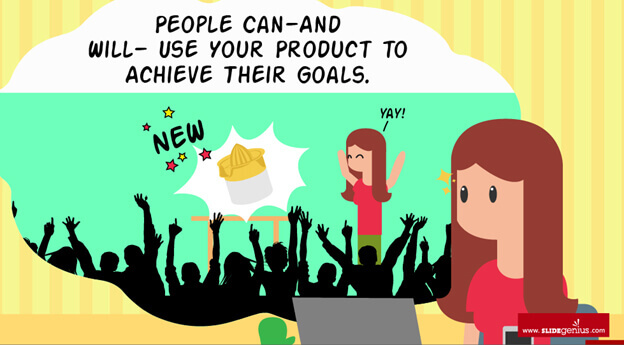
Finally, we move to the inverse of the Skeptic mindset. Once you have rigorously stress-tested your content, you must switch to the "Pygmalion" mindset. This psychological phenomenon suggests that higher expectations lead to an increase in performance.
In the context of a presentation, this applies in two ways:
Expectation of the Product: If you truly believe your product is world-class, your body language, tone, and energy will reflect that confidence. If you pitch with the mindset that "this might work," the audience will smell the hesitation. If you pitch with the mindset that "this will change your business," that conviction is contagious.
Expectation of the Audience: Treat your audience as intelligent, capable, and ready to achieve their goals. Do not talk down to them. Present your solution as a tool for high-achievers. When you frame your product as something that smart, successful people use, the audience will want to align themselves with that identity.
Nailing a great presentation is grueling work. It involves managing nerves, technology, and interpersonal dynamics. But if you enter the room with the high expectation that you are about to deliver value and that the audience is ready to receive it, you create a self-fulfilling prophecy of success.
Conclusion
You don’t have to be a graphic design expert or a TED Talk veteran to succeed. You simply need to align your mindset. Look at your product. Understand the problem it solves (Value), the future it creates (Vision), the resistance it faces (Skepticism), and the potential it unlocks (Pygmalion).
Don’t worry about mental blocks. By the time you step on stage, you will have prepared for the skeptics and aligned yourself with the visionaries. Keep going. It’s the only direction you will want to take.

About the Author
Rick Enrico is a presentation expert and entrepreneur with a passion for helping businesses communicate their value effectively. He writes regularly on the art of pitching, visual storytelling, and public speaking strategies.