


Personal Productivity Skills
See also: Setting Personal GoalsModern life is exceptionally busy. For most of us, balancing personal obligations with professional duties can feel like a relentless, overwhelming juggling act. We are constantly surrounded by digital notifications, overdue assignments, and the looming pressure of critical appointments.
When faced with this mounting pressure, most people simply scramble to finish projects or attend meetings without a strategic plan. We may acknowledge that we need to improve our time management skills, but we rarely take the time to address the root causes of our inefficiency. True productivity does not happen by accident; it occurs when we proactively manage our time, energy, and attention.
Knowing how to cultivate deep focus is just as important as organizing your calendar. After all, what good is carving out three hours to accomplish a major project if you routinely allow yourself to be distracted by your smartphone? Time management and focus are personal skills that are rarely taught in traditional education, yet mastering them yields profound benefits for your career trajectory and your mental wellbeing.
The Psychology of Task Decomposition
One of the primary reasons we procrastinate is cognitive overload. When we look at a massive project on our to-do list—such as "Write Annual Report" or "Plan Marketing Strategy"—our brains perceive the task as ambiguous and threatening. This ambiguity triggers anxiety, causing us to retreat to easier, low-value tasks like checking email.
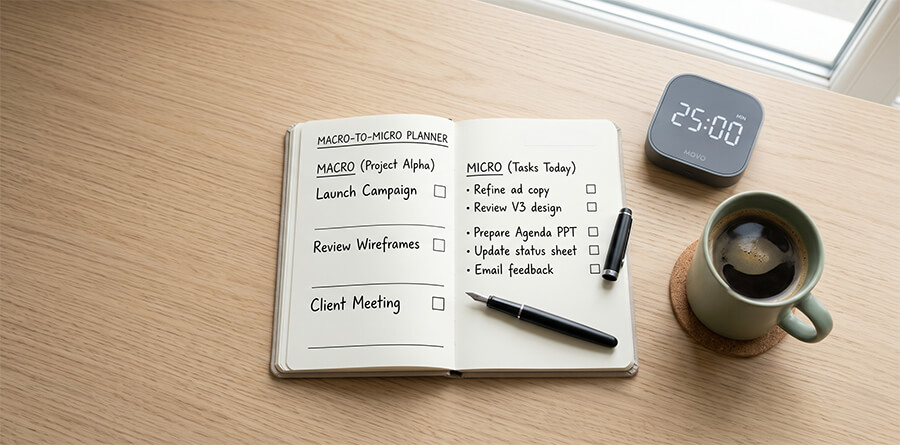
The antidote to cognitive overload is task decomposition. Decomposing tasks helps you plan a linear course of action so you can accomplish complex goals without feeling overwhelmed. Without proper organising skills, you will likely spend your day executing minor, disconnected chores without a clear understanding of how they serve your larger objectives.
How to Effectively Decompose a Task
Decomposition is the process of breaking a monolithic project down into its smallest, most actionable sub-tasks. A well-decomposed task leaves no room for ambiguity regarding what needs to be done next.
Consider a common task: "Redesign the company website." This is not a task; it is a project. To decompose it, you must break it down into sequential phases, and then into individual actions. For example:
- Audit existing website pages (1 hour).
- Draft new copy for the 'About Us' section (2 hours).
- Select three new stock images for the homepage (30 minutes).
By breaking the work down, you lower the "activation energy" required to start. You can clearly see dependencies—realising that you cannot select images until the copy is finalised—and you can develop a reliable timeline. You no longer have to figure out *how* to do the project; you simply have to execute the next micro-task on the list.
Mastering Focus in a Distracted World
Setting aside time to complete your decomposed tasks is critical, but it is only half the battle. To many professionals, blocking out uninterrupted time feels impossible because we are conditioned to remain constantly available for emergent situations.
If we are honest with ourselves, genuine emergencies are incredibly rare. However, the expectation of an emergency gives us a convenient excuse to seek out distractions. We check our messaging apps, refresh our email inboxes, or scroll through social media under the guise of "staying connected." Learning how to focus is ultimately the same as learning how to minimise distractions.
The Cost of Context Switching
Every time you glance away from your primary task to check a notification, you engage in "context switching." Psychological research shows that when you switch from one task to another, a portion of your attention remains stuck on the previous task—a phenomenon known as "attention residue."
This is why multitasking is a myth. Attempting to write a complex report while simultaneously answering emails does not make you more productive; it drastically reduces your cognitive capacity, increases your error rate, and accelerates mental fatigue. To combat this, you must build an environment that defaults to focus rather than distraction.
Practical Strategies for Deep Productivity
You do not need to rely on complex software or paid subscriptions to master your productivity. The most effective strategies are behavioral. Here are three powerful frameworks you can implement immediately:
1. The Pomodoro Technique
If you struggle to sustain focus for long periods, the Pomodoro Technique is highly effective. It involves working in intense, timed bursts—typically 25 minutes of pure, uninterrupted focus—followed by a strict 5-minute break. After four cycles, you take a longer 15-to-30-minute break.
This technique works because it creates a sense of urgency and forces you to ignore distractions for a very manageable window of time. It also prevents burnout by baking mandatory rest periods into your workflow, ensuring your mind remains sharp throughout the day.
2. Time Blocking
A to-do list without a schedule is merely a wish list. Time blocking takes task decomposition a step further by assigning specific sub-tasks to specific blocks of time on your daily calendar. For example, instead of hoping you find time to write a report, you block out 9:00 AM to 10:30 AM exclusively for drafting.
When you time block, you take control of your day rather than letting your inbox dictate your priorities. Treat these blocks as immutable appointments with yourself. If a colleague asks for a meeting during a blocked period, you can confidently say you are booked.
3. The Two-Minute Rule
Productivity is not just about deep focus; it is also about preventing small administrative tasks from cluttering your mind. The Two-Minute Rule states that if a task takes less than two minutes to complete—such as replying to a quick email, filing a document, or confirming an appointment—do it immediately.
If you put off these micro-tasks, they pile up and create a persistent, low-level anxiety that drains your mental energy. By clearing them out instantly, you keep your to-do list lean and reserve your heavy cognitive lifting for the tasks that truly matter.

Further Reading from Skills You Need
The Skills You Need Guide to Personal Development
Unlock your potential with our comprehensive guide to personal growth. Learn how to set effective personal goals and find the motivation to achieve them. Dive into personal development, a suite of essential skills designed to help you thrive in your career, studies, and personal life.
Building on the success of our bestselling eBook, this updated third edition is perfect for anyone looking to enhance their skills and learning capacity. Filled with practical, easy-to-follow advice, the guide empowers you to take charge of your development journey.
Conclusion
Being focused and staying productive are critical for achieving both your personal ambitions and your professional goals. You want to drive meaningful results at work while still having the energy to enjoy your life at home, and that balance requires intentional design.
Productivity is not about working relentlessly or finding the perfect digital app. It is about understanding how your brain works, breaking intimidating projects down into actionable steps, and fiercely protecting your attention from the countless distractions of the modern world. By implementing strategies like task decomposition, time blocking, and the Pomodoro Technique, you can transform your workflow, reduce your daily stress, and consistently produce your highest quality work.
About the Author
Dr. Lydia Caldwell is an Organizational Psychologist and Productivity Consultant. She specializes in helping corporate teams and executives overcome cognitive overload, optimize their daily workflows, and build sustainable habits for deep focus. When she is not writing or consulting, Lydia enjoys long-distance running and exploring the psychology of habit formation.