


How to Guide Your Employees
Through Difficult Customer Interactions
See also: Dealing with Difficult Customers
For any business that deals directly with the public, the quality of the customer experience is paramount. Unfortunately, working with customers isn’t always pleasant. Even if a customer is angry for a good reason, the language and attitude they use toward your employees can be challenging to handle.
However, a well-trained and well-supported team can navigate these minefields, often turning a negative situation into a positive outcome for both the customer and the business.
Research consistently shows that service agents have the most significant impact on the customer experience. Spending time training your employees not only results in a more positive buyer journey but also builds a more resilient and professional team. While teaching company policies and role-playing scenarios are crucial, there will always come a time when your staff must deal with an irate customer. Here is how you can guide them through those difficult interactions to satisfy the customer while protecting your team from burnout.
Establishing a Framework for Difficult Interactions
Before a difficult situation even arises, you must equip your team with the right mindset and tools. This involves setting clear expectations and providing a supportive structure that empowers them to act confidently.
-
Stress Professionalism and Emotional Detachment
Humans are emotional creatures. When a customer starts raising their voice or making personal remarks, the natural instinct is to react defensively. It is vital to train your employees to consciously remove emotion from the interaction. They must learn to take a mental step back and recognise that the customer’s frustration is almost always directed at the situation or the company, not at them personally.
Provide them with techniques for emotional regulation, such as taking a slow, deep breath before responding. Teach them to use neutral, objective language. For instance, instead of saying, "You’re not making any sense," they could say, "I want to make sure I understand the issue correctly. Could you please clarify that last point for me?" This shifts the focus from confrontation to collaboration.
-
Cultivate a "Customer Obsessed" Culture
Studies have shown that companies with a customer-obsessed culture tend to see more significant revenue growth. When a customer walks away unhappy, the entire team should see it as an opportunity to learn and improve. Your goal should be to ensure every client is satisfied with your product or service. If they aren’t, you must find a solution.
Empower your employees with the freedom to come up with creative solutions. Many have heard the famous customer service story about the online shoe company that overnighted a new pair of shoes to a bride who had ordered the wrong size, ensuring she had them for her wedding. Even though the initial error wasn’t the company's fault, their actions created a loyal customer for life. Encourage this level of problem-solving by giving your team the autonomy to make things right within reasonable limits.
-
Institute Clear Protective Measures and Escalation Paths
Your employees should never feel trapped or abandoned in a hostile interaction. If they encounter a situation they cannot handle, they must know the clear chain of command and feel empowered to immediately escalate the issue to a manager or senior team member. It is far better for a manager to step in and de-escalate the situation than for a service agent to lose their composure.
If you manage a call centre, have systems in place to monitor for signs of distress. For in-person interactions, a manager should always be alert to raised voices or escalating tension and be ready to intervene. Your team needs to know you have their back. They will also learn invaluable skills by observing how a more experienced representative handles an irate person with confidence and empathy.
-
Train Staff to Modulate Their Tone of Voice
When someone starts shouting or speaking dramatically, the instinctive reaction can be to match their volume. Train your representatives to do the opposite: speak more softly and calmly. Your tone of voice can be a powerful tool for de-escalation. It helps to soothe the nerves of everyone involved and makes the employee appear calm and in control, even if they feel stressed internally.
A polite and soft tone can often jolt an angry person out of their emotional spiral, forcing them to quieten down simply to hear what is being said. You cannot begin to solve a customer's problem until they are calm enough to listen to your proposed solutions.
-
Respect the Customer's Time
In our busy world, few things are more frustrating than feeling like your time is being wasted. Train your agents to be efficient without being dismissive. While scripts can be useful for guidance, an agent who rigidly follows a checklist without listening is impersonal and ineffective. A conversation that forces a customer to repeat information or perform pointless steps only adds to their frustration.
Instead, strive for genuine efficiency. This is achieved by listening carefully to the customer's problem first, and then moving straight to problem-solving. Teach your team to trust the customer and to use their own judgement to get to the heart of the issue as quickly as possible.
-
Practice Active Listening and Never Interrupt
Put your agents in the shoes of a disgruntled customer. They are already unhappy and just want to be heard. The most important first step is to let the customer vent and explain what is wrong without interruption. Train your staff to actively listen, which means not just staying silent but showing they are engaged. They should use verbal nods ("I see," "I understand") and then, once the customer has finished, summarise the issue back to them. For example: "So, if I've understood correctly, the delivery was late, and when it arrived, the item was damaged. Is that right?"
This simple act validates the customer's feelings and confirms that your employee has understood the problem correctly, which is the foundation for finding a solution.
-
Ask the Customer for Their Ideal Solution
Often, a customer has already thought about how they would like the situation to be resolved. They may have a specific solution in mind and will only be satisfied if you can meet, or at least acknowledge, those expectations. Empower your team to ask a simple question: "What would you like to see happen to make this right for you?"
If their proposed solution is reasonable, give your agents the power to provide it. If it is not feasible, it provides a starting point for negotiation. A truly customer-centric business will often go one step further, perhaps by offering a full refund and including a discount on a future purchase to thank the customer for their patience.
-
Offer and Encourage Recovery Time
At some point, every employee will deal with an exceptionally difficult or abusive customer. It is crucial to give them time to recover after these nasty interactions. Encourage them to take a short break, go for a walk, or step away from their desk for a few minutes. Check in with them and remind them they are doing excellent work and that you support them.
You do not want to lose your well-trained, top-performing representatives to burnout. Understand that even if they do not take the situation personally, it is a high-stress event, and they need time to decompress.
-
The Importance of Following Up
After a difficult interaction has been resolved, a follow-up can transform a negative experience into a powerfully positive one. A short email or phone call a day or two later to ensure the solution is working and the customer is now happy shows that you genuinely care. This final step can solidify customer loyalty and demonstrates a commitment to service that goes beyond just solving the immediate problem. It also provides a final, positive touchpoint for both the customer and the employee who handled the issue.
Further Reading from Skills You Need
The Skills You Need Guide to Interpersonal Skills eBooks.
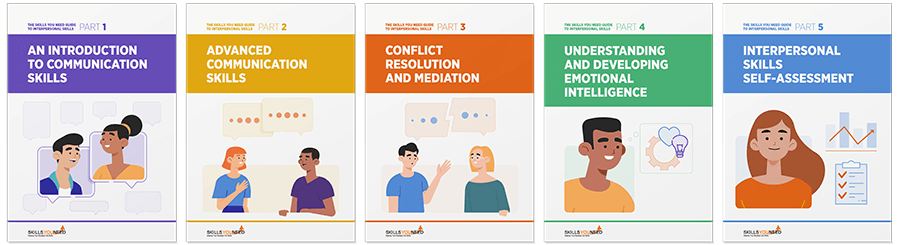
Develop your interpersonal skills with our series of eBooks. Learn about and improve your communication skills, tackle conflict resolution, mediate in difficult situations, and develop your emotional intelligence.
Conclusion
Excellent customer service helps your brand develop a positive reputation, turning customers into advocates who will sing your praises. You should also use every complaint as an opportunity to improve your business. Ask what you can fix in your processes so that future customers are not upset in the first place.
By implementing ongoing training, maintaining consistent policies, and fostering a customer-first approach, you can improve your customer service and give your employees the skills and confidence they need to handle any difficult interaction with grace and professionalism.
About the Author
Eleanor Hecks is the editor-in-chief at Designerly Magazine. She previously worked as a creative director at a digital marketing agency before becoming a full-time freelance designer. Eleanor lives in Philadelphia with her husband and dog, Bear.