

5 Easy At-Home ABA Techniques
for Kids on the Spectrum
See also: Understanding Autism Spectrum Disorder
If your child has autism, you have likely encountered the term Applied Behavior Analysis, commonly known as ABA therapy. You might even be taking your child to weekly sessions with a certified professional. However, you may not have a complete understanding of exactly what ABA is, the psychological mechanisms behind it, or its true potential to assist your child’s long-term cognitive and social development.
Applied Behavior Analysis is an evidence-based type of therapy that relies on a foundational concept of human psychology: positive rewards encourage desired behavior, while a lack of positive reinforcement or natural negative consequences discourages undesired behavior. By applying these principles consistently, therapists and parents can help shape positive, adaptive behaviors in children on the autism spectrum.
To truly grasp how this works, it helps to understand the Antecedent-Behavior-Consequence model, often referred to as the ABCs of ABA therapy. The antecedent is what happens immediately before the behavior. The behavior is the child's response to the antecedent. The consequence is what happens immediately after the behavior. For example, if a child always receives a small healthy snack after they tidy their play area, they will become more willing to clean up. They learn to associate the completion of the task with a positive, rewarding outcome.
Conversely, if they do not get to play with their favorite toy when they act out aggressively in the supermarket, experiencing this natural consequence may make them less likely to throw a tantrum in the future to get what they want. By utilizing psychology and breaking down difficult tasks into smaller, more manageable goals, ABA therapy helps children learn or improve their communication skills, social skills, and daily living tasks.
Bringing Therapy into the Home
While structured therapy sessions are highly beneficial, it is also incredibly important to start practicing what your child learns in therapy within the comfort of your own home. Doing ABA exercises at home reinforces what they have already learned in a clinical setting and helps you actively support their progress. It can dramatically speed up their learning curve, as the home is where children spend the majority of their time and feel the safest.
Before diving into specific exercises, it is crucial to establish a calm, structured environment. Consistency is the bedrock of ABA. If you are inconsistent with rewards, the child will receive mixed signals, which can lead to frustration and behavioral regression. Always ensure that the rewards you offer are highly motivating for your specific child, whether that means a specific toy, enthusiastic verbal praise, or a few minutes of their favorite interactive game.
Case Study: Maya's Journey with Routine
Consider the case of Maya, a four-year-old girl diagnosed with Autism Spectrum Disorder. Maya struggled significantly with transitions and sitting still during family meals, often leading to disruptive outbursts. Her parents, working alongside her therapist, implemented a home-based ABA strategy. They started by asking Maya to sit at the table for just thirty seconds, rewarding her immediately with a sticker—her absolute favorite item. Over a period of three months, they gradually increased the duration requirement before providing the sticker. By breaking the monumental task of "sitting through dinner" into micro-milestones, Maya eventually learned to sit with her family for full twenty-minute meals without distress. This perfectly illustrates the power of incremental progress and positive reinforcement.
5 Practical At-Home ABA Techniques
Without further ado, here are five comprehensive exercises you can do at home to help your child keep growing, stay engaged, and learn vital new skills.
Sitting in a Chair
Teaching your child to sit still might seem like a straightforward expectation, but it can be incredibly difficult for kids with autism who are hyperactive, easily distracted, or dealing with sensory processing challenges. Thus, helping them sit calmly during meals or focused activities can greatly improve their overall attention span. Start by sitting your child in a chair in a quiet room with minimal distractions. Ask them to stay seated beside you. Give immediate verbal praise and a tangible reward when they stay seated, even if it is only for a few seconds, and let them take frequent breaks. Gradually increase the sitting time by praising them at longer intervals and spacing out the breaks. Include fun table-based activities, such as drawing or building blocks, to make sitting for extended periods a highly enjoyable experience rather than a chore.
Looking at You and Making Eye Contact
Children on the spectrum often find direct eye contact overwhelming or challenging. This is a crucial area to work on, as eye contact forms the basis of effective non-verbal communication and helps build their interpersonal communication. This activity provides a low-pressure way for them to practice this important skill. Use a highly visual and fun prop to naturally draw your child's attention toward your face and mouth. Holding a bubble wand near your eyes is a classic and effective method. Gently ask your child to look at you. The moment your child makes eye contact, blow the bubbles immediately and praise their efforts enthusiastically. Providing the reward instantaneously reinforces the behavior, helping the child build a positive association with looking at faces.
Matching Colors and Objects
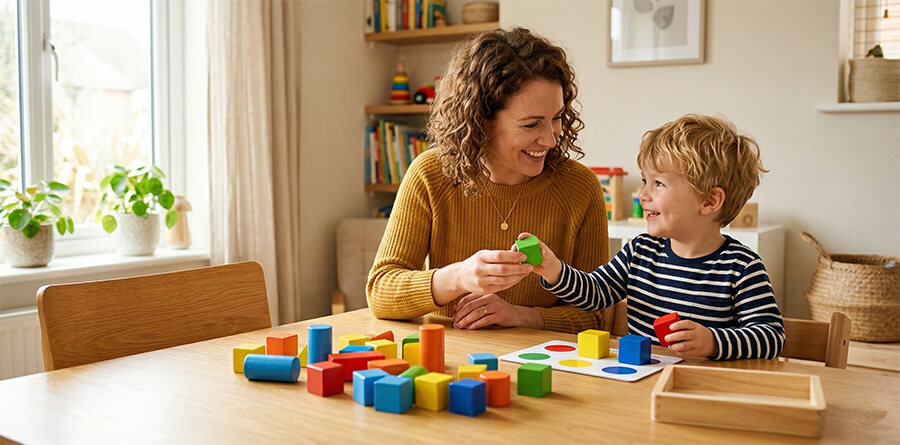
Color matching is a foundational cognitive skill taught early in ABA therapy. It helps children categorize their world and develops visual discrimination. You can easily help your child practice this skill at home by turning it into a simple, engaging game. Gather a few familiar objects from around the house, such as red blocks, blue crayons, or green socks, that they see on a daily basis. Show one object to your child and ask them to find another object of the exact same color. You can guide them by physically showing them how to match the first few items, acting as a model, before letting them try independently. Use encouraging phrases like "Green matches green!" to reinforce the language alongside the visual task. After each successful match, praise your child immensely with high fives or an excited tone. Start with identical shades, and as they master the concept, introduce different shades of the same color to increase the difficulty.
Identifying and Expressing Emotions
Kids with autism sometimes struggle to interpret and understand emotions, both in themselves and in the people around them. A good therapist will prioritize this during clinical sessions, but it is imperative for emotional regulation exercises to be initiated at home where real-life feelings occur naturally. Print out or draw large, clear emojis showing different basic emotions such as happy, sad, angry, and surprised. Put the cards face down on a table and let your child flip them over one by one. Ask your child to name the emotion shown on the card. Always ensure you praise them when they get it right. To take this a step further, encourage them to identify emotions in real-time. For example, if a sibling is laughing, you might say, "Your sister looks really happy right now! What do you think she is feeling?" This bridges the gap between flashcards and real human interaction.
Engaging in Structured Fun Activities
Last, but certainly not least, ensure there are plenty of structured, engaging activities that help your child learn how to play both independently and collaboratively. Play is the work of childhood, and it is how crucial social skills are learned. Engaging in shared activities will help the child hone their ability to share, take turns, and communicate, which is vital for success in playground and schoolground settings. Try simple, rule-based games like tag or taking turns blowing and popping bubbles. Play with swings and encourage your child to actively use their words or communication device to ask for a push. Guide them through crawling tunnels or obstacle courses that require following sequential directions. Pick activities that necessitate interaction so they can practice asking for things and engaging in reciprocal communication in a highly motivating context.
Conclusion
Implementing Applied Behavior Analysis techniques at home can profoundly support and accelerate the cognitive and social development of children diagnosed with autism spectrum disorder. By creating a structured environment that prioritizes positive reinforcement, you can dramatically improve your child's ability to navigate daily challenges.
These at-home exercises serve to reinforce what children are already learning in their professional therapy sessions, empowering parents to take an active, confident role in their child's learning and developing journey. There is truly no greater reward than watching your child build new skills, gain independence, and experience joy as you work with them consistently day after day.
When you thoughtfully incorporate activities like sitting in a chair, practicing comfortable eye contact, matching colors, identifying complex emotions, and engaging in collaborative social play, you create a nurturing ecosystem focused entirely on growth and connection. For further reading and support, reputable organizations like the National Autistic Society offer excellent resources for parents. Consistency remains the ultimate key to success; by frequently practicing these techniques and maintaining a steady stream of positive reinforcement, you pave the way for your child's continued well-being.
About the Author
Dr. Sarah Jenkins is a licensed clinical child psychologist and Board Certified Behavior Analyst (BCBA) with over fifteen years of experience specializing in autism spectrum disorders and early childhood development. She is passionate about empowering parents with practical, evidence-based strategies to support their children's growth at home. When she isn't helping families reach new developmental milestones, Sarah enjoys hiking through the Peak District with her golden retriever, Barnaby.