


Interpersonal Communication Skills
See also: What is Communication?What is Interpersonal Communication?
Interpersonal communication is the process by which people exchange information, feelings, and meaning through verbal and non-verbal messages: it is face-to-face communication.
Interpersonal communication is not just about what is actually said - the language used - but how it is said and the non-verbal messages sent through tone of voice, facial expressions, gestures and body language.
When two or more people are in the same place and are aware of each other's presence, then communication is taking place, no matter how subtle or unintentional.
Without speech, an observer may be using cues of posture, facial expression, and dress to form an impression of the other's role, emotional state, personality and/or intentions. Although no communication may be intended, people receive messages through such forms of non-verbal behaviour.
See our pages on Body Language and Non-Verbal Communication: Face and Voice for more.
Elements of Interpersonal Communication
Much research has been done to try to break down interpersonal communication into a number of elements in order that it can be more easily understood. Commonly these elements include:
The Communicators
For any communication to occur there must be at least two people involved. It is easy to think about communication involving a sender and a receiver of a message. However, the problem with this way of seeing a relationship is that it presents communication as a one-way process where one person sends the message and the other receives it. While one person is talking and another is listening, for example.
In fact communications are almost always complex, two-way processes, with people sending and receiving messages to and from each other simultaneously. In other words, communication is an interactive process. While one person is talking the other is listening - but while listening they are also sending feedback in the form of smiles, head nods etc.
The Message
Message not only means the speech used or information conveyed, but also the non-verbal messages exchanged such as facial expressions, tone of voice, gestures and body language. Non-verbal behaviour can convey additional information about the spoken message. In particular, it can reveal more about emotional attitudes which may underlie the content of speech.
See our page: Effective Speaking for more on how you can use your voice to full effect.
Noise
Noise has a special meaning in communication theory. It refers to anything that distorts the message, so that what is received is different from what is intended by the speaker. Whilst physical 'noise' (for example, background sounds or a low-flying jet plane) can interfere with communication, other factors are considered to be ‘noise’. The use of complicated jargon, inappropriate body language, inattention, disinterest, and cultural differences can be considered 'noise' in the context of interpersonal communication. In other words, any distortions or inconsistencies that occur during an attempt to communicate can be seen as noise.
Our page: Barriers to Effective Communication explains this in more detail.
Feedback
Feedback consists of messages the receiver returns, which allows the sender to know how accurately the message has been received, as well as the receiver's reaction. The receiver may also respond to the unintentional message as well as the intentional message. Types of feedback range from direct verbal statements, for example "Say that again, I don't understand", to subtle facial expressions or changes in posture that might indicate to the sender that the receiver feels uncomfortable with the message. Feedback allows the sender to regulate, adapt or repeat the message in order to improve communication.
Our pages: Giving and Receiving Feedback, Clarification and Reflecting describe common ways to offer feedback in communication, while our page: Active Listening describes the process of listening attentively.
Context
All communication is influenced by the context in which it takes place. However, apart from looking at the situational context of where the interaction takes place, for example in a room, office, or perhaps outdoors, the social context also needs to be considered, for example the roles, responsibilities and relative status of the participants. The emotional climate and participants' expectations of the interaction will also affect the communication.
Channel
The channel refers to the physical means by which the message is transferred from one person to another. In a face-to-face context the channels which are used are speech and vision, however during a telephone conversation the channel is limited to speech alone.
When you have the opportunity to observe some interpersonal communication, make a mental note of the behaviours used, both verbal and non-verbal.
Observe and think about the following factors:
- Who are the communicators?
- What messages were exchanged?
- What (if any) noise distorts the message?
- How is feedback given?
- What is the context of the communication?
You probably do this all the time, subconsciously, but when you actively observe interpersonal communication you can more fully appreciate its mechanics.
By observing others - making a conscious effort to understand how communication occurs - you will think about how you communicate and be more aware of the messages you send. This provides a perfect opportunity for you to develop your interpersonal communication skills.
Further Reading from Skills You Need
The Skills You Need Guide to Interpersonal Skills eBooks.
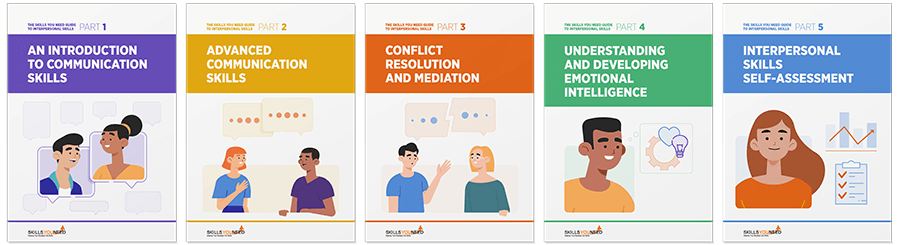
Develop your interpersonal skills with our series of eBooks. Learn about and improve your communication skills, tackle conflict resolution, mediate in difficult situations, and develop your emotional intelligence.
Uses of Interpersonal Communication
Most of us engage in some form of interpersonal communication on a regular basis, often many times a day, how well we communicate with others is a measure of our interpersonal skills.
Interpersonal communication is a key life skill and can be used to:
- Give and collect information.
- Influence the attitudes and behaviour of others.
- Form contacts and maintain relationships.
- Make sense of the world and our experiences in it.
- Express personal needs and understand the needs of others.
- Give and receive emotional support.
- Make decisions and solve problems.
- Anticipate and predict behaviour.
- Regulate power.
How well do you communicate with others?
Assess your interpersonal skills with the
Interpersonal Skills Self-Assessment