


Interpersonal Skills
See also: Employability SkillsInterpersonal skills are the skills we use every day when we communicate and interact with other people, both individually and in groups. They include a wide range of skills, but particularly communication skills such as listening and effective speaking. They also include the ability to control and manage your emotions.
It is no exaggeration to say that interpersonal skills are the foundation for success in life. People with strong interpersonal skills tend to be able to work well with other people, including in teams or groups, formally and informally. They communicate effectively with others, whether family, friends, colleagues, customers or clients. They also have better relationships at home and at work.
You can improve your interpersonal skills by developing your awareness of how you interact with others and practising your skills.
This page provides an overview of interpersonal skills and how they are developed and used. It explains where these skills are important, including particular jobs that may require very good interpersonal skills. Finally, it discusses how you can start to develop your interpersonal skills further.
What are Interpersonal Skills?
Interpersonal skills are sometimes referred to as social skills, people skills, soft skills, or life skills.
However, these terms can be used both more narrowly and more broadly than ‘interpersonal skills’. On this website, we define interpersonal skills as:
“The skills you need and use to communicate and interact with other people.”
This definition means that interpersonal skills therefore include:
- Communication skills, which in turn covers:
- Verbal Communication – what we say and how we say it;
- Non-Verbal Communication – what we communicate without words, for example through body language, or tone of voice; and
- Listening Skills – how we interpret both the verbal and non-verbal messages sent by others.
- Emotional intelligence – being able to understand and manage your own and others’ emotions.
- Team-working – being able to work with others in groups and teams, both formal and informal.
- Negotiation, persuasion and influencing skills – working with others to find a mutually agreeable (Win/Win) outcome. This may be considered a subset of communication, but it is often treated separately.
- Conflict resolution and mediation – working with others to resolve interpersonal conflict and disagreements in a positive way, which again may be considered a subset of communication.
- Problem solving and decision-making – working with others to identify, define and solve problems, which includes making decisions about the best course of action.
The Importance of Interpersonal Skills
Interpersonal skills matter because none of us lives in a bubble.
In the course of our lives, we have to communicate with and interact with other people on a daily if not hourly basis, and sometimes more often. Good interpersonal skills ‘oil the wheels’ of these interactions, making them smoother and pleasanter for all those involved. They allow us to build better and longer-lasting relationships, both at home and at work.
Interpersonal skills at home
Good interpersonal skills help you to communicate more effectively with family and friends.
This is likely to be particularly important with your partner. For example, being able to give and receive feedback effectively with your partner can help to resolve small problems between you before they become big issues.
There is more about this, and other aspects of using interpersonal skills at home, in our pages on Personal and Romantic Relationship Skills and Parenting Skills.
Interpersonal skills at work
You may not like to think about it in these terms, but you almost certainly spend more time with your colleagues than your partner.
At work, you are required to communicate with and interact with a wide range of people, from suppliers and customers through to your immediate colleagues, colleagues further afield, your team and your manager. Your ability to do so effectively can make the difference between a successful working life, and one spent wondering what went wrong.
There are, of course, some jobs in which interpersonal skills are particularly important.
Customer-facing roles, such as sales and customer relations management, are likely to specify good interpersonal skills as a prerequisite. However, there are a number of other less obvious jobs and careers where interpersonal skills are also vitally important. These include:
Healthcare provision, including doctors, nurses and other healthcare professionals. Being able to listen to, and talk to, patients and their families is an essential skill, as is being able to give bad news in a sensitive way. We almost take these skills for granted in healthcare professionals—but we also know how devastating the situation can be when these professionals have poor skills and fail to communicate effectively.
Financial advice and brokerage. Financial advisers and brokers need to be able to listen carefully to their customers, and understand both what they are saying, and what they are not articulating. This enables them to provide recommendations that match their clients’ needs. Poor interpersonal skills mean that they will find it harder to build good customer relationships, and to understand customer needs.
Computer programming and development. This area is often thought of as the ultimate territory for ‘geeks’, with the assumption that interpersonal skills are not essential. However, technical developers increasingly need good interpersonal skills to understand their customers, and to be able to ‘translate’ between the technical and the practical.
Interpersonal Skills for Job Seekers
Good interpersonal skills are essential at work, but many people find them hard to demonstrate during a job application process. Some ideas to help include:
‘Naming and claiming’ in your CV or resume. Give a clear statement of a particular skill or skills that you possess, and then give examples to show how you have demonstrated them in practice. For example:
“I have excellent written communication skills, and my colleagues often ask me to check their written work for them before onward transmission.”
- Carefully name-checking any specific skills that are mentioned in the job description or person specification. Make life easy for the recruiter. In your personal statement or covering letter, use the same terms as the job description or person specification, and again, give examples.
For more ideas about how to improve your chances of getting a job, see our pages on Writing a CV or Resume, Writing a Covering Letter and Applying for a Job.
Developing Your Interpersonal Skills
Good interpersonal skills are the foundation for good working and social relationships, and also for developing many other areas of skill.
It is therefore worth spending time developing good interpersonal skills.
You Already Have Interpersonal Skills
We've all been developing our interpersonal skills since childhood, usually subconsciously.
Interpersonal skills often become so natural that we take them for granted, never thinking about how we communicate with other people. If you have developed good habits, this is fine. However, it is of course also possible to develop bad habits, and then fail to understand why your communications or relationships are suffering.
Improving and developing your interpersonal skills is best done in steps, starting with the most basic, but vital:
1. Identify areas for improvement
The first step towards improving is to develop your knowledge of yourself and your weaknesses.
You may already have a good idea of areas that you need to develop. However, it is worth seeking feedback from other people, because it is easy to develop ‘blind spots’ about yourself. You might also find it useful to do our Interpersonal Skills Self-Assessment.
Interpersonal Skills Self-Assessment
Discover your interpersonal skills strengths and weaknesses.
Our free self-assessment covers listening skills, verbal communication, emotional intelligence and working in groups.

The self-assessment may give you an idea of which areas to develop first. It may, however, also be worth starting with the basics, and moving on from there.
2. Focus on your basic communication skills
Communication is far more than the words that come out of your mouth.
Some would even go so far as to suggest that there is a reason why you have two ears and one mouth, and that you should therefore listen twice as much as you talk!
Listening is very definitely not the same as hearing. Perhaps one of the most important things you can do for anyone else is to take the time to listen carefully to what they are saying, considering both their verbal and non-verbal communication. Using techniques like questioning and reflection demonstrates that you are both listening and interested.
Visit our Listening Skills pages to learn more.
When you are talking, be aware of the words you use. Could you be misunderstood or confuse the issue? Practise clarity and learn to seek feedback or clarification to ensure your message has been understood. By using questions effectively, you can both check others’ understanding, and also learn more from them.
Our page on Verbal Communication introduces this subject. You may also find our pages on Questioning and Clarification useful.
You may think that selecting your words is the most important part of getting a message across, but non-verbal communication actually plays a much bigger part than many of us are aware. Some experts suggest that around three-quarters of the ‘message’ is communicated by non-verbal signals such as body language, tone of voice, and the speed at which you speak.
These non-verbal signals reinforce or contradict the message of our words, and are much harder to fake than words. They are therefore a much more reliable signal. Learning to read body language is a vital part of communication.
For more about this, see our page on Non-Verbal Communication. If you are really interested, you may want to explore more, either about Body Language, or the importance of Face and Voice in non-verbal communication.
3. Improve your more advanced communication skills
Once you are confident in your basic listening and verbal and non-verbal communication, you can move on to more advanced areas around communication, such as becoming more effective in how you speak, and understanding why you may be having communication problems.
Our page on Effective Speaking includes tips on how to use your voice to full effect.
Communication is rarely perfect and can fail for a number of reasons. Understanding more about the possible barriers to good communication means that you can be aware of—and reduce the likelihood of—ineffective interpersonal communication and misunderstandings. Problems with communication can arise for a number of reasons, such as:
- Physical barriers, for example, being unable to see or hear the speaker properly, or language difficulties;
- Emotional barriers, such as not wanting to hear what is being said, or engage with that topic; and
- Expectations and prejudices that affect what people see and hear.
See our page Barriers to Communication for more information.
There are also circumstances in which communication is more difficult: for example, when you have to have an unpleasant conversation with someone, perhaps about their standard of work. These conversations may be either planned or unplanned.
There tend to be two issues that make conversations more difficult: emotion, and change.
- Various emotions can get in the way of communicating, including anger and aggression, or stress. Few of us are able to communicate effectively when we are struggling to manage our emotions, and sometimes the best thing that can be done is to postpone the conversation until everyone is calmer.
- Difficult conversations are often about the need for change. Many of us find change hard to manage, especially if it is associated with an implied criticism of existing ways of working.
Our page Communicating in Difficult Situations offers further ideas to help you to get your message across when stress levels or other emotions are running high.
4. Look inwards
Interpersonal skills may be about how you relate to others, but they start with you. Many will be improved dramatically if you work on your personal skills.
For example, people are much more likely to be drawn to you if you can maintain a positive attitude. A positive attitude also translates into improved self-confidence.
You are also less likely to be able to communicate effectively if you are very stressed about something. It is therefore important to learn to recognise, manage and reduce stress in yourself and others (and see our section on Stress and Stress Management for more). Being able to remain assertive, without becoming either passive or aggressive, is also key to effective communication. There is more about this in our pages on Assertiveness.
Perhaps the most important overarching personal skill is developing emotional intelligence.
Emotional intelligence is the ability to understand your own and others’ emotions, and their effect on behaviour and attitudes. It is therefore perhaps best considered as both personal and interpersonal in its nature, but there is no doubt that improving your emotional intelligence will help in all areas of interpersonal skills. Daniel Goleman, the author of a number of books on emotional intelligence, identified five key areas, three of which are personal, and two interpersonal.
-
The personal skills, or ‘how we manage ourselves’, are self-awareness, self-regulation, and motivation. In other words, the first steps towards understanding and managing the emotions of others is to be able to understand and manage our own emotions, including understanding what motivates us.
-
The social skills, or ‘how we handle relationships with others’, are empathy and social skills. These mean understanding and feeling for others, and then being able to interact effectively with them.
Improving your emotional intelligence therefore improves your understanding that other people have different points of view. It helps you to try to see things from their perspective. In doing so, you may learn something whilst gaining the respect and trust of others.
5. Use and practise your interpersonal skills in particular situations
There are a number of situations in which you need to use interpersonal skills. Consciously putting yourself in those positions, and practising your skills, then reflecting on the outcomes, will help you to improve.
For example:
Interpersonal skills are essential when working in groups.
Group-work is also a common situation, both at home and at work, giving you plenty of opportunity to work on your skills. It may be helpful to understand more about group dynamics and ways of working, as these can affect how both you and others behave.
For more about the different types of teams and groups, see our page An introduction to Teams and Groups, and for more about how people behave in groups, see Group and Team Roles. You can find more about the skills essential to team working in our page on Effective Team-Working.
Interpersonal skills may also be particularly helpful if you have to negotiate, persuade and influence others.
Effective negotiations—that is, where you are seeking a win–win outcome, rather than win–lose—will pave the way to mutual respect, trust and lasting interpersonal relations. Only by looking for a solution that works for both parties, rather than seeking to win at all costs, can you establish a good relationship that will enable you to work together over and over again.
Being able to persuade and influence others—again, for mutual benefit—is also a key building block towards strong interpersonal relations.
There is more about all of these in our pages on Negotiation and Persuasion. These pages explain negotiation, and discuss how it works, and explore the art of persuasion and influence in more detail.
Resolving and mediating in conflict scenarios can be a real test of interpersonal skills
Sometimes negotiation and persuasion are not enough to avoid conflict. When this happens, you need strong conflict resolution and potentially even mediation skills. Conflict can arise from poorly-handled interpersonal communications, and may be addressed simply by listening carefully to both sides, and demonstrating that you have done so. Finding a win–win situation is similarly important here, because it shows that you respect both sides.
These skills may be thought of as advanced communication skills. However, if you are often required to manage such situations, some specialist training may be helpful.
See our pages on Conflict Resolution and Mediation Skills for more.
Finally, problem-solving and decision-making are usually better when they involve more than one person
Problem-solving and decision-making are key life skills. While both can be done alone, they are often better for the involvement of more people. This means that they also frequently involve interpersonal elements, and there is no doubt that better interpersonal skills will help with both.
See our pages on Problem-Solving and Decision-Making for more.
6. Reflect on your experience and improve
The final element in developing and improving your interpersonal skills is to develop the habit of self-reflection. Taking time to think about conversations and interpersonal interactions will enable you to learn from your mistakes and successes, and continue to develop. You might, for example, find it helpful to keep a diary or learning journal and write in it each week.
For more about this, see our pages on Reflective Practice and Improving Communication Skills.
Further Reading from Skills You Need
The Skills You Need Guide to Interpersonal Skills eBooks.
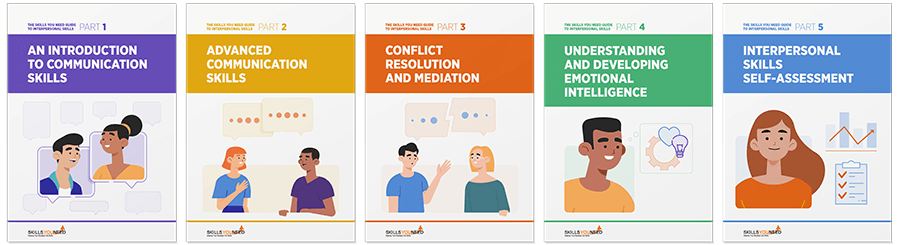
Develop your interpersonal skills with our series of eBooks. Learn about and improve your communication skills, tackle conflict resolution, mediate in difficult situations, and develop your emotional intelligence.